

Published 4 November 2025, updated 12 July 2026
Reversing Around Corners – How to Master It: Essential Steps for Learner Drivers
Reversing around corners might sound tricky, but it’s actually one of the most useful skills you can learn as a driver. Whether you’ve taken a wrong turn down a narrow street or need to change direction safely, this manoeuvre gives you the confidence to handle tight spots with ease.
Reversing around a corner clicks with the right guidance, and you can perfect manoeuvres like this on an intensive driving course where an instructor fine-tunes your technique in real time.
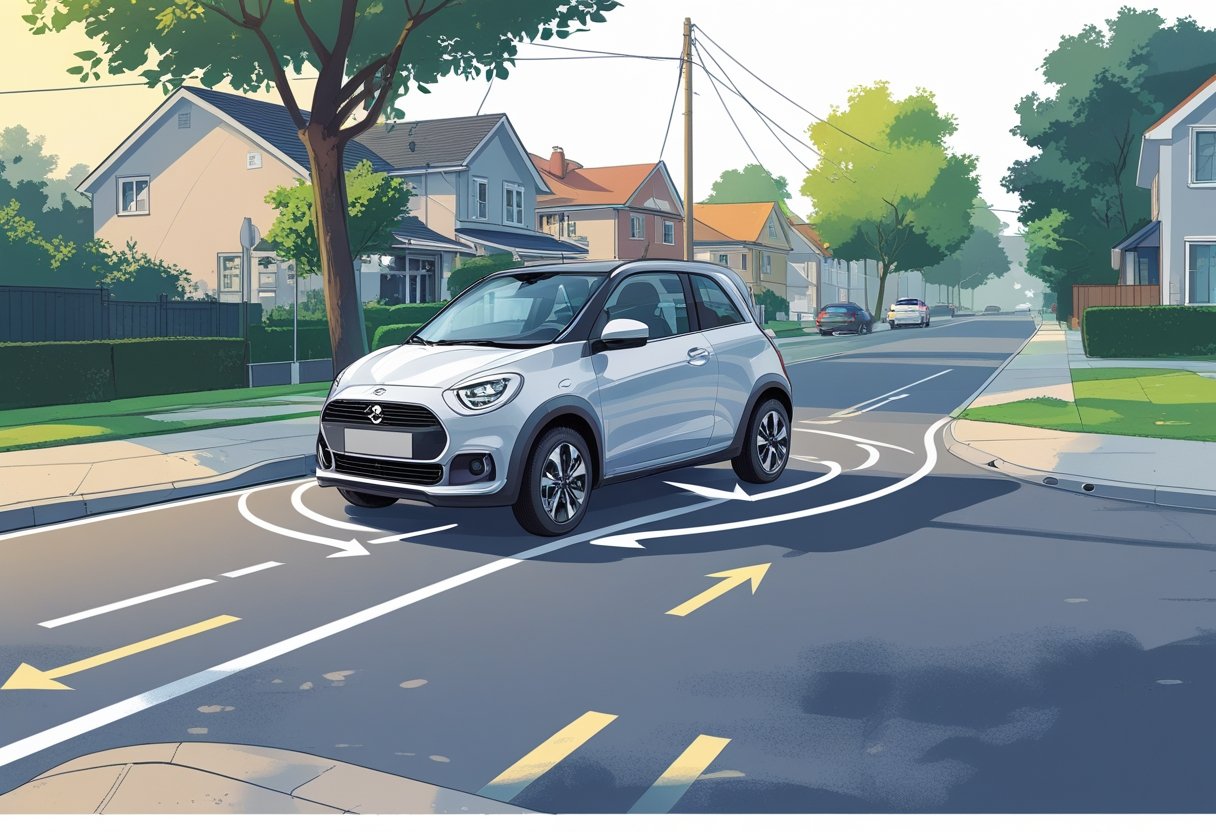
The key to mastering reverse around a corner lies in understanding your reference points, maintaining steady control, and checking your surroundings constantly throughout the manoeuvre. Once you’ve got the basics sorted, you’ll find this technique becomes second nature, giving you more options when you’re out on the road.
We know it can feel overwhelming at first, especially when you’re juggling steering, observations, and vehicle control all at once. The good news is that with the right approach and a bit of practice, you’ll soon be reversing around corners like a pro. Let’s break down everything you need to know to build your confidence and nail this essential driving skill.
Key Takeaways
- Master your reference points and observation techniques to execute the manoeuvre safely and smoothly
- Avoid common mistakes like poor positioning and insufficient observations that can make the manoeuvre unnecessarily difficult
- Build confidence through regular practice in quiet areas before attempting the manoeuvre in busier locations
Understanding the Reverse Around a Corner Manoeuvre
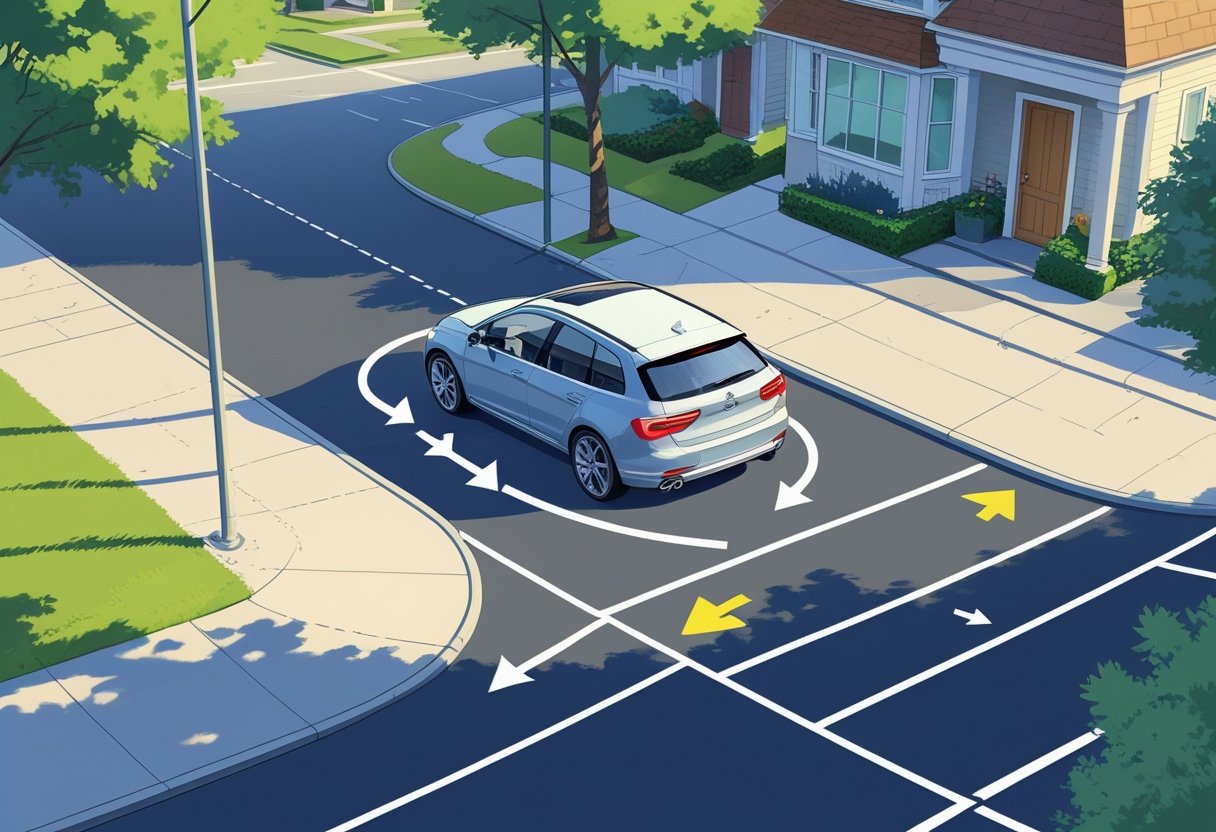
This fundamental driving skill involves backing your vehicle around a corner or junction, requiring careful observation and precise vehicle control. We’ll explore what this manoeuvre entails and why it remains valuable for drivers navigating Britain’s varied road conditions.
What Is the Reverse Around a Corner?
The reverse around a corner manoeuvre involves driving your car backwards around a junction or corner, typically from a main road into a side street. You start by positioning your vehicle beyond the turning point, then carefully reverse into the new road whilst maintaining proper spacing from the kerb.
During this parking manoeuvre, you’ll need to coordinate several skills simultaneously. We’re talking about clutch control for smooth movement, mirror usage for spatial awareness, and steering adjustments to follow the road’s curve.
The basic sequence includes:
- Stopping in a safe position past your intended turning point
- Selecting reverse gear and beginning the backward movement
- Applying steering lock as your rear wheels align with the corner
- Monitoring your mirrors to maintain proper kerb distance
- Straightening the steering wheel once you’ve completed the turn
Most learner drivers find left-hand corners easier to master initially. Your nearside mirror provides clearer visibility of the kerb, making distance judgement more straightforward.
When and Why You Might Need This Skill
Real-world driving presents numerous situations where reversing around corners becomes essential. Narrow residential streets often leave you with limited options for turning around, particularly in older British housing estates with tight road layouts.
Common scenarios include:
- Backing out of cul-de-sacs when forward exit isn’t possible
- Manoeuvring in car parks with awkward junction angles
- Navigating delivery areas or industrial estates
- Reversing into driveways that connect at sharp angles to main roads
Emergency situations sometimes demand quick spatial thinking. If you’ve driven down a narrow lane and encounter an obstruction, confident reversing skills help you retreat safely without mounting kerbs or damaging your vehicle.
We’ve found that drivers who master this technique feel more confident tackling challenging parking situations. Your spatial awareness improves dramatically, making parallel parking and bay parking feel much more manageable.
Relevance Beyond the Driving Test
Although the DVSA removed reversing around corners from the practical driving test, the skills remain incredibly valuable for confident motoring. Modern driving focuses more on real-world applications than test-specific manoeuvres.
Key benefits include:
- Enhanced vehicle control in tight spaces
- Improved mirror usage and spatial judgment
- Greater confidence when parking in challenging locations
- Better understanding of your car’s turning circle and dimensions
Professional drivers often rely on these skills daily. Delivery drivers, tradespeople, and anyone navigating Britain’s mix of modern and historic road layouts find these abilities indispensable.
We encourage new drivers to practice this manoeuvre even without test pressure. The combination of observation skills, vehicle control, and spatial awareness transfers directly to countless driving situations you’ll encounter throughout your motoring journey.
Key Principles for Success
Mastering reverse around a corner boils down to three critical areas: keeping everyone safe through proper observation, maintaining precise control of your vehicle, and selecting the most suitable location for the manoeuvre.
Observation and Safety First
We cannot stress this enough: your eyes are your most valuable tools when reversing around corners. Before you even think about selecting reverse gear, take a thorough look around for pedestrians and cyclists who might be approaching.
Check all your mirrors systematically. Look over both shoulders to cover your blind spots completely. This isn’t just good practice – it’s absolutely essential for safety.
Cyclists can appear surprisingly quickly, especially on quiet residential streets. They often travel faster than we expect and might not always follow predictable paths.
Pedestrians present their own challenges. Children can dart out unexpectedly, and elderly people might move more slowly across your intended path. Always give them plenty of time and space.
Keep checking throughout the entire manoeuvre. We recommend quick mirror checks every few seconds, particularly your nearside mirror when turning left. Don’t get so focused on the kerb that you forget about everything else happening around you.
If you spot any potential hazards, stop immediately. Wait for the area to clear before continuing. There’s absolutely no shame in pausing – it shows you’re being responsible and aware.
Accuracy and Vehicle Control
Smooth clutch control makes all the difference between a graceful manoeuvre and a jerky, stressful experience. Find your biting point before you begin reversing, then use gentle pressure to maintain a steady, slow pace.
Your speed should be barely faster than walking pace. Think of it this way: if someone could comfortably jog alongside your car, you’re moving at the right speed.
Reverse gear can feel quite different from forward gears, especially in terms of how quickly your car responds to steering inputs. Small movements of the steering wheel create bigger changes in direction when reversing.
Watch your reference points carefully. The edge of your door mirror aligned with the kerb often works brilliantly for judging distance. When your rear bumper reaches the corner, apply full lock smoothly – not in one sharp movement.
Keep your movements deliberate and controlled. Rushing leads to mistakes, and mistakes mean potentially mounting the kerb or swinging too wide into oncoming traffic.
Practice finding that perfect balance between too much and too little steering input. It takes time to develop this feel, but once you’ve got it, you’ll reverse around corners with genuine confidence.
Choosing the Right Spot
Not every corner is suitable for this manoeuvre, and recognising the difference could save you considerable stress and potential danger. Look for quiet residential streets or minor roads with minimal traffic flow.
Avoid corners near schools during busy times, main road junctions, or areas with heavy pedestrian traffic. These locations create unnecessary pressure and increased risk of complications.
Check for adequate space both before and after the corner. You’ll need roughly two car lengths of clear road behind you and sufficient width on the new road to complete the turn safely.
Consider the gradient carefully. Steep hills make clutch control more challenging and can cause your car to roll if you’re not completely comfortable with the biting point.
Look out for parked cars that might obstruct your view or limit your manoeuvring space. A corner that looks perfect might become impossible if there’s a large van parked just around the bend.
Weather conditions matter too. Wet roads affect your grip and visibility, whilst strong winds can influence your car’s movement. On challenging days, it’s perfectly sensible to choose an easier location or postpone practice until conditions improve.
Remember, the best corner for learning is one where you can focus entirely on your technique without worrying about external pressures.
Step-by-Step: How to Reverse Around a Corner
The key to mastering this manoeuvre lies in proper preparation, precise positioning, and recognising that crucial point of turn when your car reaches the corner.
Initial Preparation
Before we even think about moving, let’s get our car ready for the reverse around a corner manoeuvre. This preparation phase sets us up for success.
First, engage the clutch and select reverse gear. Take your time here – there’s no rush. We want to bring the clutch to the biting point, that sweet spot where you feel the car wanting to move but hasn’t started rolling yet.
Clutch control becomes absolutely vital during this manoeuvre. If we’re reversing on a flat surface, we can often manage with just the clutch. However, if there’s any slope involved, keep your right foot ready on the brake pedal.
Check your mirrors are properly adjusted. We’ll be relying heavily on them, especially the left door mirror, to judge our distance from the kerb.
Take a moment to observe all around the vehicle. Look for pedestrians, cyclists, or other cars that might affect our manoeuvre. If you spot any potential hazards, wait until it’s completely clear before proceeding.
Driving Past and Setting Up
Now we’ll drive past the minor road we’re planning to reverse into. This step helps us assess the corner and position our car correctly.
Drive slowly past the junction, observing the corner’s characteristics. Is it a sharp, tight corner or a more sweeping, gradual one? This observation will determine how much steering input we’ll need later.
Continue past the corner for about two car lengths. This distance gives us enough space to manoeuvre without being too far away.
Pull up parallel to the main road kerb, roughly half a metre away. Make sure our wheels are pointing straight ahead. This positioning is crucial – too close and we risk hitting the kerb, too far and the manoeuvre becomes unnecessarily difficult.
Stop the car and apply the handbrake. We’re now in the perfect position to begin our reverse.
Double-check that the road behind us is clear and that no vehicles are approaching that might complicate our manoeuvre.
Finding the Point of Turn
The point of turn marks the moment we start steering left to navigate around the corner. Getting this right makes the difference between a smooth manoeuvre and needing corrections.
Begin reversing slowly in a straight line. Keep checking your mirrors and looking through the rear window. We’re moving towards that critical point where the back of our car aligns with the beginning of the corner.
For sharp corners, watch through your back left window. When you can see the kerb of the minor road appearing, you’ve reached the point of turn. For sweeping corners, watch the kerb disappearing from view in your rear window.
Once we reach this point, stop the car completely. Make thorough observations all around – this is when our car will swing out into the road as we turn.
Now apply full left lock for sharp corners, or half a turn for sweeping corners. Move slowly, using your left door mirror to judge the distance from the kerb. We’re aiming to keep reasonably close without getting too tight.
Continue until the kerb appears central in your rear window – this tells us we’re straight in the new road. Straighten the steering wheel and continue reversing for three or four car lengths to complete the manoeuvre safely.
Executing the Manoeuvre with Confidence
The key to successful execution lies in maintaining constant awareness of your surroundings whilst mastering smooth clutch control and precise steering inputs. These skills work together to create a controlled, safe manoeuvre that keeps you well clear of kerbs and other road users.
Observation During the Manoeuvre
Your eyes are your most valuable tools when reversing around a corner. We need to develop a scanning pattern that covers all critical areas whilst maintaining our primary focus on the nearside mirror.
Start by checking all mirrors and blind spots before selecting reverse gear. Look specifically for pedestrians who might step into your path and cyclists who could appear suddenly from either direction.
Once you begin reversing, your nearside mirror becomes your primary reference point. This mirror shows the kerb position and helps you judge your distance from it. Keep glancing between this mirror and your rear window to maintain spatial awareness.
Don’t forget about the offside mirror either. Quick checks here reveal approaching traffic or pedestrians on the opposite side of your vehicle.
Your observation sequence should follow this pattern:
- All-round check before starting
- Primary focus on nearside mirror (70% of attention)
- Regular rear window checks (20% of attention)
- Quick offside mirror glances (10% of attention)
Watch for movement in your peripheral vision. Pedestrians and cyclists can change direction quickly, especially children who might dart between parked cars.
Mastering Steering and Clutch Control
Smooth clutch control transforms this manoeuvre from jerky and stressful into flowing and confident. We recommend finding the biting point before you start moving, then using tiny clutch adjustments to control your speed.
Your speed should match a slow walking pace throughout the entire manoeuvre. This gives you time to react to changing conditions and make smooth steering corrections when needed.
The point of turn is crucial for success. Wait until your rear bumper aligns with the corner before applying full steering lock. Turning too early pushes you towards the kerb, whilst turning too late swings you wide into the road.
Follow this steering sequence:
- Reverse straight until the point of turn
- Apply full lock smoothly (not suddenly)
- Monitor your path through the nearside mirror
- Begin straightening as you enter the new road
- Return to centre position once straight
Keep your hands relaxed on the steering wheel. Tense muscles lead to jerky movements that upset the car’s balance. Think of stirring a delicate sauce rather than wrestling with the controls.
If you start getting too close to the kerb, ease off the steering lock slightly. Getting too wide means applying a bit more lock. These small adjustments become natural with practice.
Common Mistakes and How to Dodge Them
Most reversing mistakes happen because drivers get their steering mixed up or lose sight of where they are in relation to the kerb. We also see many learners forget to check for pedestrians and cyclists who might appear suddenly during the manoeuvre.
Steering the Wrong Way
This is the classic mistake that catches almost everyone at first. When you’re in reverse gear, turning the steering wheel left makes your car go right, and turning right makes it go left.
It feels completely backwards to your brain. Your natural instinct tells you to steer one way, but the car responds in the opposite direction.
Here’s what we tell our students: think about where you want the back of your car to go. If you want the rear to swing left around the corner, turn your wheel left. It’s that simple.
Many drivers try to overthink this. They get tangled up wondering which way the front will move or how the whole car will pivot.
Practice tip: Find a quiet car park and just reverse in straight lines first. Turn the wheel left and right whilst reversing slowly. Watch how your car responds.
This builds the muscle memory you need. Your hands will learn the feel of reverse steering before your brain catches up.
Don’t feel embarrassed if you get this wrong during lessons. Even experienced drivers sometimes have a moment of confusion when they haven’t reversed for a while.
Losing Track of the Kerb
Getting too close to the kerb is probably the most common way this manoeuvre goes wrong. You start perfectly positioned, then gradually drift closer until you’re scraping your tyres or mounting the pavement.
Your nearside mirror is your best friend here. When reversing around a left corner, keep glancing at your left mirror. When going right, watch your right mirror.
Set yourself a reference point. Many of our students align the kerb with a specific part of their mirror housing. When the kerb appears at that exact spot, they know they’re the perfect distance away.
The opposite problem happens too. Some drivers stay so far from the kerb that they swing wide into the road. This blocks traffic and looks uncertain.
Aim for about 30cm from the kerb throughout the manoeuvre. That’s roughly the width of a large book or small laptop.
If you find yourself drifting too close, don’t panic. Gently steer away from the kerb to correct your position. Small adjustments work much better than dramatic steering movements.
Remember, you can always stop and start again if things go wrong. There’s no rule saying you must complete it in one continuous movement.
Overlooking Other Road Users
This mistake can be genuinely dangerous. When you’re concentrating hard on your steering and kerb position, it’s easy to forget about pedestrians and cyclists around you.
Pedestrians often appear from nowhere. They step out from between parked cars or emerge from driveways just as you’re mid-manoeuvre.
Cyclists are particularly tricky because they move quickly and quietly. They can appear in your blind spots without warning.
Before you even select reverse gear, take a proper look around. Check all your mirrors and glance over both shoulders. This isn’t just a quick peek – really look.
Keep checking throughout the manoeuvre. Every few seconds, scan your mirrors again. If you spot anyone approaching, stop immediately and wait for them to pass.
Don’t feel pressured to rush because other cars are waiting. A few extra seconds of caution is far better than an accident.
Some areas are particularly busy with pedestrians: near schools, shopping centres, or residential streets with lots of driveways. Be extra vigilant in these spots.
Listen as well as look. Often you’ll hear pedestrians chatting or cyclists approaching before you see them. Rolling down your windows can help with this.
Building Confidence: Practice Tips and Next Steps
The key to mastering corner reversing lies in finding safe practice spaces and understanding how this skill connects to other essential driving manoeuvres. Once you’ve got the basics sorted, you can tackle more challenging scenarios and build on these skills for parallel parking and bay parking.
Practice Locations and Real-Life Scenarios
Start with quiet residential streets where you won’t feel rushed by traffic. Sunday mornings work brilliantly for this. Look for wide corners first, then gradually work your way up to tighter spots.
Empty car parks offer fantastic practice opportunities. You can set up your own corners using cones or markers. This lets you repeat the manoeuvre without worrying about other drivers getting impatient.
Industrial estates on weekends provide real corner practice without the pressure. The roads are typically wider than residential streets, giving you more room for error whilst you’re learning.
Once you’re comfortable, try practicing during different weather conditions. Light rain or overcast days help you understand how visibility changes affect your reference points.
Don’t rush into busy areas until you can complete the manoeuvre smoothly three times in a row. We’ve seen too many learners lose confidence by attempting difficult scenarios too early.
Keep a practice log noting which corners felt easier and which proved challenging. This helps you identify patterns in your technique and builds systematic improvement.
Progressing to Other Manoeuvres
Corner reversing builds crucial skills that transfer directly to parallel parking and bay parking. The spatial awareness you develop becomes invaluable for these trickier manoeuvres.
Turn in the road becomes much easier once you’ve mastered corner reversing. Both require precise steering control and excellent observation skills. The confidence you’ve built carries over naturally.
Parallel parking uses similar reference points and mirror work. The main difference is working in tighter spaces with cars front and back. Your corner reversing experience makes judging distances much simpler.
Bay parking relies on the same slow, controlled movements you’ve been practising. Whether reversing into a supermarket space or pulling up on the right, you’ll use identical techniques.
Practice these manoeuvres in progression rather than jumping between them randomly. Master corner reversing first, then move to turn in the road, followed by bay parking, and finally parallel parking.
Book refresher lessons with your instructor when you’re ready to tackle these advanced skills. They’ll help you apply your corner reversing knowledge to new challenges.
Frequently Asked Questions
Mastering the reverse corner technique involves understanding proper positioning, maintaining steady clutch control, and keeping your observations sharp throughout the manoeuvre. These common questions address the key challenges learners face when perfecting this essential driving skill.
What are the steps to perfecting my technique when reversing around a corner?
Start by finding a safe, clear side road with good visibility. Drive past the junction and position your car about one car length beyond the corner you want to reverse into.
Put the car into reverse gear and begin moving at walking pace. Keep your car within one drain cover’s width from the kerb as you approach the turning point.
Watch for the kerb to disappear from your left door mirror. This signals the perfect moment to begin turning your steering wheel one full turn to the left.
Continue reversing slowly around the bend, adjusting your steering if you drift too close or too far from the kerb. Remember to straighten your wheel with an equal turn to the right once you’ve completed the corner.
How can I ensure I maintain proper observation while reversing around a bend?
Look over your left shoulder as your primary view whilst reversing. This gives you the clearest picture of where you’re heading and helps you judge your distance from the kerb.
Scan constantly for approaching traffic, pedestrians, or cyclists. Before you start turning left, do a complete 360-degree check around your vehicle.
Give way to any approaching traffic. Other road users have priority over you during this manoeuvre, so be ready to stop immediately if needed.
Keep checking your mirrors alongside your shoulder observations. This helps you spot vehicles approaching from behind or alongside your car.
Could you share some top tips for smoothly handling clutch control during reverse manoeuvres?
Find your car’s biting point before you start the manoeuvre. This prevents stalling when you need to move off smoothly under pressure.
Keep your speed at a slow walking pace throughout the entire manoeuvre. Too much speed makes steering corrections difficult and reduces your reaction time.
Use gentle, steady pressure on the clutch pedal. Avoid rapid lifting or pressing movements that can cause jerky motion or engine stalling.
Practice clutch control on flat ground first. Once you’re confident with smooth reverse movement, move on to practising the full corner technique.
What common mistakes should I watch out for to avoid when learning to reverse around corners?
Don’t start turning your steering wheel too early. Wait until the kerb edge disappears from your door mirror before beginning your left turn.
Avoid dry steering, which means turning the wheel whilst the car isn’t moving. This damages your tyres and makes precise control much harder.
Never continue if you’re positioned poorly. Take a shunt forward to correct your position rather than carrying on with a bad line.
Don’t forget to check all around before moving. Many learners focus only on the corner and miss approaching traffic from other directions.
How much space should I leave between the car and the kerb during the reverse corner manoeuvre?
Aim to stay within one drain cover’s width from the kerb throughout the manoeuvre. This typically equals about 30 to 45 centimetres from the kerb edge.
If you get closer than this distance, you risk hitting the kerb and damaging your tyres. Gently ease off some of your left steering to move away slightly.
Getting too far from the kerb puts you towards the centre of the road. This creates danger from oncoming traffic and shows poor vehicle control.
Use the kerb line in your left door mirror as a reference point. Keep this line visible but not disappearing completely until your turning point.
Can you guide me through the ideal speed and approach angle for a reverse corner manoeuvre?
Maintain a steady walking pace throughout the entire manoeuvre. This gives you time to make smooth steering adjustments and react to any hazards.
Your approach angle should keep you parallel to the kerb before you start turning. Don’t angle towards the corner too early in your approach.
Begin your steering input gradually when the kerb disappears from your mirror. One full turn of the steering wheel usually provides the right angle for most corners.
Adjust your speed if needed by using clutch control rather than the accelerator. Smooth, consistent movement helps you maintain better control than varying your speed with the gas pedal.
Ready to pass in weeks, not months?
LPOD Academy runs tailored intensive driving courses from 10 to 50 hours across most of the UK, with your theory and practical test support included.
Ready to Book Driving Lessons?
LPOD Academy offers intensive driving courses across the UK. Find your nearest location: