

Do EU Licences Allow You to Supervise a Learner?
Many drivers with EU licences wonder whether they’re legally allowed to help their friends or family members practise driving. The good news is straightforward and might surprise you. EU licence holders can absolutely supervise learner drivers in the UK, provided they meet the same basic requirements as any other supervisor: being at least 21 years old and having held their full licence for three years or more.
Whether you’ve got a Spanish, German, French, or any other EU driving licence, the rules remain refreshingly simple. You’re treated exactly the same as someone with a UK licence when it comes to teaching a nervous teenager how to reverse park or navigate their first roundabout. This opens up brilliant opportunities for families where parents or relatives hold EU licences to actively support their loved ones through the learning process.
We’ll walk you through everything you need to know about using your EU licence for supervision, from insurance requirements and legal responsibilities to practical tips for creating positive learning experiences. Understanding these rules properly means you can focus on what really matters helping build a confident, capable driver whilst staying completely within the law.
Essential Requirements for Supervising a Learner Driver
When you’re thinking about supervising a learner driver, there are strict legal requirements you’ll need to meet first. The good news is that EU driving licences do count towards these requirements, alongside specific age limits and vehicle type restrictions that ensure everyone stays safe on the road.
Who Qualifies as a Supervisor
Not everyone can jump in the passenger seat and help someone learn to drive. We need to be realistic about who’s actually allowed to supervise.
You must be at least 21 years old to supervise any learner driver. This isn’t negotiable – even if you’ve been driving since you were 17, you’ll have to wait until your 21st birthday.
The other crucial requirement is that you cannot currently be banned from driving. Even if your ban has technically expired but you haven’t got your licence back yet, you’re not allowed to supervise.
Here’s something many people don’t realise: you cannot accept any payment for supervising a learner driver. This includes money for petrol, lunch, or any other form of compensation. Only an approved driving instructor (ADI) or trainee instructor can legally accept payment for driving lessons.
If you’re caught taking money for supervision, you could face serious legal consequences. Leave the paid lessons to the professionals and focus on being a supportive friend or family member.
Valid Full Driving Licences and the EU Connection
Your driving licence is the foundation of your ability to supervise, and EU licences definitely count towards the requirements.
EU driving licences are fully recognised for supervising learner drivers in the UK. This includes licences from Switzerland, Norway, Iceland, and Liechtenstein as well as traditional EU member states.
You must hold a full driving licence for the specific category of vehicle you’re supervising in. If someone’s learning in a manual car, your automatic-only licence won’t cut it – you need that manual car licence yourself.
The licence needs to be current and valid. If your EU licence has expired or been suspended, you cannot supervise until you’ve sorted out the renewal or resolved any issues.
Age and Experience Criteria
Experience matters just as much as age when it comes to supervising learner drivers safely.
You must have held your full driving licence for at least three years before you can supervise anyone. This three-year period starts from when you first passed your driving test, not from when you got your provisional driving licence.
The three-year rule exists for good reason. New drivers often haven’t developed the hazard perception skills and road awareness needed to spot dangerous situations before they develop.
During those first three years, you’re still learning yourself. You’re building up experience with different road conditions, traffic situations, and weather challenges that you’ll need to help guide a learner driver.
Recent driving experience is also crucial. If you passed your test three years ago but haven’t driven much since, consider getting some refresher lessons with an approved driving instructor before you start supervising.
Type of Vehicle You Can Supervise In
The type of car you use for supervision needs to match both your licence and the learner’s needs perfectly.
Your licence category must match the vehicle type exactly. If you only hold an automatic licence, you cannot supervise someone learning to drive a manual car. The learner would need to find someone with a manual car licence instead.
The vehicle itself must meet several legal requirements:
- L plates (or D plates in Wales) on front and back
- Valid MOT certificate if required
- Current road tax and registration
- Proper insurance covering the learner driver
We strongly recommend fitting an extra rear-view mirror for the supervisor’s side. This gives you a clear view of what’s happening behind the vehicle and helps you make better judgements about safety.
Remember that learner drivers cannot use motorways unless they’re with an approved driving instructor in a car fitted with dual controls. This means your supervision sessions need to stick to other types of roads for now.
Licence Rules for Supervising: UK and EU Explained
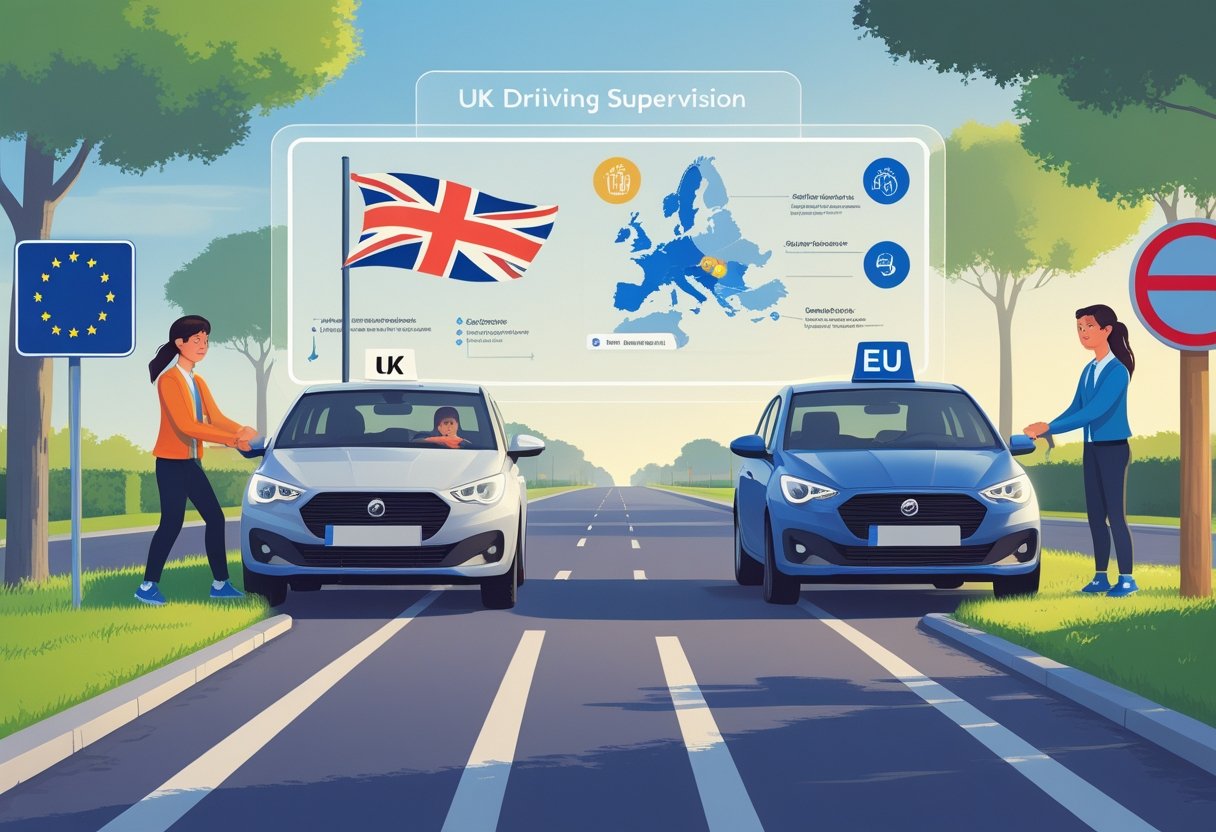
EU licence holders can supervise learners, but specific validity requirements must be met alongside the standard age and experience criteria. Brexit has introduced new considerations for EU licence recognition, though core supervision rights remain intact for qualifying drivers.
Holding an EU Licence: What Counts as Valid
Your EU driving licence can absolutely qualify you to supervise a learner driver in the UK. We’re delighted to confirm that licences from EU countries, Switzerland, Norway, Iceland, and Liechtenstein are all recognised for supervision purposes.
The key requirement is having held your full driving licence for at least three years. This experience threshold ensures you’ve had sufficient time to develop the skills needed to guide someone else safely.
Important licence matching rules:
- If you passed in an automatic vehicle, you can only supervise automatic practice
- Manual car licence holders can supervise both manual and automatic learners
- Your licence category must match the vehicle type being used
You’ll need to be at least 21 years old to supervise. Some insurance companies set their minimum age at 25, so it’s worth checking your policy details before planning any practice sessions.
Remember, you cannot be subject to any driving ban or disqualification. Even a temporary ban would prevent you from taking on supervisory responsibilities until it’s fully lifted.
Brexit and Recognition of EU Licences
Brexit hasn’t changed the fundamental rules around EU licence holders supervising learners. Your valid EU licence continues to be recognised for supervision purposes, which is fantastic news for families and friends wanting to help with driving practice.
The three-year holding period still applies exactly as before. Whether you obtained your licence in France, Germany, Spain, or any other EU country, the experience requirement remains consistent.
Current recognition includes:
- All 27 EU member states
- Switzerland, Norway, Iceland, and Liechtenstein
- Both paper and photocard licence formats
You don’t need to exchange your EU licence immediately to supervise a learner. However, if you’re now a UK resident, you’ll eventually need to swap it for a UK licence within specific timeframes.
The supervision rules have remained refreshingly stable despite the broader changes Brexit brought to driving licence regulations.
Periods of Disqualification or Ban
Any driving ban or disqualification completely prevents you from supervising a learner driver. This applies whether the ban was issued in the UK or your home EU country.
You must wait until your disqualification period ends completely before taking on supervision duties. There’s no “partial lifting” for supervision purposes – the ban must be fully expired.
Disqualifications that affect supervision:
- Drink driving convictions
- Drug driving offences
- Dangerous driving bans
- Totting up disqualifications (12+ penalty points)
If you received points or penalties in an EU country, these count towards your driving record. We always recommend checking your driving status before agreeing to supervise someone.
The moment your ban lifts, you can resume supervision activities. Just ensure you meet all other requirements, including valid insurance coverage and the minimum three-year licence holding period.
Insurance Essentials for Learner Driver Supervision
Getting the right insurance cover sorted is absolutely crucial before you start those practice sessions. There are several ways to arrange cover, from adding learners as named drivers to taking out temporary policies specifically designed for practice runs.
Learner Driver Insurance Options
When it comes to protecting yourself and your learner during practice sessions, you’ve got a few brilliant options to choose from. The key is finding what works best for your situation and budget.
Traditional learner driver insurance remains the most popular choice. Your learner can be added to an existing car insurance policy as a named driver. This approach gives you comprehensive cover and keeps everything straightforward.
Specialist learner policies have become increasingly popular. These are designed specifically for practice sessions and often include helpful features like:
- Dual control simulation training
- Extended cover periods
- Flexible payment options
We always recommend checking what your current insurance policy already covers. Some comprehensive policies automatically include supervised learner driving, which could save you money.
Pay-as-you-go options work brilliantly for occasional practice sessions. These policies let you pay only for the time you actually need cover, making them perfect for weekend warriors or holiday practice.
Named Drivers vs Own Policy
This decision often causes confusion, but we’ll break it down simply for you. Each option has distinct advantages depending on your circumstances.
Adding a learner as a named driver to your existing policy is usually the most cost-effective route. Your insurance company extends cover to include the learner during supervised practice. However, any claims they make could affect your precious no claims discount.
Separate learner policies protect your no claims bonus completely. The learner takes out their own temporary car insurance that covers them driving your vehicle. This approach costs more initially but shields your driving record.
Most insurance companies require supervisors to be at least 25 years old when using named driver arrangements. Always double-check this requirement before your first practice session.
Policy flexibility varies significantly between insurers. Some allow unlimited practice sessions, while others restrict cover to specific times or locations. Read the small print carefully to avoid nasty surprises.
Temporary and Practice Session Insurance
Short-term insurance solutions have revolutionised how we approach learner supervision. These flexible options give you exactly what you need without long-term commitments.
Hourly insurance lets you buy cover for individual practice sessions. Perfect for those spontaneous “fancy a quick drive?” moments. Policies typically start from just one hour and extend up to several days.
Monthly temporary cover works brilliantly for intensive practice periods. Many learners find this approach ideal in the weeks leading up to their driving test when practice sessions become more frequent.
Multi-car policies deserve special mention if you’re supervising in different vehicles. Some temporary insurers offer flexible cover that works across multiple cars, giving you fantastic freedom to practise anywhere.
We’ve found that automatic renewal options can be both helpful and costly. While convenient for regular practice, they can lead to unnecessary charges if you forget to cancel. Set reminders to review your temporary insurance regularly.
Claims handling with temporary policies is usually swift and efficient. Most providers understand that learner incidents happen and have streamlined processes to get you back on the road quickly.
Legal Responsibilities and Road Rules for Supervisors
When you’re supervising a learner driver, you carry serious legal obligations that go beyond simply sitting in the passenger seat. These responsibilities include staying completely sober, avoiding certain activities, and understanding the potential penalties if rules are broken.
Being Sober and Fully Alert
You absolutely cannot supervise a learner driver if you’ve been drinking alcohol or taking drugs. The law treats this exactly the same as if you were driving yourself.
You must not exceed:
- The legal breath alcohol limit
- The legal blood alcohol limit
- Specified limits for illegal drugs or certain medicines
Even one drink could impair your judgement when you need to react quickly. Remember, you’re responsible for everyone’s safety on the road.
If you’re feeling tired, stressed, or unwell, it’s best to postpone the practice session. Your ability to concentrate and make split-second decisions could mean the difference between a safe journey and an accident.
We’ve seen too many situations where supervisors thought they were “fine to supervise” but weren’t truly alert. Your learner is counting on your experience and quick reactions.
Prohibited Activities While Supervising
Several activities are strictly forbidden whilst supervising learner drivers. Breaking these rules can result in serious penalties.
You cannot:
- Hold or use a mobile phone – This includes texting, making calls, taking photos, or browsing websites
- Use handheld sat navs or tablets – These must be mounted or handled by the learner
- Take the car on motorways – Only approved driving instructors (ADIs) with dual controls can do this
You must sit in the front passenger seat at all times. Other passengers can join you, but they mustn’t distract the learner driver.
Unlike a driving instructor or ADI, you cannot accept any payment for supervising. This includes money for petrol or any other compensation. Only qualified instructors can charge for lessons.
Penalties for Breaking the Rules
The consequences for breaking supervision rules are severe and can affect both you and the learner driver.
Potential penalties include:
- Driving ban – You could lose your licence
- Penalty points – Up to 8 points on your licence
- Unlimited fines – Particularly for insurance violations
- Criminal charges – In serious cases
If the learner drives without proper insurance whilst under your supervision, they face an unlimited fine, driving ban, and up to 8 penalty points. As the supervisor, you could also face charges.
Using a mobile phone whilst supervising carries the same penalties as if you were driving – 6 penalty points and a £200 fine. New drivers who receive 6 points within two years of passing lose their licence entirely.
We always remind supervisors that these aren’t just bureaucratic rules – they exist because lives depend on responsible supervision.
Helping the Learner Succeed: Practical Guidance for Supervisors
Supporting a learner driver between their driving lessons requires patience, planning, and clear communication. We’ll help you create a positive learning environment that builds confidence whilst keeping safety at the heart of every practice session.
Planning Effective Practice Sessions
Successful practice sessions don’t just happen by chance. We recommend starting each session with a clear goal, whether it’s mastering parallel parking or building confidence on dual carriageways.
Before you set off, consider these key elements:
- Weather conditions and traffic levels
- Your learner’s current skill level and comfort zone
- Areas covered in their recent driving lessons with their approved driving instructor
- Specific skills that need reinforcing
Start with familiar routes before progressing to more challenging roads. This approach helps build confidence gradually rather than overwhelming your learner driver with too much at once.
Keep sessions between 30-60 minutes. Longer sessions can lead to fatigue and frustration, which doesn’t benefit anyone. We’ve found that shorter, focused practice sessions often yield better results than marathon drives around town.
Always have a backup plan ready. If your original route becomes too stressful due to heavy traffic or roadworks, know alternative quieter roads where you can continue practising safely.
Staying Calm and Encouraging
Your emotional state directly affects your learner driver’s confidence and performance. When we stay calm, learners feel more relaxed and can focus better on developing their skills.
Remember that mistakes are part of the learning process. Instead of showing frustration, use errors as teaching moments. A gentle “Let’s try that again” works far better than criticism or sighs of exasperation.
Keep these encouraging phrases ready:
- “You’re getting much better at that”
- “I can see real improvement since last week”
- “That was a tricky situation, and you handled it well”
Celebrate small victories along the way. Acknowledging progress, even tiny improvements, helps maintain motivation between formal driving lessons. Your learner driver needs to feel they’re moving forward, not just making mistakes.
Take breaks when tension rises. Sometimes pulling over for five minutes can reset the mood and make the rest of the session more productive.
Communicating Clearly and Building Confidence
Clear, timely instructions make all the difference during practice sessions. We need to give guidance that complements what their approved driving instructor teaches, not contradicts it.
Give instructions early enough for your learner driver to process and act on them safely. Saying “turn left here” as you approach the junction creates unnecessary pressure. Instead, try “we’ll be turning left at the next set of traffic lights.”
Use consistent language that matches what they’ve learned in their driving lessons. If their instructor uses specific terms or phrases, stick with the same vocabulary to avoid confusion.
Focus on positive reinforcement:
- Point out good decisions they make independently
- Acknowledge when they spot potential hazards
- Praise smooth gear changes and confident manoeuvres
Ask questions that encourage thinking rather than just following orders. “What do you notice about that pedestrian?” helps develop hazard perception skills better than simply telling them what to watch for.
Remember that building confidence takes time. Some learner drivers progress quickly, whilst others need more patient support. Your role is to provide a safe space where they can develop their skills at their own pace.
Vehicle, Road, and Safety Requirements
When supervising learner drivers with your EU licence in the UK, specific vehicle standards and road restrictions apply. Learners must meet eyesight requirements, vehicles need proper identification plates, and certain roads remain off-limits during practice sessions.
Minimum Eyesight Rules
Every learner driver must meet the UK’s minimum eyesight standards before we can supervise them on the roads. This isn’t just a formality – it’s a crucial safety requirement that ensures they can spot hazards, read road signs, and drive safely.
The standard eyesight test requires learners to read a car number plate from 20 metres away. We’re talking about the standard format plates that you see on every car today. If they need glasses or contact lenses to pass this test, they must wear them every single time they’re behind the wheel.
Here’s what counts as meeting the requirements:
- Reading a number plate clearly at 20 metres
- Vision can be corrected with glasses or contacts
- Both eyes together must meet the standard
- No specific visual field requirements for car licences
If your learner struggles with this test, encourage them to visit an optician before any driving practice. Many learners don’t realise their vision has changed since their last eye test. Getting this sorted early prevents disappointment later and keeps everyone safer on the road.
L Plates and D Plates: Proper Display
Getting those L plates positioned correctly is absolutely essential – and it’s our responsibility as supervisors to ensure this happens properly. In England, Scotland, and Northern Ireland, we use the familiar red ‘L’ on a white background. In Wales, learners can choose between L plates or D plates (for ‘Dysgwr’, meaning learner in Welsh).
The rules are refreshingly straightforward. L or D plates must be displayed on both the front and back of the vehicle during every practice session. They should be clearly visible and not obscured by anything – no tucking them behind windscreen wipers or number plates.
Size matters here too. Legal L plates measure 178mm tall and 203mm wide. The ‘L’ itself should be 102mm high with 38mm wide red borders.
Remember to remove or cover these plates when anyone with a full licence drives the car afterwards. Driving around with L plates when you’re fully qualified can confuse other drivers and isn’t required by law.
Many of us find magnetic plates the most practical option – they stick securely during lessons but come off easily when needed.
Car Ownership and Registered Keeper
The question of who owns the practice car creates some important considerations around insurance and legal responsibility. Whether your learner uses your vehicle or their own, certain requirements must be met before any practice begins.
If they’re using your car, adding them as a named driver to your existing policy often works well. Just bear in mind that any claims they make could affect your no-claims discount. Alternatively, learner driver insurance policies can cover them specifically for practising in your vehicle.
When learners want to use their own car, they must be the registered keeper with DVLA. They’ll need their own comprehensive learner insurance policy too. This arrangement often gives them more flexibility for practice sessions and professional lessons.
Some insurance companies require supervisors to be over 25, regardless of the legal minimum age of 21. We always recommend checking the policy details before heading out for that first practice session.
The car itself needs to be:
- Registered with DVLA
- Currently taxed
- Holding a valid MOT (if over 3 years old)
- Safe and roadworthy for each journey
Motorway Restrictions
This is one rule that catches many supervisors off guard – we absolutely cannot take learner drivers onto motorways during private practice. It doesn’t matter how experienced they seem or how confident they feel. Motorways remain completely off-limits when we’re supervising.
Only approved driving instructors (ADIs) can take learners onto motorways, and only in cars fitted with dual controls. This makes perfect sense when you think about it – motorway driving involves high speeds, complex lane changes, and situations where split-second decisions matter enormously.
This restriction applies to all types of motorways, including the M25, M1, M6 – every single one across the UK. Even those short motorway stretches that connect to major roads are included in this ban.
Instead, focus your practice sessions on dual carriageways, which offer excellent preparation for faster driving without the legal restrictions. A-roads with dual carriageways help learners build confidence with higher speeds, overtaking, and joining faster-moving traffic.
Don’t worry about missing out on motorway experience during private practice. Professional instructors will cover this properly when your learner is ready, using the right equipment and expertise to keep everyone safe.
Frequently Asked Questions
EU licence holders face specific requirements and timeframes when supervising learner drivers in the UK. The key factors include minimum age requirements, licence validity periods, and understanding your legal responsibilities as a supervisor.
What requirements must I meet to legally supervise a learner driver in the UK?
You’ll need to tick several boxes before getting behind the wheel with a learner driver. First, you must be at least 21 years old – not 18 like many people assume.
Your driving licence needs to cover the exact type of vehicle you’re supervising. If the learner’s practising in a manual car, your automatic-only licence won’t cut it.
You must have held your full driving licence for at least three years. This experience requirement ensures you’ve had enough time to develop proper road skills and judgement.
Most importantly, you cannot currently be banned from driving. Even if your ban has ended, make sure your licence is fully restored before supervising anyone.
Can I use my European driving licence to guide a novice driver in the UK, or do I need a British one?
Your European licence can absolutely be used to supervise learner drivers in the UK. We accept full driving licences from EU countries, Switzerland, Norway, Iceland, and Liechtenstein.
The same three-year minimum holding period applies to your European licence. Count from when you first received your full licence, not from any exchange or renewal dates.
You don’t need to convert your EU licence to a UK one specifically for supervising purposes. Your original European licence maintains its validity for supervision duties.
However, check your licence’s expiry date. An expired licence won’t allow you to supervise, regardless of where it was issued.
What’s the minimum age for supervising a learner behind the wheel if I hold an EU licence?
The age requirement remains exactly the same whether you hold a UK or EU licence – you must be at least 21 years old. This rule applies universally to all supervisors in the UK.
We often see younger drivers with EU licences wondering if different rules apply to them. They don’t – the 21-year minimum age is non-negotiable.
Even if you’ve held your EU licence since you were 18, you’ll need to wait until your 21st birthday before supervising anyone. Safety regulations don’t make exceptions based on licence origin.
Are there specific responsibilities I should be aware of when accompanying a learner driver with my EU licence?
Your responsibilities as a supervisor remain identical whether you hold a UK or EU licence. You’re legally in charge of the vehicle, even when the learner is driving.
You must sit in the front passenger seat throughout the practice session. Never attempt to supervise from the back seats or any other position in the car.
Stay completely sober – the drink-drive limits apply to supervisors just as strictly as they do to drivers. Your judgement needs to be sharp to keep everyone safe.
Keep your mobile phone tucked away. You cannot hold or use it for any reason whilst supervising, including checking maps or taking calls.
If my European licence is from a non-EEA country, does that affect my eligibility to supervise a learner in the UK?
Licences from countries outside the EU, EEA, Switzerland, Norway, Iceland, and Liechtenstein won’t qualify you to supervise learner drivers in the UK. The accepted list is quite specific.
If your licence originates from elsewhere, you’ll need to obtain a UK driving licence first. Once you’ve held that UK licence for three years, you can then supervise learners.
We understand this might feel frustrating if you’re an experienced driver from another country. However, these rules ensure all supervisors understand UK driving laws and road conditions.
Consider this an opportunity to familiarise yourself thoroughly with British driving standards before helping others learn.
Does the duration I’ve held my foreign driving licence affect my ability to oversee a learner driver’s practice?
The three-year minimum holding period is absolutely crucial, regardless of your licence’s origin. We count from the date you first received your full driving licence in any qualifying country.
Recent licence exchanges or renewals don’t reset this clock. If you’ve held your German licence for five years, then exchanged it for a UK one, you still qualify based on those five years.
However, breaks in your driving history might affect your eligibility. If your licence lapsed or was suspended, speak with DVLA about how this impacts your supervision rights.
Keep documentation of your driving history handy. Insurance companies and legal authorities may request proof of your licence timeline when needed.