

How to Change Your Provisional Licence Address: A Complete Guide
Moving house is one of life’s biggest milestones, but many provisional licence holders forget about updating their address with the DVLA amidst all the chaos of packing boxes and changing postal codes. You can change your provisional licence address completely free of charge through the DVLA’s straightforward online system or by post, and it’s exactly the same process as updating a full licence. The best part? You won’t face any disruption to your learning journey whilst waiting for your updated licence to arrive.
What many learner drivers don’t realise is that failing to update your address isn’t just an administrative oversight, it could land you with a hefty fine of up to £1,000. We know that sounds daunting, but don’t worry! The process is genuinely simple once you know what you’re doing, and we’re here to guide you through every step.
Whether you’re moving for university, starting a new job, or simply relocating closer to family, keeping your provisional licence details current is crucial for your driving journey. Throughout this guide, we’ll walk you through the online and postal methods, explain what other documents need updating alongside your licence, and cover those special circumstances that might apply to your situation.
Why It’s Essential to Update Your Provisional Licence Address
Keeping your provisional licence address current isn’t just good practice—it’s a legal requirement that protects you from hefty fines and ensures you stay connected with the DVLA. An outdated address can also create complications with insurance claims and official correspondence that could derail your driving journey.
Legal Consequences of Not Updating Your Address
We can’t stress this enough: failing to update your address on your provisional licence is against the law. The DVLA takes this seriously, and you could face a fine of up to £1,000 if you don’t inform them when you move house.
This isn’t just a scare tactic, it’s a real penalty that many learners discover the hard way. The law requires you to notify the DVLA as soon as possible after changing address.
Think of it this way: your driving licence is an official government document. Just like you’d update your address with the council or HMRC, the DVLA needs to know where you live too.
The good news? You can still continue driving whilst waiting for your updated licence to arrive. Your old licence remains valid during the transition period, so there’s no need to pause your learning.
How an Old Address Can Affect Insurance and Documents
An incorrect address on your provisional licence can create a real headache when dealing with insurance companies. If you need to make a claim, insurers will check that all your documents match up—and mismatched addresses can delay or even invalidate your claim.
Your insurance premium might also be affected. Insurance companies calculate risk based on where you live, so providing an old address could mean you’re not getting the right price for your cover.
Beyond insurance, think about other driving-related documents. Your theory test certificate, practical test bookings, and any correspondence from driving instructors all rely on having the correct address on file.
Police checks can become problematic too. If you’re stopped whilst learning to drive, officers expect your licence details to match your current circumstances.
Staying Connected with DVLA Correspondence
Missing important letters from the DVLA because they’re going to your old address can seriously disrupt your driving progress. We’ve seen learners miss renewal reminders, test appointments, and even penalty notices simply because their post was going elsewhere.
The DVLA sends time-sensitive information that you really don’t want to miss. This includes updates about your licence status, reminders about medical requirements, or changes to driving regulations that might affect you.
Your provisional licence is just the beginning of your relationship with the DVLA. As you progress through your driving journey—from theory test to practical test to full licence—you’ll need to receive their correspondence promptly.
Email confirmations help, but postal mail remains crucial. Many official documents still arrive by post, so keeping your address current ensures nothing slips through the cracks during this exciting phase of learning to drive.
When and Where You Must Change Your Provisional Licence Address
You’ll need to update your provisional licence address with the DVLA whenever you move homes permanently, and understanding what counts as a qualifying move versus temporary arrangements helps you stay compliant with the law.
Situations That Require an Address Update
Moving house permanently triggers the requirement to update your provisional licence address. This includes relocating to a new flat, buying your first home, or shifting from student accommodation to a permanent residence.
You must update your address when you:
- Move to a new permanent home
- Change from temporary to permanent housing
- Relocate from parents’ home to your own place
- Move between different regions within Great Britain
The DVLA requires notification within specific timeframes to avoid penalties. You can face fines up to £1,000 if you don’t inform them about your address change.
Student situations often create confusion. If you’re studying away from home but plan to return to your family address, that typically remains your permanent address for licence purposes.
Moving abroad means you cannot register an overseas address on your British provisional licence. Instead, you’ll need to contact the driving licence authority in your new country.
Understanding Permanent Versus Temporary Moves
Permanent moves require immediate licence updates. These include any situation where you’ve established a new main residence and don’t intend to return to your previous address.
Short-term stays don’t usually count as address changes. Holiday accommodations, brief visits to relatives, or temporary work placements typically don’t require licence updates.
The key question is: where do you genuinely live most of the time? Your driving licence should reflect your actual home address where you receive important post and consider your main base.
University students face unique circumstances. If you maintain strong ties to your family home and return regularly, that often remains your permanent address. However, if you’ve truly relocated and established independent living, your student accommodation becomes your permanent address.
Using the Correct Address for Your Licence
Your provisional licence must display the address where you actually live and can reliably receive correspondence from the DVLA. This ensures you don’t miss important communications about your licence or driving test arrangements.
Choose the address where you:
- Receive your regular post
- Are registered to vote
- Consider your main home
- Can be contacted reliably
Shared accommodations work perfectly fine for licence addresses. Whether you’re flatsharing, living with relatives, or in a house of multiple occupancy, use that address if it’s genuinely where you reside.
Avoid using:
- Work addresses unless you live there
- PO Box numbers
- Addresses where you can’t receive post regularly
- Temporary accommodation addresses
The address on your provisional licence should match other official documents where possible. This creates consistency across your records and helps prevent confusion during your driving journey.
How to Change Your Provisional Licence Address Online
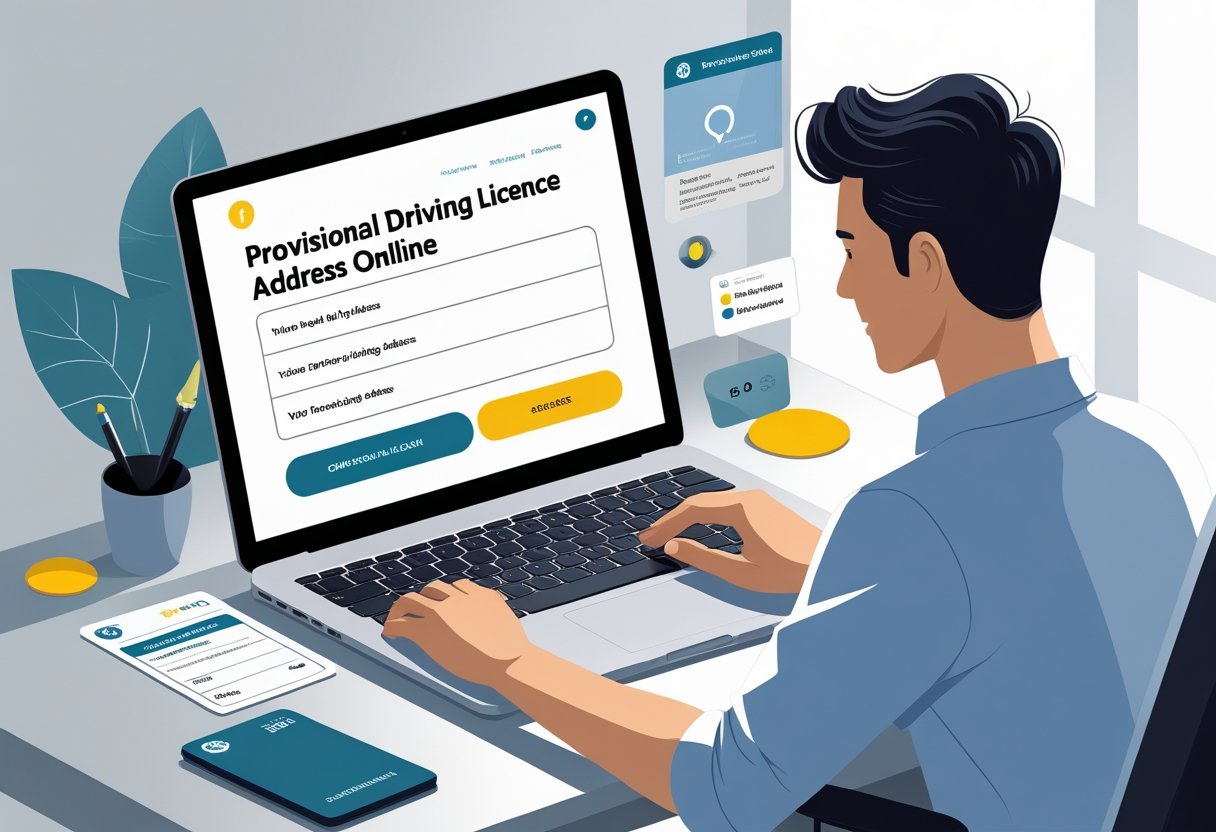
The DVLA’s online service makes updating your provisional licence address straightforward and completely free. You’ll need your driving licence details, National Insurance number, and address history from the past three years to complete the application successfully.
Step-by-Step Guide to the DVLA Online Application
Getting started with your address change is simpler than you might think. We’ll walk you through each stage so you feel confident throughout the process.
First, visit the official GOV.UK website and search for “change driving licence address.” Click on the official DVLA service link to begin your application.
You’ll start by entering your personal details. This includes your full name, gender, and date of birth exactly as they appear on your current provisional licence.
Next, input your driving licence number from your photocard driving licence. Take your time here getting this wrong can delay your application.
The system will then ask for your National Insurance number. Have this ready as it helps verify your identity quickly.
Address Information Section
You’ll need to provide all addresses where you’ve lived during the past three years. List these in chronological order, starting with your most recent address.
Enter your new address details carefully. Double-check the postcode and house number to avoid any postal delays with your new licence.
The final step involves reviewing all your information before submitting. Once you’re happy everything’s correct, submit your application.
What You Need: Documents and Details Checklist
Having everything ready beforehand makes the whole process much smoother. We’ve created this checklist to help you gather what you need.
Essential Documents:
- Your current provisional driving licence (you’ll need the licence number)
- National Insurance number
- Passport number (if you have one)
Address Information Required:
- Your new complete address including postcode
- Full address history for the past three years
- Dates when you lived at each address
You don’t need to send any physical documents for a simple address change. The online system handles everything digitally.
Keep your provisional licence handy throughout the application. You might need to reference other details from it as you progress through the form.
Additional Requirements:
- Access to an email address for confirmation
- You must be a resident of Great Britain
- You cannot be currently banned from driving
Expected Timelines and Confirmation Process
Your application moves through the system faster than you might expect. Here’s what happens after you hit submit.
You’ll receive a confirmation email from the DVLA immediately after completing your application. Keep this safe as proof you’ve updated your details.
Your new provisional licence typically arrives within three weeks. Royal Mail delivers it to your new address, so make sure someone can receive post there.
During the Waiting Period:
- You can continue driving with your current licence
- Your old licence remains valid until the new one arrives
- Update your car insurance with your new address separately
If your licence doesn’t arrive after three weeks, contact the DVLA directly. They can track your application and resolve any issues quickly.
The DVLA might ask you to participate in research via email. You can easily opt out if you’re not interested.
Tips for a Smooth Online Experience
A few simple preparations can save you time and prevent frustration during your application.
Before You Start:
- Clear your browser cache and cookies
- Use a reliable internet connection
- Set aside 15-20 minutes of uninterrupted time
- Have all your documents within arm’s reach
Double-check every piece of information before moving to the next page. It’s much easier to correct mistakes as you go rather than starting over.
If the system times out, don’t panic. Simply restart the application, your progress won’t affect future attempts.
Common Mistakes to Avoid:
- Rushing through the address history section
- Mixing up old and new postcodes
- Forgetting to update vehicle registration separately
Remember, this service is completely free. If any website asks for payment for a simple address change, you’re not on the official DVLA site.
Save the confirmation email in a folder you’ll remember. You might need it if any questions arise about your application later.
How to Change Your Provisional Licence Address by Post
Applying by post gives you complete control over the process and works brilliantly when you need to change other details alongside your address. You’ll use either the D1 form for most situations or the D741 form for specific circumstances, and the process varies slightly depending on whether you hold a modern photocard driving licence or an older paper version.
Choosing the Right Form: D1 and D741 Explained
The D1 form is your go-to choice for most address changes. It’s the standard application form that handles address updates, name changes, and photo renewals all in one go.
You’ll want the D1 form when you’re:
- Moving to a new address within Great Britain
- Changing your name at the same time
- Updating your photo (if your licence expires within two years)
- Replacing a damaged or lost licence
The D741 form serves a more specific purpose. We recommend this form when you’re dealing with medical conditions or specific DVLA requirements that affect your driving eligibility.
Most learner drivers will find the D1 form meets their needs perfectly. You can download it directly from the DVLA website or pick one up from most Post Office branches.
The forms are completely free to obtain. However, you’ll pay £17 if you’re updating your photo alongside your address change.
Completing and Sending Your Application
Start with Section 1 of your D1 form by filling in your current driving licence details. Double-check your licence number matches exactly what’s printed on your provisional licence.
Section 2 requires your personal information. Include your full name, date of birth, and National Insurance number. Write clearly in black ink to avoid processing delays.
Section 3 is where you’ll update your address details. List your previous address and your new one. We need addresses for the last three years, so include any additional previous addresses if you’ve moved recently.
Don’t forget to sign and date the declaration in Section 5. This confirms all information is accurate and complete.
Pack everything carefully before posting. Include your current provisional licence (both the photocard and paper counterpart if you have the older version) with your completed D1 form.
Send your application to the address printed on the D1 form. Use recorded delivery for peace of mind, especially since you’re sending important documents.
Differences for Photocard and Paper Licence Holders
Photocard driving licence holders follow the standard process we’ve outlined above. Your modern plastic photocard contains all necessary information, making the update straightforward.
You’ll send just the plastic photocard with your D1 form. The process typically takes two to three weeks, and you’ll receive your updated photocard driving licence by post.
Paper driving licence holders need to include both parts of their licence if they still have them. Some older licences came with paper counterparts before 2015, though these are no longer valid for legal purposes.
If you only have the old green paper licence, you’ll need to surrender this with your application. The DVLA will automatically issue you a modern photocard driving licence as part of the address change process.
This upgrade is brilliant news because you’ll receive a current photocard driving licence without paying extra fees. Your new licence will have the same expiry date as your original paper version.
Paper licence holders should expect slightly longer processing times, typically three to four weeks, as the DVLA needs to create your new photocard from scratch.
What to Update Alongside Your Provisional Licence Address
When you’ve sorted out your provisional licence address change, there are a few other important bits and pieces that need updating too. You’ll want to tackle your vehicle log book if you own a car, sort out any vehicle tax payments, and give your insurance company a quick ring.
Telling DVLA About Your Vehicle Log Book (V5C)
If you’ve got a car registered in your name, you’ll need to update the V5C vehicle log book separately from your provisional licence. This is a crucial step that many new drivers forget about!
The good news is that changing your address on your V5C is completely free. You can do this online through the DVLA website, just like you did with your provisional licence.
You’ll need your V5C reference number handy when you start the process. This 11-digit number sits right on the front of your log book document.
What you’ll need:
- Your current V5C log book
- The vehicle registration number
- Your new address details
- Details of where you’ve lived in the past 3 years
The updated V5C will arrive at your new address within a few weeks. Keep your old log book safe until the new one turns up, you might need it if any questions arise.
Updating Vehicle Tax Direct Debit Details
Got your vehicle tax set up on Direct Debit? Brilliant choice for staying on top of payments, but you’ll need to update those details when you move house.
This isn’t automatic, so don’t assume DVLA will sort it out for you. You’ll need to log into your vehicle tax account online and manually change your address details.
Quick steps to update:
- Visit the DVLA vehicle tax service online
- Sign in with your vehicle registration and reference number
- Navigate to your Direct Debit settings
- Update your billing address to match your new home
If you don’t update these details, your Direct Debit might get cancelled. That could leave you accidentally driving without valid tax, definitely not what you want as a new driver!
Informing Your Car Insurance Provider
Your insurance company needs to know about your address change straight away. This isn’t just good practice, it’s actually a legal requirement that could affect your cover.
Different postcodes carry different risk levels for insurers. Your premium might go up or down depending on your new area’s crime rates and accident statistics.
Ring your insurer as soon as possible after you move. Most companies have 24-hour helplines, so there’s no excuse for delays.
Some insurers let you update your address online through their customer portals. Check if yours offers this option, it’s often quicker than waiting on hold.
Don’t worry if your premium changes slightly. It’s better to have accurate, valid insurance than to risk driving without proper cover because of outdated information.
Special Circumstances and Frequently Overlooked Details
When updating your provisional licence address with the DVLA, certain situations require extra attention that many learner drivers miss. Moving abroad creates different requirements than standard address changes, whilst updating multiple personal details simultaneously involves specific procedures.
Moving Abroad or Spending Time Outside the UK
If you’re planning to move abroad permanently, you cannot register your new overseas address on your British provisional licence. This catches many people off guard, but it’s a firm DVLA rule.
Instead, you’ll need to contact the driving licence authority in your new country of residence. Each nation has different requirements for licence conversion or recognition.
What about temporary moves? If you’re studying abroad for a semester or working overseas for a few months, your situation differs entirely. You can keep your UK provisional licence active as long as you maintain a UK address where correspondence can reach you.
Consider using a family member’s address as your official contact point. This ensures you won’t miss important DVLA communications about your licence.
Remember, you cannot take your UK driving test whilst living abroad permanently. Plan your learning journey accordingly if international moves are on your horizon.
Changing Other Personal Details at the Same Time
Here’s where things get interesting – you might want to update your name alongside your address change. Unfortunately, the DVLA’s online system doesn’t allow simultaneous changes of both details.
If you need to change your name too, you must apply by post instead of online. This means gathering supporting documents like marriage certificates or deed poll paperwork.
The process takes longer when done by post, so factor this into your timeline. You’ll still receive confirmation, but expect 2-3 weeks rather than the usual online turnaround.
Photo updates work differently. If your licence has less than two years remaining, you can update your photo when changing your address. For licences valid longer than two years, you’ll need to renew separately.
This costs £14 unless you’re over 70 or hold a medical short-period licence.
Avoiding Common Mistakes with Address Changes
Many learner drivers forget they need to provide all addresses from the past three years, not just their current one. Gather this information before starting your application.
Don’t forget these crucial steps:
- Update your vehicle log book (V5C) if you own a car
- Change your vehicle tax Direct Debit address
- Update any personalised registration documents
The biggest mistake? Thinking you have ages to update your address. You could face fines up to £1,000 if you don’t tell the DVLA promptly about address changes.
Double-check your National Insurance number and passport details before starting. Having these ready speeds up the entire process and prevents frustrating delays.
Frequently Asked Questions
We know changing your address can feel a bit overwhelming when you’re already juggling learning to drive. These common questions will help you navigate the process with confidence and get back to focusing on what matters most – getting behind the wheel.
What’s the simplest way to update my personal details on my provisional licence?
The easiest method is using the DVLA’s online service. It’s straightforward and takes just a few minutes to complete.
You’ll need your current provisional licence and basic details like your National Insurance number. The online system guides you through each step clearly.
We recommend this approach because it’s free and you get instant confirmation. Plus, you can still drive whilst waiting for your updated licence to arrive.
Can you walk me through updating my address online if I’ve recently moved?
Start by visiting the official DVLA website and look for the address change service. You’ll need to provide addresses for everywhere you’ve lived in the past three years.
Have your provisional licence number ready along with your National Insurance number. The system will ask for your new address details and verify your identity.
Once you’ve submitted everything, you’ll receive a confirmation email straight away. Your new licence typically arrives within a few weeks, but you can continue practising your driving skills in the meantime.
Is there a charge for revising the address on my learner’s permit, and if so, how much will it set me back?
Great news – updating your address costs absolutely nothing! The DVLA provides this service completely free of charge.
However, if you decide to update your photo at the same time, there’s a £14 fee. This only applies if your licence has at least two years left before it expires.
We think it’s brilliant that keeping your details current won’t cost you a penny. It means there’s no excuse for putting off this important update.
What documents should I have on hand when I’m ready to change the address on my provisional driving licence?
You’ll definitely need your current provisional licence – this is essential for the process. Your National Insurance number is also required for verification.
If you have a passport, having that number available helps speed things along. You’ll also need a list of all addresses where you’ve lived over the past three years.
Keep these documents somewhere safe and accessible. Having everything ready beforehand makes the whole process much smoother and less stressful.
How long will it take for my updated provisional licence to arrive once I’ve submitted my new address?
Your new provisional licence usually arrives within two to three weeks of submitting your application. The DVLA processes these requests fairly quickly.
Don’t worry if it takes slightly longer – postal services can sometimes cause minor delays. You’ll receive that confirmation email immediately, which proves you’ve updated your details properly.
Remember, you can continue with your driving lessons and practice whilst waiting. Your old licence remains valid until the new one arrives.
If I’m only at a temporary address, should I still change the address on my provisional licence, and what’s the process?
You’re legally required to update your address even if it’s temporary. The key factor is whether you’re genuinely residing there, not how long you plan to stay.
You can face fines up to £1,000 for not updating your address when you move. It’s simply not worth the risk, even for short-term relocations.
The process remains exactly the same as any other address change. Use the online service and update it again when you move to your next address. We know it might feel tedious, but staying compliant keeps you safe from unnecessary penalties.