

Understanding Priority at Mini Roundabouts: A Learner’s Guide
Mini roundabouts can feel like puzzles when you’re learning to drive. These compact junctions pop up everywhere in residential areas, and they often leave new drivers scratching their heads about who goes first. The confusion is understandable because mini roundabouts work differently from regular traffic lights or stop signs.
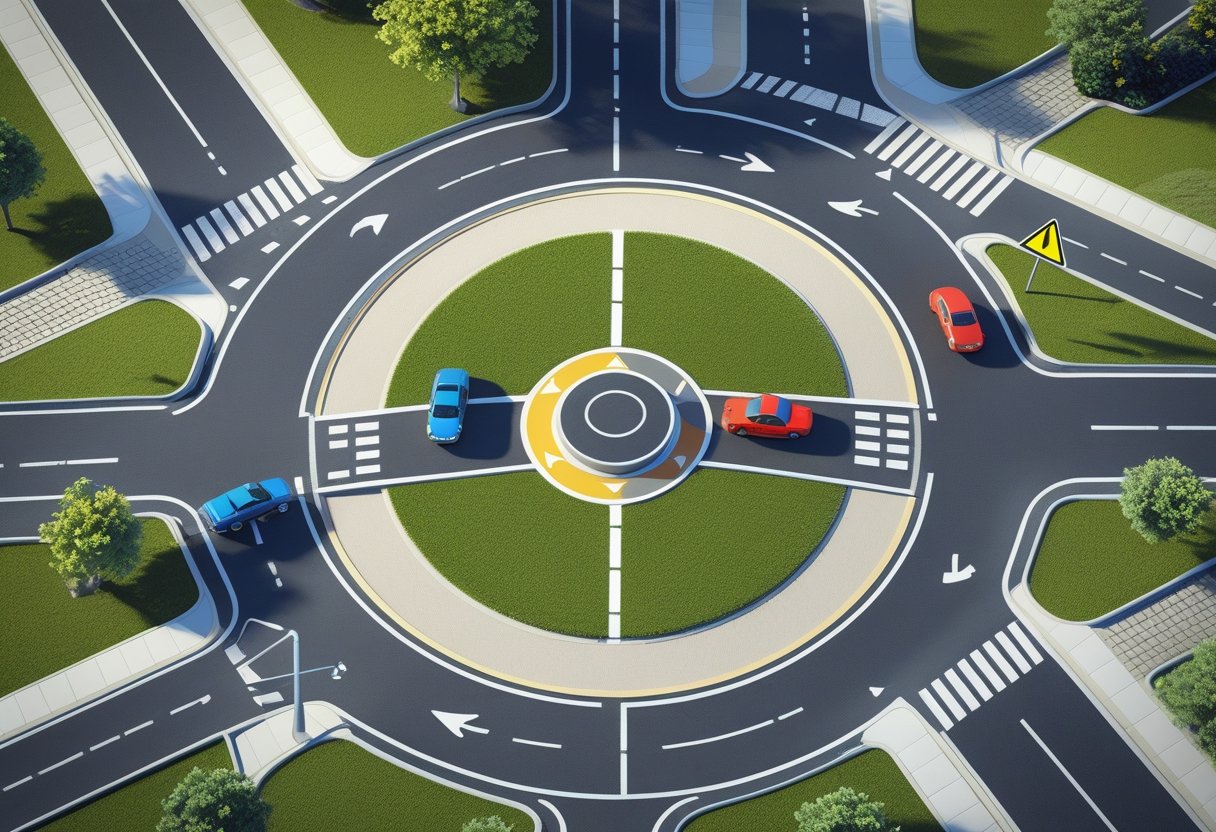
You must give way to traffic approaching from your right and already on the roundabout, whilst traffic from your left gives way to you. This fundamental rule stays the same whether you’re going straight ahead, turning left, or turning right. Once your front wheels cross those white give way lines, you’ve established your priority on the roundabout.
We know that mastering these junctions is crucial for your driving test success and everyday driving confidence. Mini roundabouts might seem tricky at first, but they’re actually quite logical once you understand the basic principles. They keep traffic flowing smoothly and reduce accidents compared to traditional crossroads, making them a popular choice for busy residential intersections.
Key Takeaways
- Always give priority to vehicles from your right and those already on the roundabout
- Signal clearly when turning right due to limited space and time for other drivers to react
- Treat each mini roundabout independently and use proper mirror checks throughout your approach
What Are Mini Roundabouts?

Mini roundabouts are smaller circular junctions designed for tighter spaces, typically found in residential areas where standard roundabouts wouldn’t fit. They’re marked with white road markings rather than raised kerbs, and most can be driven over when necessary.
Differences Between Mini and Standard Roundabouts
The most obvious difference is size. Mini roundabouts are much smaller than their full-sized cousins.
Instead of a raised central island, mini roundabouts use a flat white circle painted on the road surface. This marking can be driven over by larger vehicles like lorries and buses when they need extra space to navigate the junction.
Physical differences:
- White painted circle instead of raised kerb
- Usually only one lane approaching and exiting
- No street lighting around the central area
- Smaller overall diameter
Most mini roundabouts have just one lane in each direction. This makes them simpler to navigate than multi-lane roundabouts where you need to choose the correct lane.
The compact design means you’ll approach and exit much faster than on larger roundabouts. There’s less time to signal and position your vehicle, so quick decision-making becomes important.
Where You’ll Find Mini Roundabouts
Mini roundabouts pop up most often in residential areas where space is tight but traffic flow needs improving.
You’ll commonly find them replacing T-junctions or crossroads in housing estates. They help traffic move more smoothly when several residential streets meet.
Common locations include:
- Quiet residential streets
- Village centres
- Country lanes where roads intersect
- Areas where traditional junctions cause bottlenecks
Many are installed as traffic calming measures. They naturally slow drivers down whilst keeping traffic moving better than stop signs or give way markings alone.
We often see double mini roundabouts in busier residential areas. These are two mini roundabouts placed close together where multiple roads converge.
The Role of Road Markings and Signs
The blue circular sign with a white circle tells you there’s a mini roundabout ahead. This gives you time to prepare and slow down appropriately.
White road markings create the circular junction itself. The central white circle shows where the roundabout begins, and you should drive around it clockwise.
Key markings include:
- Central white painted circle
- Give way lines at each approach
- Direction arrows showing traffic flow
- Sometimes hatched markings around the central circle
Give way lines mark where you must stop if traffic on your right has priority. These work exactly like give way lines at any junction.
The painted circle might look small, but it serves the same purpose as a raised island on larger roundabouts. You should treat it with the same respect and follow the same priority rules.
Priority Rules at Mini Roundabouts

Mini roundabouts follow the same basic priority rules as larger roundabouts, but their compact size creates unique challenges for drivers. The key is giving way to traffic from your right whilst watching for safe gaps in the flow of vehicles.
The Golden Rule: Give Way to the Right
At every mini roundabout, we must give priority to traffic approaching from our right. This rule stays consistent whether we’re turning left, going straight ahead, or turning right.
Traffic already on the roundabout always has priority over vehicles waiting to enter. If a car is coming from your right and has reached the roundabout first, you need to wait.
The tricky bit comes when two vehicles arrive simultaneously from different directions. In these situations, the vehicle approaching from your right gets priority.
Watch out for these common scenarios:
- A car coming straight from your right whilst you’re turning left
- Traffic turning right from the opposite direction when you’re going straight
- Multiple vehicles approaching from different angles at busy times
Some drivers mistakenly think going straight gives them automatic priority. It doesn’t. The direction you’re travelling matters far less than where other traffic is coming from.
Understanding Equal Priority
Mini roundabouts create equal priority for all directions of traffic flow. Unlike T-junctions where one road typically has priority, every approach to a mini roundabout has the same status.
This equal priority system helps traffic move more smoothly through residential areas. No one direction gets stuck waiting whilst others zip through freely.
However, equal priority doesn’t mean equal timing. We still need to follow the give way to the right rule when vehicles arrive together.
Benefits of equal priority:
- Reduces queuing during busy periods
- Allows fairer access from all directions
- Keeps traffic moving when roads are quiet
The system works brilliantly when everyone understands the rules. Problems arise when drivers assume they have priority based on their intended direction or the size of their road.
Spotting a Safe Gap
Finding the right moment to enter a mini roundabout requires good observation skills and timing. We need to look early and assess the traffic situation before we reach the give way line.
Start checking for gaps whilst you’re still approaching the roundabout. Look to your right first, then sweep around to check other directions.
A safe gap means you can enter and complete your manoeuvre without forcing other drivers to brake or change their plans. Don’t just focus on the immediate space – consider where traffic will be by the time you’re moving through.
Key things to check:
- Speed of approaching vehicles from the right
- Distance between vehicles in the traffic flow
- Whether other drivers are signalling their intentions
- Pedestrians near crossing points
Large vehicles like buses and lorries need extra space and may cross over the central markings. Give them plenty of room and don’t try to squeeze past.
What to Do When Approaching
Your approach to a mini roundabout sets you up for success or trouble. Use the MSPSL routine: mirrors, signal, position, speed, and look early to gather information.
Check your mirrors to see what’s behind you. Signal your intentions clearly – especially important when turning right due to limited space.
Position your vehicle correctly for your intended exit. Most mini roundabouts only have one lane, which simplifies positioning compared to larger roundabouts.
Adjust your speed based on what you can see. If the way looks clear, approach in second gear ready to keep moving. If traffic is heavy or visibility is poor, select first gear and be prepared to stop.
Speed and gear selection:
- Clear conditions: Second gear, smooth approach
- Busy traffic: First gear, ready to stop at give way line
- Poor visibility: Slower approach, extra caution
Keep looking right up until you enter the roundabout. Traffic situations change quickly, and that gap you spotted might disappear as you get closer.
Approach and Navigation Techniques
Getting your approach right at mini roundabouts means mastering three key skills: following a clear observation routine, selecting the proper gear and speed for the junction, and using smooth clutch control when you need to slow down or stop.
Mastering the MSM Routine
The MSM routine (Mirrors, Signal, Manoeuvre) becomes your best friend when approaching any mini roundabout. We recommend starting this sequence well before you reach the junction itself.
Check your mirrors first. Look in your interior mirror, then your left door mirror if turning left, or right door mirror if heading right. This tells you what’s happening behind you before you make any moves.
Signal your intentions early. If you’re turning left, indicate left as you approach. Going right means signalling right from the start. Travelling straight ahead? No signal needed on approach, but you’ll signal left as you pass the exit before yours.
Position yourself correctly during the manoeuvre. For left turns, stay towards the left side of your lane. When turning right, move closer to the centre line without crossing it. Keep central for straight ahead.
Your observation doesn’t stop once you’ve signalled. Keep scanning the roundabout as you approach, paying special attention to traffic coming from your right.
Choosing Your Gear and Speed
Speed control makes the difference between a smooth approach and a jerky, stressful experience. We find that most mini roundabouts work best when you slow to around 10-15 mph.
Drop into second gear before you reach the roundabout. This gives you better control and means you can pull away smoothly if the way is clear. Third gear often feels too fast for the tight turns these junctions require.
Adjust your speed based on what you can see. If traffic looks busy, slow down earlier. When the roundabout appears quiet, you might maintain a slightly higher speed, but always be ready to stop.
Look ahead for clues about traffic flow. Cars slowing down on your right might be giving way to their right, which could create an opportunity for you to proceed.
Remember that your speed affects everyone else’s decisions. Other drivers judge when to emerge based on your approach speed, so consistency matters more than being overly cautious or too aggressive.
Clutch Control at Slow Junctions
Smooth clutch work transforms mini roundabout navigation from stressful to straightforward. Your clutch becomes particularly important when you need to creep forward or stop and start frequently.
Find your biting point as you approach. When you’ve slowed to second gear, ease the clutch up until you feel it start to grip. This position lets you control your speed precisely without stalling.
Use clutch control for moving off smoothly. If you need to stop at the roundabout, bring the clutch up to the biting point before adding gentle acceleration. This prevents that embarrassing kangaroo hop effect.
Practice the creep technique. Sometimes you’ll need to edge forward slowly to get a better view. Hold the clutch just below the biting point and use tiny movements to control your progress.
Keep your right foot ready on the accelerator, but don’t rush. The combination of gentle acceleration and careful clutch control lets you respond quickly when a gap appears, whilst maintaining full control if you need to stop suddenly.
Signals, Mirrors, and Positioning
Proper signals, mirror checks, and positioning form the foundation of safe mini roundabout navigation. These three elements work together to communicate your intentions clearly whilst keeping you aware of surrounding traffic.
Signalling for Each Direction
Getting your signals right at mini roundabouts can feel tricky during your early driving lessons, but we’ve got a simple approach that works every time.
When going left: Signal left as you approach the roundabout. Keep that signal on until you’ve completed your turn.
When going straight ahead: Don’t signal on approach. This might feel odd at first, but it prevents confusion for other drivers who might think you’re turning.
When turning right: Signal right before you reach the roundabout. This is crucial because there’s limited space and time for other drivers to react.
The key driving tip here is to signal early enough that others can see your intentions. We recommend signalling at least 30 metres before the roundabout when turning right.
Many learner drivers worry about when to cancel their signals. Your steering wheel will usually return the indicator to neutral position naturally, but always check it’s switched off after completing your manoeuvre.
Remember that other drivers might signal incorrectly. Always watch what vehicles actually do rather than just trusting their indicators.
Effective Mirror Checks
Mirror checks keep you safe and informed about what’s happening around your vehicle. We use the MSM routine (mirrors, signal, manoeuvre) for every mini roundabout approach.
Start with your interior mirror to see what’s behind you. Then check your left door mirror to spot any cyclists or motorcycles that might be alongside.
Your right door mirror is particularly important when approaching from the left side of a mini roundabout. Look early to identify any vehicles that have priority over you.
Quick mirror sequence:
- Interior mirror first
- Left door mirror
- Right door mirror
- Interior mirror again as you enter
Don’t forget to check mirrors again as you exit the roundabout. This final check updates you on traffic that might be following or approaching from behind.
During driving lessons, practise making these checks smooth and natural. Quick glances work better than long stares that take your attention away from the road ahead.
Avoiding Common Mistakes
We see certain mistakes crop up repeatedly, especially with nervous learner drivers preparing for their driving test.
Position problems happen when drivers approach too close to the kerb or drift towards the centre. Aim to position your vehicle in the centre of your lane, roughly one metre from the kerb.
Signal confusion occurs when drivers indicate left when going straight ahead. Remember our rule: no signal for straight ahead, left signal for left turns, right signal for right turns.
Mirror neglect is dangerous and common. Some drivers check mirrors on approach but forget the exit check. Make it a habit to glance in your interior mirror as you leave the roundabout.
Speed misjudgement causes problems too. Approach slowly enough that you can stop safely if needed, but don’t crawl so slowly that you create unnecessary queues.
Following too closely behind large vehicles creates blind spots. Give lorries and buses extra space because they may need to drive over the central white circle.
The most important driving tip we can share is this: when in doubt, wait. It’s better to pause an extra moment than to cause an accident or fail your driving test.
Challenges and Hazards on Mini Roundabouts
Mini roundabouts in residential areas present unique challenges that require extra attention and patience. We’ll need to watch for pedestrians crossing nearby, share space safely with cyclists, and navigate tighter roads where space is limited.
Dealing with Pedestrian Crossings
Pedestrians near mini roundabouts can appear suddenly, especially in busy residential areas. We need to scan constantly for people walking along pavements or approaching crossings.
Key areas to watch:
- Zebra crossings just before or after the roundabout
- Bus stops where people gather
- School zones during peak times
- Shopping areas with heavy foot traffic
The reduced visibility around mini roundabouts makes spotting pedestrians trickier. Buildings, parked cars, or overgrown hedges can hide people from view.
We should always reduce our speed when approaching these junctions. This gives us more time to react if someone steps into the road unexpectedly.
Children can be particularly unpredictable around mini roundabouts. They might not understand the traffic flow or could dash across without looking properly.
Sharing Space with Cyclists
Cyclists often struggle with mini roundabouts because they’re vulnerable and need extra space to manoeuvre safely. We must give them plenty of room and patience.
Watch for cyclists:
- Taking the lane to position themselves safely
- Signalling late due to the tight turning space
- Moving slower than expected through the junction
- Wobbling slightly on sharp turns
Never try to squeeze past a cyclist on a mini roundabout. The space is simply too tight, and we risk causing a serious accident.
Some cyclists might ride around the central marking rather than over it. This is perfectly legal and we need to respect their road position.
Be extra patient during rush hours when more cyclists use residential routes. A few extra seconds of waiting can prevent a collision.
Navigating Tight Residential Roads
Residential mini roundabouts often sit on narrow roads with parked cars lining both sides. This creates several challenges that we need to handle carefully.
Common hazards include:
- Limited sight lines due to parked vehicles
- Narrow approach lanes that make positioning difficult
- Car doors opening from parked vehicles
- Delivery vans blocking visibility
We might need to creep forward slowly to get a proper view of approaching traffic. Don’t feel rushed by other drivers behind us.
Larger vehicles like refuse trucks or delivery lorries might need to drive over the central marking. We should give them space and wait patiently rather than trying to squeeze through.
Parking near mini roundabouts creates particular problems. Cars parked too close to the junction reduce visibility for everyone and make the approaches even tighter.
Test Success: Mini Roundabouts in Exams
Mini roundabouts appear frequently in both practical driving tests and theory exams because they test your understanding of priority rules and hazard awareness. We’ll help you prepare for what examiners expect and tackle common theory questions with confidence.
Driving Test Expectations
Your driving examiner will be watching carefully at every mini roundabout you encounter. They’re looking for smooth, confident navigation that shows you understand who has priority.
Mirror checks are crucial. We recommend checking your interior mirror as you approach each mini roundabout. This shows awareness that it’s a potential hazard where other drivers might react unexpectedly.
Indicating correctly matters immensely. Turn left or right? You must signal clearly. Going straight ahead requires no signal on approach, but many learner drivers forget this simple rule.
Don’t stop unnecessarily. This catches out loads of learners. Only stop if you need to give way to traffic from the right or if the junction is completely blind.
The examiner expects you to:
- Give way to traffic from your right
- Avoid driving over the white centre circle
- Check for cyclists before turning left
- Maintain appropriate speed for the conditions
Speed control shows competence. Approach at a sensible pace that allows you to assess the situation properly without holding up following traffic.
Mini Roundabout Questions in the Theory Test
Theory test questions about mini roundabouts focus heavily on priority rules and safe positioning. We’ve seen these topics come up repeatedly in recent exams.
Priority questions are extremely common. You’ll likely face scenarios asking who should give way when multiple vehicles approach simultaneously. Remember: traffic from the right always has priority.
Road markings feature frequently too. Questions might show images of mini roundabouts and ask about the white centre circle or directional arrows. You must know that driving over the centre is only permitted when the roundabout is too small for your vehicle.
Signalling scenarios test your knowledge thoroughly. Expect questions about when to indicate and which direction signals to use. Left and right turns need signals, but straight ahead doesn’t require indication on approach.
Popular question formats include:
- Multiple choice priority scenarios
- Image-based road marking identification
- True/false statements about signalling rules
- Case study questions involving cyclists or pedestrians
Hazard perception clips sometimes feature mini roundabouts. Watch for developing situations where priority might be unclear or where other road users make unexpected movements.
Advanced Scenarios and Extra Advice
Some mini roundabouts come with additional challenges that require sharper observation skills and more careful decision making. These tricky situations often catch learner drivers off guard, from complex double roundabouts to navigating at T-junctions.
Double and Linked Mini Roundabouts
Double mini roundabouts appear where two roundabouts sit close together, creating a unique challenge. We treat each one separately, following the same priority rules at both.
Approaching the first roundabout:
- Give way to traffic from your right
- Signal your intentions clearly
- Check for pedestrians crossing between roundabouts
The tricky bit comes when exiting the first roundabout. We need to position ourselves correctly for the second one whilst other drivers might be doing the same thing.
Key strategies for success:
- Keep your speed steady but controlled
- Don’t rush between the two roundabouts
- Signal again before the second roundabout if your direction changes
- Watch for drivers who might cut across from other exits
Some double roundabouts have traffic lights. These make life easier because the lights control who goes when. Follow the lights first, then apply normal roundabout rules.
U-Turns and Overtaking
Making U-turns at mini roundabouts is perfectly legal, but timing and positioning matter enormously. We signal left on approach, then follow the roundabout all the way round.
Safe U-turn technique:
- Approach slowly and signal left
- Give way to traffic from the right as normal
- Keep close to the central marking (you can drive over it if needed)
- Signal right when passing the exit before yours
- Check mirrors constantly for following traffic
Overtaking near mini roundabouts is risky business. We avoid overtaking just before or on roundabouts because visibility drops and other drivers’ intentions aren’t always clear.
Traffic often bunches up before mini roundabouts. Patient drivers fare better than hasty ones here.
Mini Roundabouts at T-Junctions
T-junction mini roundabouts feel different because traffic only comes from three directions instead of four. This doesn’t change the basic priority rules, but it does affect our observations.
Coming from the bottom of the T:
- Look right first (main priority)
- Check left for turning traffic
- The road ahead might feel like you’re going straight, but you’re still turning right
Turning from the top of the T:
- Traffic from your right has priority
- Vehicles going “straight” across are actually turning
- Watch for drivers who might not signal properly
These junctions often catch people out because the layout feels less obvious than a standard crossroads. We still follow the “give way to the right” rule religiously.
The key is recognising that every movement at a T-junction roundabout involves turning, even when it feels like going straight.
Smart Tips for Everyday Driving
Real-world mini roundabout success comes from developing good habits and staying alert to common problems. We’ve gathered some practical wisdom that makes a genuine difference.
Before you reach the roundabout:
- Scan for pedestrians early
- Note any unusual road markings or signs
- Reduce speed smoothly rather than braking hard
- Position in the correct lane well in advance
Communication tricks:
- Eye contact with other drivers helps
- Don’t rely solely on indicators (they might be wrong)
- Your car’s position tells a story too
When things go wrong:
- If someone doesn’t give way, stay calm
- Don’t force your priority aggressively
- Give confused drivers extra space and time
- Remember that being “right” isn’t worth a collision
Watch for cyclists and motorcyclists particularly carefully. They’re harder to spot but have the same rights as cars. We give them plenty of room and never assume they’ll behave predictably.
Bad weather changes everything. Wet roads mean longer stopping distances, so we approach more cautiously and leave bigger gaps.
Frequently Asked Questions
Mini roundabouts often raise questions about approach techniques, priority rules, and signalling procedures. Peak traffic conditions and unusual junction layouts can also create uncertainty for many drivers.
How should you approach a mini-roundabout to ensure a smooth driving experience?
We recommend looking ahead for the blue circular sign that warns of an approaching mini roundabout. This gives you precious time to prepare properly.
Reduce your speed gradually as you approach the junction. If traffic is flowing freely and nobody’s coming from your right, second gear usually works well.
When visibility is limited or traffic is busy, first gear gives you better control. You can then stop safely at the give way line if needed.
Keep your eyes moving between the road ahead and your right-hand side. Other vehicles can appear quickly from side roads, especially in residential areas where mini roundabouts are common.
Could you shed some light on the rules of giving way at a mini-roundabout?
The golden rule stays the same as larger roundabouts: give way to traffic approaching from your right. This applies whether vehicles are already on the roundabout or approaching it.
Traffic coming from your left must give way to you. However, we always advise checking that other drivers actually follow this rule before proceeding.
If you arrive at exactly the same time as someone from the opposite direction, normal junction rules apply. The driver going straight ahead usually has priority over someone turning across their path.
Never assume other drivers will follow the correct priority rules. Some people get confused about mini roundabout priorities, so stay alert and be ready to give way even when you technically have priority.
What is the appropriate signal timing when manoeuvring around a mini-roundabout?
Signal left when you’re turning left, just as you would at any other junction. Apply this signal before you reach the roundabout.
For right turns, signalling becomes even more important because of the tight space. Other drivers need to know your intentions quickly, so signal right well before the junction.
Going straight ahead requires no signal on approach. The limited space means other drivers can easily see your intended direction.
We suggest avoiding the exit signal when leaving small mini roundabouts. The junction is usually too compact for this to be practical or necessary.
Can you describe the correct procedure for navigating multiple mini-roundabouts in quick succession?
Treat each roundabout as a separate junction with its own rules and priorities. Don’t try to plan moves for both roundabouts at once.
Complete the first mini roundabout properly, then quickly assess the second one. Look right for approaching traffic before entering the next junction.
Your speed needs careful management between the two roundabouts. You might need to slow down again or even stop at the second give way line.
Keep your signalling clear and appropriate for each individual roundabout. What you signalled for the first junction might not match what you need for the second.
What advice can you offer for dealing with unusually shaped or angled mini-roundabouts?
Some mini roundabouts sit at awkward angles where roads don’t meet at neat right angles. The priority rules stay exactly the same regardless of the shape.
Take extra time to identify which direction counts as “right” at oddly shaped junctions. This might not be immediately obvious from your driving position.
Slower speeds work better at unusual mini roundabouts. The unfamiliar layout means other drivers might also be uncertain about the correct procedure.
Watch for larger vehicles like buses or lorries at tight mini roundabouts. They’re legally allowed to drive over the central markings when the space is too restricted.
Might there be exceptions to the standard priority rules at mini-roundabouts during peak traffic periods?
The Highway Code rules never change based on traffic levels or time of day. Priority to the right always applies, regardless of how busy the roads are.
However, courtesy and common sense sometimes help traffic flow better during rush hours. Some drivers create informal gaps to help others join the traffic stream.
We don’t recommend deviating from the official rules, even when traffic is heavy. Stick to the proper priorities to avoid confusion and potential accidents.
If traffic is completely gridlocked, avoid entering the roundabout until you can clear it completely. Blocking the junction makes things worse for everyone.