

Published 2 November 2025, updated 14 August 2026
Do Provisional Licence Holders Have to Display L‑Plates? Essential UK Rules
If you’re holding a provisional licence and wondering about those distinctive red and white plates, you’re asking exactly the right question. Yes, provisional licence holders must display L-plates on the front and back of their vehicle at all times when driving: it’s not optional, it’s the law. Getting this wrong could land you with up to six penalty points on your licence, which nobody wants when they’re just starting their driving journey.

We know it might feel a bit daunting having those bright plates announcing to the world that you’re still learning, but here’s the thing, they’re actually working in your favour. Other drivers see those L-plates and give you the space and patience you need whilst you’re building your confidence behind the wheel. Think of them as your safety net rather than a badge of inexperience.
Throughout this guide, we’ll walk you through everything you need to know about L-plates, from the specific rules about size and positioning to regional variations like D-plates in Wales. We’ll also cover what happens when you pass your test, how driving school cars work differently, and answer all those niggling questions that pop up during your learning journey.
Displaying L-plates correctly is just the start of driving legally, and the rest falls into place when you get L-plate-ready with an intensive driving course.
Legal Requirement to Display L Plates as a Provisional Licence Holder
If you’re a provisional licence holder in the UK, displaying L plates isn’t optional, it’s the law. We’ll walk you through why these plates are mandatory, what the legislation actually says, and what happens if you forget to put them on your car.
Why L Plates Are Mandatory for Learner Drivers
L plates serve as your visual announcement to the world that you’re still learning. Think of them as your driving equivalent of training wheels, they let everyone know you’re building your skills behind the wheel.
Other drivers need this heads-up. When they spot those red L plates, they’ll naturally give you more space and patience. They’ll expect you might take a bit longer at roundabouts or need extra time to pull away from traffic lights.
The plates also help create a safer driving environment for everyone. Experienced drivers can adjust their behaviour around you, perhaps leaving a bigger following distance or being more cautious when overtaking.
For learner drivers, this system works brilliantly. You get the space you need to practise without feeling rushed or pressured by impatient drivers who don’t realise you’re still learning.
The Law Surrounding Displaying L Plates
UK law states clearly: any vehicle driven by a learner driver must display red L plates. This isn’t a suggestion, it’s written into the Motor Vehicle (Driving Licences) Regulations.
You must place L plates on both the front and back of your vehicle where they can be seen easily. The plates need specific requirements:
- Red ‘L’ on a white background
- Correct size dimensions
- Clearly visible to other road users
In Wales, you’ve got options. You can choose red D plates instead of L plates, or even display both if you prefer.
The responsibility falls on you as the learner driver to ensure the plates are properly displayed. Your supervising driver should also check they’re in place before you set off.
Consequences of Not Displaying L Plates
Getting caught without L plates brings serious penalties. You could face up to 6 penalty points on your provisional licence, that’s the same number that would normally trigger a ban for new drivers.
Those penalty points don’t disappear when you pass your test either. They’ll carry over to your full licence, which means you could face a ban during your first two years of driving if you collect any additional points.
The financial cost adds up too. Along with the penalty points, you’ll likely receive a fine that could reach several hundred pounds.
We’ve seen learners caught out when their L plates fall off or get damaged during lessons. That’s why we always recommend checking your plates before every drive and keeping spare ones in your car.
Remember to remove the L plates when a fully qualified driver uses the vehicle alone, leaving them on can confuse other road users.
Rules for Positioning and Visibility of L Plates
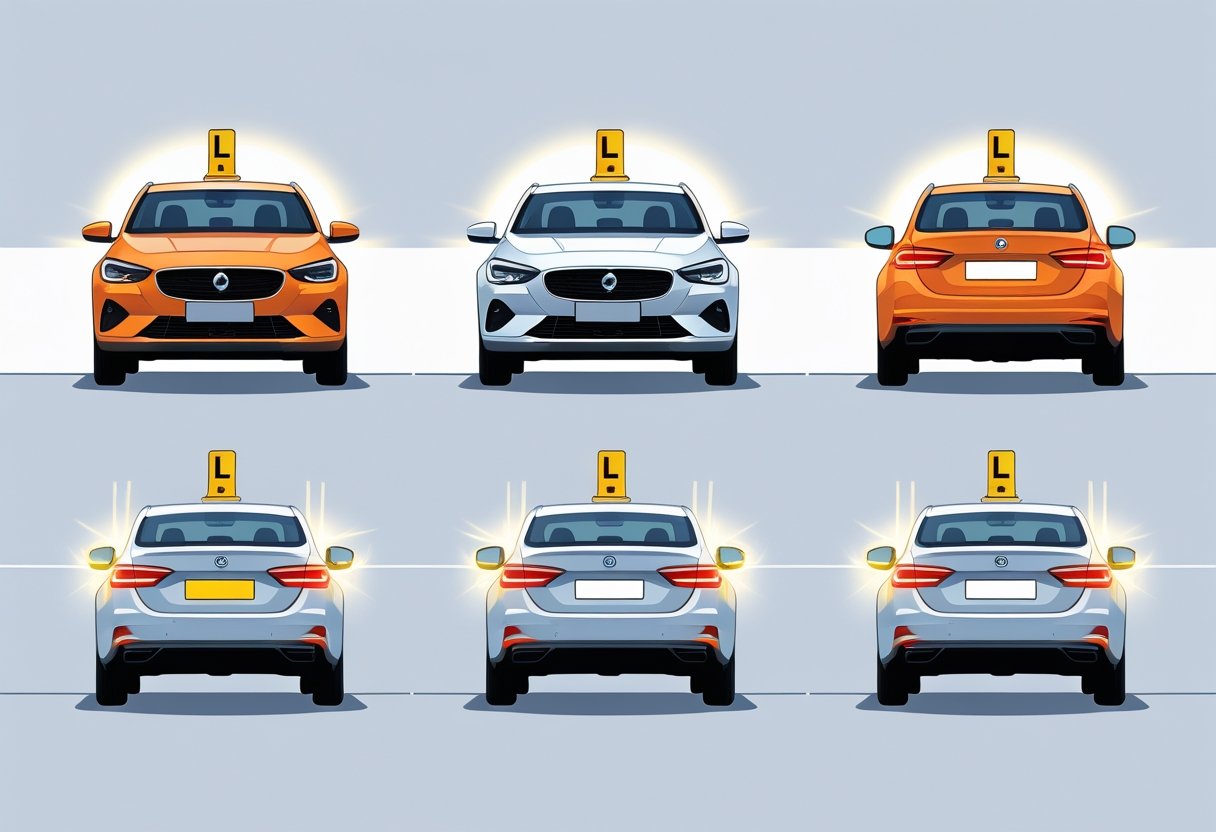
Proper placement transforms your L plates from simple legal requirements into powerful safety tools that protect you on every journey. The key lies in strategic positioning that catches every driver’s attention whilst keeping your plates secure through all weather conditions.
Correct Placement on Vehicles
Front placement works best on your bonnet, positioned as vertically as possible near the centre. This spot gives approaching drivers the clearest view of your learner status. Avoid placing plates too low where they might get obscured by number plates or bumper designs.
The rear positioning deserves equal attention. Your boot lid or rear hatch provides the ideal location for maximum visibility. Position the plate centrally and ensure it sits as upright as your car’s shape allows.
Side visibility matters too, though it’s not legally required. Many experienced instructors recommend considering how your plates look from multiple angles. This approach helps other drivers spot you when changing lanes or at busy junctions.
Remember that red L plates must be clearly visible from at least 20 metres away. This distance gives other motorists enough time to recognise your learner status and adjust their driving accordingly.
Window Placement: Myths and Realities
Many learners believe sticking plates inside rear windows meets legal requirements. Unfortunately, this common practice can land you in trouble with traffic police.
Interior window placement often fails visibility tests due to tinted glass, reflections, or awkward angles. Rain, condensation, and dirt further reduce clarity when you need it most.
External window mounting works better but comes with challenges. Wind resistance at motorway speeds can tear away poorly secured plates. Choose robust magnetic or suction cup systems designed for automotive use.
The windscreen myth persists among new drivers. Front windscreen placement blocks your vision and breaks road safety rules. Keep your view completely clear for safe driving.
Rear window success depends entirely on glass clarity and plate positioning. Clean windows and high-quality plates give you the best chance of meeting legal standards.
Ensuring L Plates Stay Secure
Magnetic L plates offer brilliant convenience for shared vehicles. Choose strong neodymium magnets that won’t slide or fall off during normal driving. Test them thoroughly before your first lesson.
Adhesive options provide permanent solutions for dedicated learner cars. Remove old residue completely before applying fresh plates. Clean, dry surfaces ensure maximum adhesion.
Clip-on systems work wonderfully for number plate mounting. These clever devices slip over existing plates without causing damage. Check they don’t obscure any letters or numbers on your registration.
Regular checks prevent embarrassing roadside penalties. Inspect your plates before every journey, looking for damage, dirt, or loose fixings. Replace worn plates immediately rather than risking fines.
Weather conditions test every mounting system. Strong winds, heavy rain, and car washes challenge even premium products.
Tips for Avoiding Visibility Issues
Cleaning routine keeps your plates readable in all conditions. Wipe them down weekly using warm soapy water and a soft cloth. Avoid harsh chemicals that might fade the red lettering.
Size compliance eliminates most legal problems before they start. Standard L plates measure 178mm x 203mm with specific letter dimensions. Buy from reputable suppliers who guarantee legal compliance.
Contrast checking ensures your plates stand out against your car’s paintwork. White cars sometimes make standard plates harder to spot. Consider the visual impact from different angles and lighting conditions.
Damage replacement protects you from penalty points and fines. Cracked, faded, or partially obscured plates fail legal requirements. Carry spare plates during longer journeys for emergency replacements.
Professional advice from driving instructors often reveals positioning tricks that work perfectly for your specific vehicle model.
D Plates and Regional Variations

In Wales, learner drivers have a unique option that sets them apart from the rest of the UK. Welsh learners can choose between traditional L plates and distinctive D plates, giving them flexibility that reflects the country’s bilingual heritage.
D Plates in Wales
Welsh learner drivers enjoy something special that other UK drivers don’t have. You can display red D plates instead of the standard L plates when you’re behind the wheel.
These D plates serve exactly the same purpose as L plates. They let other road users know there’s a learner driver in the vehicle. The red letter D stands for “dysgwr,” which means “learner” in Welsh.
The legal requirements are identical to L plates:
- Must be clearly visible from front and rear
- Need to meet official size specifications
- Should be removed when a qualified driver takes over
The choice between D plates and L plates is entirely yours. Many Welsh learners feel proud to display D plates as they represent their cultural identity whilst learning to drive.
Using Both L Plates and D Plates
Here’s something that surprises many learners – you can actually display both L plates and D plates on the same vehicle simultaneously. Welsh law specifically allows this combination.
Some driving instructors in Wales choose this approach. It helps ensure maximum visibility and understanding from all road users, whether they recognise L plates or D plates.
Benefits of using both plates:
- Clear identification for English-speaking drivers
- Cultural recognition for Welsh speakers
- Extra visibility for enhanced safety
This dual approach works particularly well in border areas. You’ll find it gives you confidence knowing every driver around you understands you’re learning.
Switching Plates When Crossing Borders
When you drive across the Welsh border into England, your D plates remain perfectly legal. English drivers might not immediately recognise them, but they’re still valid learner plates.
However, many instructors recommend switching to L plates for lessons in England. This prevents any confusion from drivers who might not understand what D plates mean.
Practical tips for border crossings:
- Keep both types of plates in your vehicle
- Switch plates based on where you’ll spend most of your lesson
- Consider your route – will you cross borders multiple times?
Remember, consistency helps build your confidence. If you’re comfortable with L plates, stick with them throughout your learning journey, even in Wales.
Specifics on Plate Design, Size, and Types Allowed
Getting the right L-plates isn’t just about ticking a box, it’s about staying legal and keeping yourself protected on the road. The law sets clear standards for how these plates should look, what size they need to be, and which types you’re allowed to use.
UK Standards for Plate Size and Colour
When it comes to L-plates, the government doesn’t mess about with specifications. Every L-plate must display a red letter ‘L’ on a white background, no other colour combinations will do.
The size requirements are equally strict. Your L-plates need to meet exact measurements that ensure other drivers can spot them clearly from both front and rear.
Here’s what makes an L-plate legal:
- Red letter on white background only
- Specific size dimensions (check current gov.uk guidelines for exact measurements)
- Clearly visible from front and behind your vehicle
- Clean and undamaged condition
In Wales, you’ve got a brilliant option that other parts of the UK don’t have. You can choose red ‘D’ plates instead of L-plates, or even use both if you fancy. The ‘D’ stands for ‘Dysgwr’ Welsh for learner.
The corners of your plates can be slightly rounded, which gives you a bit more flexibility when choosing where to position them on your car.
Magnetic, Stick-On, and Permanent Plates
We love that you’ve got choices when it comes to how you attach your L-plates. Each type has its own advantages, and the best option depends on your situation.
Magnetic plates are absolutely brilliant for most learners. They stick firmly to metal parts of your car but come off easily when you’re not driving. Perfect if you’re sharing the family car or want to remove them between lessons.
Stick-on plates use strong adhesive and stay put in all weather conditions. They’re great if you’re the main driver of the vehicle, though removing them later takes a bit more effort.
Permanent plates work well for driving school cars or if you know you’ll be displaying them for months. These are typically screwed or bolted onto the vehicle.
Whatever type you choose, make sure they’re positioned where they won’t obstruct your view or interfere with safety features like lights or number plates.
Avoiding Non-Compliant Plate Pitfalls
Getting caught with dodgy L-plates isn’t worth the risk: you could face up to six penalty points on your licence. That’s a hefty price to pay for something so easily avoided.
Common mistakes that can land you in trouble include using plates that are too small, faded, or damaged. If your plates have seen better days, replace them straight away.
Never use novelty L-plates with funny slogans, different colours, or non-standard designs. They might raise a chuckle, but they won’t raise your chances of staying on the right side of the law.
Some learners forget to remove L-plates when a qualified driver takes over. Unless it’s a driving school car, you should take them off or cover them up when you’re not behind the wheel.
Remember to check your plates regularly. Wind, rain, and general wear can make them less visible over time.
L Plates and Driving Test Regulations
During your driving test, L plates remain a legal requirement and must be properly displayed on your vehicle. If an L plate becomes loose or falls off during the examination, specific procedures help ensure your test can continue without penalty.
Displaying L Plates During the Driving Test
Your driving test requires proper L plate display, even though you’re demonstrating your readiness to drive independently. We know it might seem odd, but this regulation applies to all learner drivers taking their practical examination.
The DVSA insists on L plate display throughout your entire test. This includes candidates converting foreign licences or those with grandfather rights who technically hold valid driving entitlements.
Your L plates must be:
- Clearly visible on front and rear of the vehicle
- Correct size and specification
- Securely attached before the test begins
Your driving examiner will check L plate positioning during the initial vehicle safety questions. If they’re missing or incorrectly positioned, your test could face delays or postponement.
We recommend arriving early to double-check your L plates are secure. Weather conditions like wind or rain can sometimes loosen them, so a quick inspection gives you peace of mind before this important moment.
What Happens if an L Plate Falls Off in the Test
Don’t panic if an L plate comes loose during your driving test – this situation happens occasionally and there are clear procedures to follow. Your examiner understands these circumstances are beyond your control.
If you notice an L plate has fallen off whilst driving, mention it to your examiner at the next safe opportunity. They’ll typically allow you to pull over safely and reattach it if possible.
The examiner will:
- Assess whether it’s safe to continue
- Allow reasonable time for reattachment
- Not penalise you for the incident itself
If the L plate cannot be reattached or is damaged beyond use, your examiner may decide to continue the test depending on which plate was affected. A missing rear L plate is generally less problematic than a missing front one.
We’ve seen candidates successfully pass their tests even after L plate mishaps. The key is staying calm, communicating clearly with your examiner, and focusing on demonstrating your driving skills once the situation is resolved.
Driving School Cars, Approved Instructors, and Insurance Considerations
When you’re learning with a driving school, L-plate rules work alongside specific requirements for instructor vehicles and insurance policies. These elements work together to create a safe, legal learning environment that protects both you and other road users.
L Plates on Driving School Vehicles
Driving school cars must display L-plates just like any other learner vehicle. Your driving instructor will ensure these plates are properly positioned on both the front and rear of the car before each lesson begins.
Most driving schools use magnetic L-plates that attach easily to their vehicles. These can be quickly removed when the instructor drives alone between lessons. You won’t need to worry about bringing your own plates – this is always sorted for you.
The plates must be clearly visible and meet the same size requirements as personal vehicles. Professional driving instructors take this seriously because they’re responsible for ensuring legal compliance during your lessons.
Some driving school cars also display the instructor’s business details alongside the L-plates. This helps other drivers recognise you’re in a lesson and often encourages more patient behaviour from fellow road users.
Approved Driving Instructor Vehicle Requirements
Approved driving instructors must use cars fitted with dual controls for your safety. These additional pedals on the passenger side allow your instructor to intervene if needed during lessons.
The instructor’s vehicle must also display their green ADI badge, usually positioned on the windscreen. This proves they’re qualified and legally authorised to teach you. Without this badge, they cannot provide professional driving instruction.
Motorway driving lessons are only possible with approved instructors in dual-control vehicles. This is the one exception where learners can legally drive on motorways, giving you valuable experience before your test.
Insurance requirements for driving school vehicles are more complex than standard policies. Your instructor must carry comprehensive business insurance that covers teaching activities and multiple learners throughout each day.
How L Plates Impact Learner Driver Insurance
When learning with a driving school, you’re typically covered under the instructor’s business insurance policy. This removes the stress of arranging your own cover for professional lessons.
However, you’ll still need separate insurance if you plan to practise with family or friends in their vehicles. L-plates signal to insurance companies that you’re a learner, which affects premium calculations.
Learner driver insurance is often more affordable than you might expect. Many insurers offer short-term policies specifically designed for provisional licence holders. These can cover you for anything from a single day to several months.
Some insurance providers offer ‘pay as you go’ policies that work well alongside driving school lessons. This flexibility means you’re not paying for cover when you’re only taking professional lessons with your instructor’s car.
Transitioning from Provisional to Full Licence: When to Remove L Plates
Once you’ve passed your driving test and received your full driving licence, you’ll need to remove your L plates immediately. You can then choose whether to display green P plates to show other drivers that you’re a newly qualified driver.
Removing L Plates after Passing the Test
You must take L plates off your car straight away once you hold a full driving licence. The Highway Code is crystal clear on this – plates should be removed when you’re not a learner anymore.
Driving with L plates when you have a full driving licence isn’t technically illegal. However, it’s not recommended and goes against official guidance.
Here’s what happens if you forget:
- Occasional forgetfulness: You’re unlikely to face penalties
- Deliberate misuse: Could potentially cause issues with authorities
- Driving school vehicles: These are exempt from the removal rule
We recommend keeping a small toolkit in your boot. This makes it easy to remove plates right after your test.
Many test centres have bins nearby where you can chuck your old L plates. It’s quite satisfying, actually – like a little celebration of your achievement!
P Plates and Next Steps for New Drivers
P plates are completely optional but can be brilliant for newly qualified drivers. These green plates show other road users that you’ve recently passed your test.
Unlike L plates, you can keep P plates on for as long as you fancy. There’s no time limit or legal requirement to remove them.
Benefits of using P plates include:
- Extra patience from other drivers
- More space when parking or manoeuvring
- Reduced pressure in challenging situations
You don’t need any special insurance or documentation for P plates. Simply stick them on and you’re sorted.
Some new drivers worry that P plates make them look inexperienced. Remember though – everyone was a new driver once. Most motorists will actually appreciate the heads-up and give you extra room.
The choice is entirely yours. Whether you prefer to blend in or signal your new driver status, both options are perfectly valid.
Frequently Asked Questions
These common questions help clear up confusion about L-plate rules and when you need to display them during your learning journey. Understanding these requirements keeps you legal and confident on the road.
What’s the scoop on needing ‘L’ plates: is it a must for every learner driver?
Absolutely, yes! Every provisional licence holder must display L-plates when driving. It’s not optional, it’s the law.
You could face up to six penalty points on your licence if you don’t display them properly. That’s quite a hefty consequence for something so simple to avoid.
Think of L-plates as your safety announcement to other drivers. They signal that you’re still learning, which encourages others to give you extra space and patience.
Can the journey to being a fully licensed driver start without those signature ‘L’ plates displayed?
Not legally, we’re afraid. You cannot start learning to drive on public roads without displaying L-plates from day one.
The moment you sit behind the wheel with your provisional licence, those plates need to be visible on both the front and back of your vehicle. No exceptions here.
Starting without L-plates puts you at risk of penalty points before you’ve even begun your driving adventure. That’s not the kind of head start anyone wants!
Are there specific times when it’s essential to rock ‘L’ plates during driving practice?
L-plates must be displayed every single time you’re behind the wheel as a learner driver. Whether it’s a quick practice session or a lengthy lesson, they’re non-negotiable.
The only time you can remove L-plates is when a fully qualified driver is using the vehicle. If you’re the one driving, they stay on.
This applies whether you’re driving with an instructor, family member, or friend supervising you. The rule never changes whilst you hold a provisional licence.
After passing the theory, do learner drivers still need to show the world they’re learning with ‘L’ plates?
Your theory test success is brilliant progress, but L-plates stay put until you pass your practical driving test. The theory test doesn’t change your legal requirements on the road.
You’re still a provisional licence holder after passing your theory. This means all the same rules apply, including displaying L-plates during every driving session.
Keep those plates displayed proudly, you’re working towards that full licence, and every practice session gets you closer!
If a learner’s taken to the roads with a qualified instructor, do the ‘L’ plates still need to take pride of place on the car?
Yes, L-plates are still required when driving with a qualified instructor. Having professional instruction doesn’t exempt you from displaying them.
Most driving school cars already have L-plates fitted, so you won’t need to worry about this during lessons. Your instructor’s vehicle will be properly equipped.
If you’re using your own car for professional lessons, make sure those L-plates are clearly visible before your instructor arrives. It keeps everything above board.
Are there any legal exceptions where a provisional licence holder might not have to display ‘L’ plates?
There are no exceptions for provisional licence holders driving on UK roads. Every learner must display L-plates without fail.
Even if you hold a full licence from another country, UK law requires L-plates whilst learning on a provisional licence here. Previous driving experience doesn’t change this rule.
The only alternative is in Wales, where you can use red D-plates instead of L-plates. Both serve the same legal purpose and carry identical requirements.
While you wait for your licence to arrive
Your provisional usually turns up long before you have decided how you want to learn, so this is a good moment to secure course dates.
LPOD Academy runs intensive driving courses from 10 to 50 hours, and you reserve your dates with a deposit of £18 per hour, so £180 to £900 depending on the course length.
The full course price depends on your postcode zone and whether you learn in a manual or an automatic, so there is no single figure.
See the intensive course options · How course costs are worked out
Ready to pass in weeks, not months?
LPOD Academy runs tailored intensive driving courses from 10 to 50 hours across most of the UK, with your theory and practical test support included.
Ready to Book Driving Lessons?
LPOD Academy offers intensive driving courses across the UK. Find your nearest location: