

Published 4 November 2025, updated 14 August 2026
Should You Learn to Drive in Rural or Urban Areas First? Pros, Skills & Real-World Insights
Choosing where to start your driving lessons can feel overwhelming, but the decision doesn’t have to be complicated. Many new drivers wonder whether they should begin their journey on quiet country lanes or jump straight into busy city streets. The truth is, both environments offer valuable learning opportunities, but your choice should depend on your personal comfort level and long-term driving goals.
Whichever setting you start in, a course that deliberately mixes both builds the most rounded driver, which is how we plan our intensive driving courses that mix town and country.
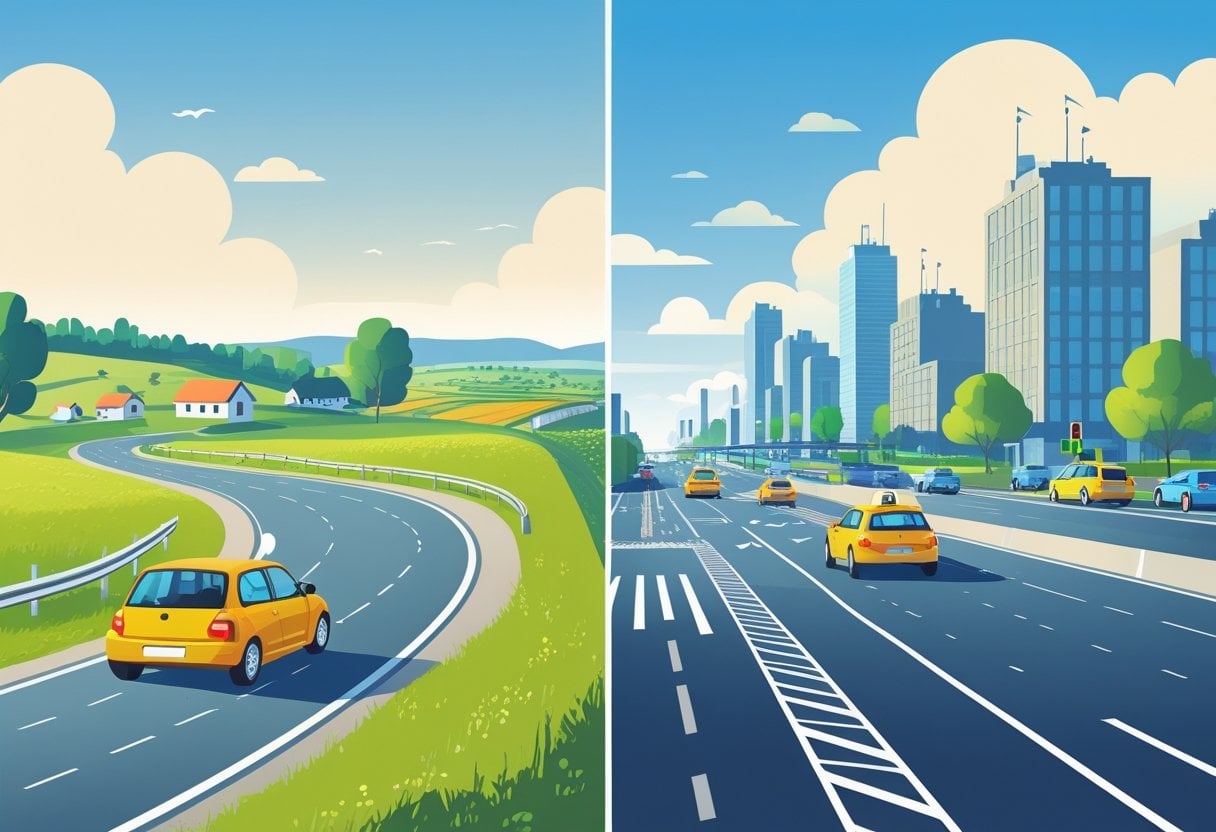
The best approach for most learners is to start with urban driving to build essential skills quickly, then progress to rural roads once you’ve mastered the basics. Urban areas provide constant practice with fundamental skills like steering, speed control, and hazard awareness. You’ll encounter traffic lights, roundabouts, pedestrians, and other drivers regularly, which means you’ll develop crucial decision-making abilities faster than you would on quiet country roads.
However, this doesn’t mean rural driving should be ignored during your learning process. Country roads present their own unique challenges, from higher speeds to unpredictable hazards like wildlife and farm vehicles. The key is finding the right balance between both environments so you become a confident, adaptable driver who can handle any situation with ease.
Key Takeaways
- Urban driving lessons help beginners master essential skills more quickly due to frequent practice opportunities
- Rural roads teach important high-speed handling and hazard awareness that urban areas cannot provide
- The most effective approach combines both environments to create well-rounded, confident drivers
Understanding Rural and Urban Driving Environments
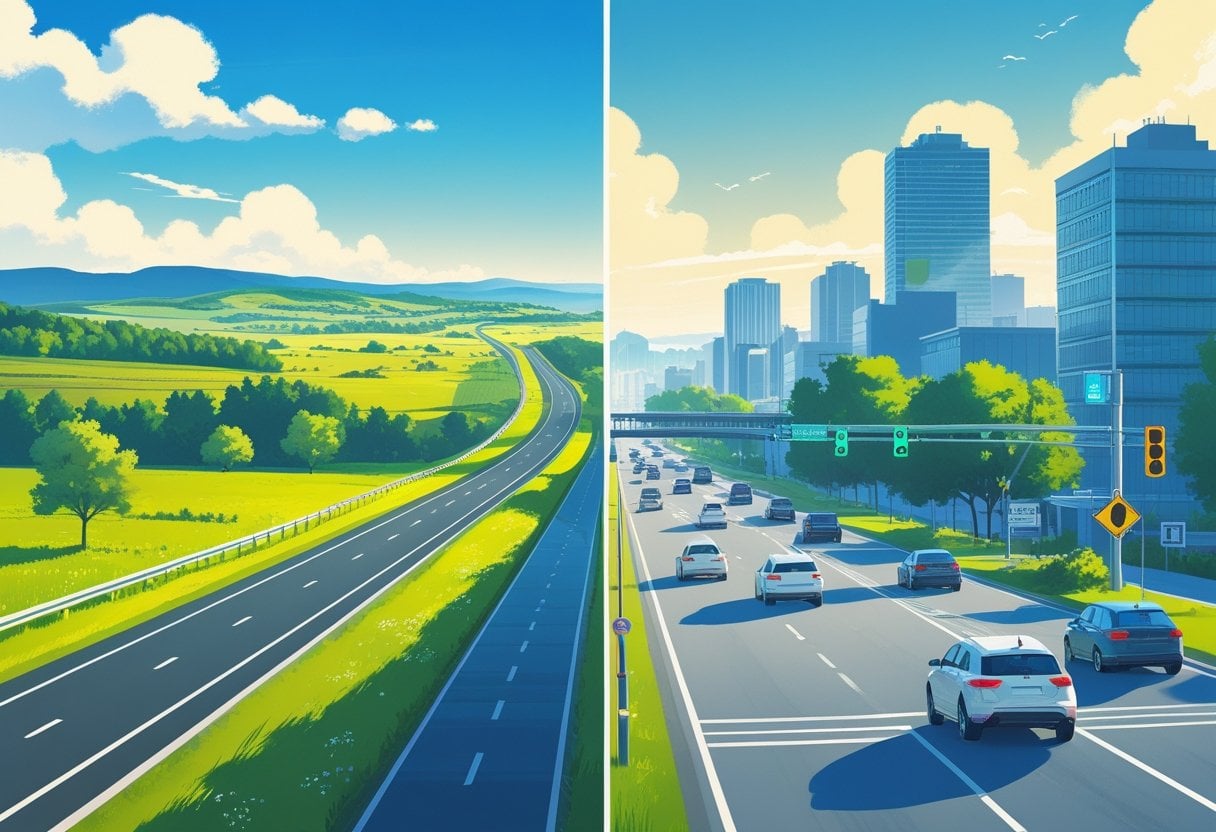
Rural driving takes place on quieter country roads with less traffic but presents unique challenges like wildlife and narrow lanes. Urban driving happens in busy city centres with heavy traffic, pedestrians, and cyclists competing for road space.
Key Features of Rural Roads
Rural roads often feel peaceful, but they’re packed with surprises we don’t encounter in cities. These roads are typically narrower than urban streets, sometimes barely wide enough for two cars to pass comfortably.
Road conditions vary dramatically on country routes. We might find ourselves driving on well-maintained tarmac one minute, then hitting gravel patches or potholes the next. Many rural roads lack proper lane markings or have faded lines that are hard to see.
Speed limits tend to be higher on rural roads, often reaching 60 mph on single carriageways. However, the actual safe driving speed can be much lower due to:
- Sharp, blind bends
- Steep hills that limit visibility
- Overhanging branches or hedgerows
- Farm vehicles moving slowly
Wildlife encounters are common, especially at dawn and dusk. Deer, rabbits, and farm animals can appear suddenly. We need to stay alert for movement in hedgerows or fields.
Limited lighting makes night driving particularly challenging. Street lamps are rare, so we rely entirely on our headlights to spot hazards ahead.
Defining Urban Driving Conditions
Urban driving throws us into a completely different world where everything moves faster and demands split-second decisions. City roads buzz with constant activity from multiple directions.
Traffic congestion defines much of urban driving. During rush hours, we’ll spend significant time in stop-and-go traffic, requiring patience and smooth clutch control for manual cars.
Multiple road users share the same space:
- Pedestrians cross at designated points and sometimes unexpectedly
- Cyclists use dedicated lanes or share the road with cars
- Buses stop frequently and pull out from bus stops
- Delivery vehicles double-park or block lanes
Complex junctions test our navigation skills. Roundabouts, traffic lights, and multi-lane intersections require us to process information quickly whilst following the correct lane markings.
Parking challenges add another layer of difficulty. We’ll need to master parallel parking, navigate tight car parks, and understand various parking restrictions and payment systems.
Lower speed limits (typically 20-30 mph in built-up areas) might seem easier, but the constant need for observation and quick reactions makes urban driving mentally demanding.
Comparing Typical Road Users
The people we encounter on roads changes dramatically between rural and urban environments, and understanding these differences helps us prepare for what lies ahead.
Rural road users include:
- Farm vehicles like tractors and combine harvesters that move slowly and are difficult to overtake safely
- Horse riders who need extra space and consideration
- Ramblers walking along narrow roads without pavements
- Occasional cyclists on leisure rides or commuting between villages
Urban road users create a busier, more complex mix:
- Commuting cyclists who know their routes well and move confidently through traffic
- Pedestrians of all ages, including children near schools and elderly people who may move slowly
- Public transport including buses, trams, and taxis that stop frequently
- Delivery drivers making quick stops for collections and drop-offs
Interaction patterns differ significantly. In rural areas, we might not see another vehicle for miles, then suddenly meet a tractor around a blind corner. Urban areas demand constant awareness of multiple road users moving in different directions at various speeds.
Communication between road users varies too. Rural drivers often acknowledge each other with a friendly wave, whilst urban driving requires clear indicator signals and positioning to communicate intentions in heavy traffic.
Starting Out: Which Setting Builds Stronger Foundation Skills?
Rural and urban environments each offer unique advantages for developing core driving abilities. Rural areas typically provide gentler conditions for mastering vehicle basics, while urban settings accelerate awareness skills through constant stimulation.
Developing Basic Vehicle Control
Rural roads create the perfect classroom for fundamental driving mechanics. The wider lanes and forgiving surfaces give you breathing room to focus on coordination without panic.
We’ve found that new drivers master clutch control and steering smoothness much faster on quiet country lanes. There’s no pressure from impatient traffic behind you. You can take your time finding the biting point or perfecting your three-point turns.
Speed limits in rural areas often start at 30mph, building gradually to national speed limits. This natural progression helps you develop confidence with acceleration and braking. You’re not thrown straight into 20mph zones with cyclists and pedestrians everywhere.
Road conditions vary beautifully in the countryside. You’ll encounter:
- Narrow lanes that teach precise positioning
- Hills for clutch control practice
- Sharp bends that develop smooth steering
- Gravel surfaces for gentle braking technique
The margin for error feels more generous. If you drift slightly wide on a country bend, you might brush some grass. In town, that same mistake could mean mounting a kerb or clipping a parked car.
Rural driving builds muscle memory without overwhelming your brain. You can focus purely on the mechanics of driving rather than processing dozens of hazards simultaneously.
Confidence Building for New Learners
Nothing beats the psychological comfort of learning on quiet roads. Urban environments can feel intimidating when you’re already nervous about basic vehicle control.
We see dramatic confidence improvements when nervous learners start in rural settings. The reduced traffic density means fewer critical decisions every minute. You have time to think, process, and react calmly.
Awareness develops naturally in the countryside. You learn to spot hazards like tractors emerging from field entrances or horses around blind corners. These skills transfer brilliantly to urban driving later.
Speed limits feel more manageable too. Cruising at 40mph on an empty B-road builds confidence with higher speeds. When you later tackle 30mph urban roads, they feel controlled rather than frantic.
Rural mistakes rarely have serious consequences. Stalling at traffic lights creates queue pressure and horn-happy drivers. Stalling on a quiet lane? You simply restart and continue learning.
The psychological benefits compound quickly. Each successful journey builds belief in your abilities. By the time you tackle busy roundabouts or school-run traffic, you’ve already mastered the fundamentals that matter most.
Advantages of Learning to Drive in Urban Areas
Urban driving teaches you crucial skills that build confidence and create well-rounded drivers. You’ll master complex traffic situations, learn to read road signals quickly, and develop the precise control needed for tight spaces.
Navigating Heavy Traffic
Learning in busy urban traffic might feel overwhelming at first, but it’s one of the best ways to build your driving confidence. Cities challenge you with constant decision-making that sharpens your instincts.
Traffic flow awareness becomes second nature when you’re surrounded by other vehicles. You’ll learn to anticipate lane changes, spot gaps in traffic, and time your movements perfectly.
Multi-lane roads teach you proper positioning and safe lane switching. Dual carriageways and ring roads give you experience with faster-moving traffic whilst still having escape routes nearby.
Rush hour practice prepares you for real-world driving conditions. Stop-and-go traffic teaches clutch control in manual cars and helps you maintain safe following distances.
Bus and lorry interactions are unavoidable in cities. You’ll quickly learn how to share the road with larger vehicles, understanding their blind spots and longer stopping distances.
The constant variety keeps you alert. One moment you’re creeping through a traffic jam, the next you’re accelerating onto a slip road. This builds adaptability that serves you well everywhere.
Mastering Intersections and Traffic Signals
Urban areas are packed with complex junctions that test your observation skills and decision-making abilities. These challenging spots become excellent learning opportunities.
Traffic light sequences vary greatly between different intersections. Some have filter arrows, others use box junctions, and many include pedestrian crossings that affect your timing.
Right-of-way rules become crystal clear when you practice at busy roundabouts and T-junctions. You’ll learn to read other drivers’ intentions and make confident decisions about when to proceed.
Pedestrian interactions happen constantly in urban driving. School zones, shopping areas, and bus stops teach you to scan for people who might step into the road unexpectedly.
Cyclists share many urban roads, especially during morning and evening commutes. You’ll develop the awareness needed to check mirrors thoroughly and leave proper clearance when overtaking.
Multiple signal types appear throughout cities. From traditional traffic lights to electronic signs and road markings, urban practice exposes you to every signal you’ll encounter.
Complex intersections with multiple lanes and turning options build your spatial awareness and planning skills better than any other environment.
Precision Parking and Manoeuvring
Urban parking challenges push your vehicle control skills to new levels. The tight spaces and awkward angles you’ll encounter build confidence for any parking situation.
Parallel parking between two cars becomes routine practice rather than a dreaded test manoeuvre. Narrow residential streets offer countless opportunities to perfect this essential skill.
Car park navigation teaches you to judge spaces accurately and manoeuvre in confined areas. Multi-storey car parks with tight corners and low ceilings demand precise steering control.
Bay parking in busy shopping centres tests your ability to reverse accurately whilst watching for pedestrians and trolleys. These real-world distractions improve your multitasking abilities.
Hill starts are common in hilly cities and urban areas with steep residential streets. Regular practice prevents stalling and builds confidence with clutch control on inclines.
Narrow roads force you to judge passing spaces accurately. You’ll learn when to wait, when to squeeze through, and how to use door mirrors effectively in tight spots.
These precision skills transfer directly to your driving test and give you confidence to park anywhere, whether it’s a tiny village car park or a busy motorway service station.
Benefits of Beginning in Rural Areas
Starting your driving journey in rural areas gives you a solid foundation in speed management and hazard awareness. You’ll master essential skills like judging safe overtaking distances and handling unexpected obstacles before facing the complexity of city traffic.
Adapting to Varying Road Types
Rural roads offer an incredible variety of surfaces and conditions that make you a more versatile driver. We see learners develop excellent car control when they practice on unsealed roads, gravel surfaces, and narrow country lanes with grass growing down the middle.
Different road surfaces teach unique skills:
- Sealed country roads help with smooth acceleration
- Gravel tracks improve steering precision
- Narrow lanes develop spatial awareness
Speed limits change frequently on rural routes. You might encounter 60mph zones that suddenly drop to 30mph through small villages. This constant variation teaches you to scan ahead for warning signs and adjust your speed smoothly.
Bends are everywhere in the countryside. Sharp corners hidden behind hedgerows or over hill crests teach you proper cornering technique. You learn to position your car correctly and judge safe entry speeds naturally.
Rural roads often have no white lines down the centre. This forces you to judge road width and oncoming traffic distance without painted guidance. It’s a skill that makes urban driving feel much easier later.
Overtaking and Handling High Speeds
Country roads are perfect for learning safe overtaking techniques. Single carriageways with occasional straight sections give you controlled opportunities to practice this essential skill.
We recommend starting with slow-moving farm vehicles. Tractors and combine harvesters travel at 15-25mph, creating obvious overtaking opportunities. You learn to judge closing speeds and available road space without pressure.
Key overtaking skills you develop:
- Checking mirrors systematically
- Positioning for best visibility
- Judging acceleration needed
- Recognising when to abort
Higher speed limits on rural roads (60mph compared to 30mph in towns) teach you motorway preparation skills. You experience how cars handle differently at speed and learn smooth acceleration techniques.
Long straight sections help you practice maintaining steady speeds. This builds confidence for dual carriageways and motorways later in your training.
Farm vehicles teach patience too. Sometimes you can’t overtake safely for miles. This develops good following distances and reduces road rage tendencies that plague many urban drivers.
Reacting to Unexpected Hazards
Rural driving throws genuine surprises at you that no driving simulator can replicate. Wild animals, fallen branches, and sudden weather changes create real-world hazard perception skills.
Common rural hazards include:
- Sheep or cattle on roads
- Pheasants flying across your path
- Mud from farm vehicles
- Potholes after heavy rain
You learn to scan the road surface constantly. Potholes can appear anywhere, especially after winter weather. This attention to road conditions becomes second nature.
Farm gates often open directly onto roads without warning signs. You develop the habit of checking field entrances and slowing when you spot agricultural activity nearby.
Weather affects rural roads more dramatically than urban streets. Morning frost lingers longer under trees, and rain creates instant puddles in low spots. These conditions teach you to adjust driving style based on environmental factors.
The lack of street lighting means night driving skills develop naturally. You learn proper headlight use and how to judge distances in darkness, skills that urban learners often struggle with initially.
Weather and Road Conditions: Challenges for New Drivers
Different weather conditions create unique driving challenges that affect visibility, road grip, and vehicle control. Rain and ice reduce traction dramatically, whilst fog and snow present serious visibility issues that require specific driving techniques.
Coping with Rain and Ice
Wet roads become surprisingly slippery, especially during the first few minutes of rainfall when water mixes with oil and dust. We recommend reducing your speed by at least 10-15 mph below normal conditions.
Essential rain driving techniques:
- Increase following distance to at least 4 seconds
- Test your brakes gently to check grip
- Avoid sudden steering movements
- Use dipped headlights even during daylight
Ice presents far greater dangers. Black ice appears invisible on the road surface but turns your car into a skating rink. Morning frost often lingers in shaded areas long after sunny spots have cleared.
When driving on icy roads, we suggest pulling away in second gear to reduce wheel spin. Keep movements smooth and deliberate. If you start to skid, ease off the accelerator and steer gently in the direction you want to go.
Ice warning signs to watch for:
- Temperature gauge showing near freezing
- Wet-looking patches on dry roads
- Steam rising from the road surface
Dealing with Fog and Snow
Fog cuts visibility dramatically and plays tricks with distance perception. We’ve seen confident drivers become completely disoriented in thick fog within minutes.
Use fog lights only when visibility drops below 100 metres. Keep your windscreen clear and avoid using full beam headlights, which create dangerous glare. Listen carefully for other vehicles and use familiar landmarks to navigate.
If you would rather pass in one focused block than stretch lessons over many months, the Gold 35 intensive course takes you from your first lesson through to test day.
Fog driving essentials:
- Slow down significantly
- Use wipers and demisters constantly
- Leave extra stopping distance
- Consider delaying your journey
Snow transforms familiar roads into challenging terrain. Fresh snow provides better grip than compacted snow, which becomes dangerously smooth. We always recommend carrying warm clothes, water, and a torch during snowy conditions.
Clear all snow from your vehicle before driving, including the roof and lights. Use gentle acceleration and allow extra time for braking. In heavy snow, following other vehicles’ tyre tracks often provides better grip than driving on untouched snow.
Staying Safe: Accident Risks and Awareness
Rural roads account for more than half of all fatal crashes in Britain, whilst collisions on these quieter routes are four times more likely to result in death. Understanding what causes accidents and developing sharp hazard awareness skills can dramatically improve your safety, whether you’re learning in the countryside or city.
Common Causes of Accidents
Rural road accidents often stem from unique hazards that catch drivers off guard. Blind bends and steep hills create visibility problems that don’t exist in urban areas.
Farm vehicles pose particular risks during summer months. Between May and September, collisions involving agricultural machinery jump to 423 per month compared to just 249 in winter months.
Poor road surfaces contribute significantly to accidents. Many country lanes lack proper barriers or hard shoulders. Loose gravel, mud, and debris make roads slippery, especially when wet.
Speed-related incidents happen frequently because drivers treat speed limits as targets rather than maximums. The mix of long straight sections and sudden sharp corners catches many people out.
Animals crossing roads create unexpected obstacles. Horses, livestock, and wildlife can appear suddenly, giving drivers little time to react safely.
Improving Hazard Awareness
Spotting warning signs early gives you precious extra seconds to respond. Manure on the road signals horses nearby, whilst mud tracks suggest farm vehicles ahead.
We recommend developing a systematic scanning technique. Check your mirrors every 8-10 seconds and constantly scan the road ahead for movement or unusual shapes.
Weather awareness becomes crucial on rural routes. Wet leaves create ice-like conditions, whilst morning fog lingers longer in valleys and dips.
Practice identifying vulnerable road users from a distance. Cyclists need at least 1.5 metres of space, whilst horse riders require you to slow to 10mph and leave 2 metres clearance.
Agricultural machinery has massive blind spots that extend several metres around the vehicle. Never assume the operator can see you, even when you feel obviously visible.
Building a Balanced Learning Experience
The key to becoming a confident driver lies in combining skills from both environments effectively. Strategic planning helps you develop the right abilities at the right pace.
Skill Transfers Between Environments
Urban driving skills translate beautifully to rural situations once you understand the connections. Those careful observation habits you develop watching for pedestrians at busy intersections become incredibly valuable when scanning for wildlife on country lanes.
The precision you gain manoeuvring through tight city car parks transforms into better vehicle control on narrow rural bridges. Traffic signals teach you timing and anticipation skills that prove essential when judging gaps for overtaking on single-carriageway roads.
Rural driving builds skills that make urban situations feel more manageable. The hazard awareness you develop spotting animals or loose gravel surfaces sharpens your ability to notice cyclists or opening car doors in town centres.
Highway speed management teaches you smooth acceleration and braking that reduces stress in stop-start city traffic. The patience required for long rural journeys helps you stay calm during urban rush hour delays.
Planning Your Learning Route
We recommend starting with quiet urban streets to master basic controls before progressing to busy intersections and complex junctions. This builds confidence with fundamental skills like steering, gear changes, and parking.
Move to rural roads once you’re comfortable with vehicle handling. Begin with wider country lanes during daylight hours before tackling narrower roads or night driving.
Plan practice sessions that include transitions between environments. Drive from suburban areas to country roads and back again. This helps you adapt quickly to changing conditions and speed limits.
Schedule regular sessions in both settings throughout your learning journey rather than completing one environment entirely before starting another.
Frequently Asked Questions
New drivers often wonder about the best environment to start their learning journey. These questions address the benefits of rural versus urban training, confidence building strategies, and the practical considerations that can help shape your driving education path.
What are the advantages of learning to drive in a rural setting?
Rural areas give you breathing room when you’re just getting started. The roads are typically quieter, which means you can focus on mastering basic car control without worrying about heavy traffic or impatient drivers behind you.
Country roads help you develop a smooth driving style. You’ll learn to handle gentle curves, changes in road surface, and varying speed limits without the pressure of city congestion.
The slower pace lets you build confidence gradually. We find that learners who start in rural areas often feel more relaxed during their early lessons, which helps them absorb new skills more effectively.
You’ll also encounter unique challenges like farm vehicles, cyclists, and narrow lanes. These experiences teach you patience and careful observation skills that serve you well throughout your driving career.
How can city driving improve my skills as a beginner?
Urban environments throw multiple challenges at you simultaneously, which sharpens your decision-making abilities quickly. You’ll learn to process information from pedestrians, traffic lights, road signs, and other vehicles all at once.
City driving teaches you to be assertive when necessary. Merging into busy roundabouts or navigating complex junctions requires confidence and clear communication with other road users.
You’ll become comfortable with stop-start traffic patterns early on. This experience helps you develop smooth clutch control and better anticipation of traffic flow changes.
Urban lessons also expose you to diverse road users including buses, motorcycles, and delivery vehicles. Each type of vehicle behaves differently, and early exposure helps you read the road more effectively.
What should I consider when choosing between urban or country driving lessons?
Think about where you’ll be doing most of your driving once you pass your test. If you live in a city and plan to drive there regularly, starting with urban lessons makes practical sense.
Consider your personality and stress tolerance. Some learners thrive on the challenge of busy roads, whilst others need a gentler introduction to build their confidence first.
Look at your local test centre requirements too. If your driving test will include city centre driving, you’ll need urban experience before your test day arrives.
Budget can also play a role. Rural instructors might need to travel further to reach varied road types, which could affect lesson costs or structure.
Can starting off in quieter areas boost my driving confidence?
Absolutely, and confidence is crucial for safe driving. When you’re not worried about heavy traffic, you can concentrate fully on coordination between the clutch, accelerator, and steering.
Quieter roads let you make mistakes without feeling embarrassed or pressured. This psychological comfort helps many learners progress faster in their early stages.
You’ll have more time to think through each decision. Rural roads often give you extra seconds to process what’s happening ahead, which builds good observation habits.
The reduced stress means you’re more likely to remember what you’ve learned. When your mind isn’t overwhelmed, the muscle memory for car control develops more naturally.
How does the complexity of urban driving affect new learners?
City driving can feel overwhelming at first because there’s so much happening simultaneously. Multiple lanes, pedestrian crossings, and constant traffic signals create a lot of information to process.
Some learners find the pressure motivating and rise to the challenge quickly. Others might feel anxious, which can actually slow down their learning progress.
Urban complexity does accelerate skill development once you adjust to it. The variety of situations you encounter means you’ll gain experience with different scenarios faster.
However, if you’re feeling stressed during lessons, you might not retain information as well. We recommend discussing your comfort level with your instructor to find the right balance.
Is there a recommended sequence for tackling different driving environments?
Many instructors prefer starting with quieter suburban roads before moving to busier areas. This approach lets you master basic controls without external pressure.
A typical progression might involve car parks, quiet residential streets, then busier local roads before tackling city centres or dual carriageways.
However, there’s no universal rule that works for everyone. Some confident learners benefit from diving into challenging environments early, whilst others need more gradual exposure.
Your instructor should assess your individual needs and adapt the learning sequence accordingly. The key is building skills systematically whilst maintaining your confidence and enthusiasm for driving.
Getting this right with an instructor beside you
Car control comes from repetition with someone watching and correcting you, which is hard to replicate from an article.
LPOD Academy intensive courses run from 10 to 50 hours with the same instructor throughout, covering around 95% of England, Wales and Scotland.
If you are not sure how many hours you need, the recommendation tool asks a few questions and suggests a package.
Ready to pass in weeks, not months?
LPOD Academy runs tailored intensive driving courses from 10 to 50 hours across most of the UK, with your theory and practical test support included.
Compare intensive driving courses Get a course recommendationReady to Book Driving Lessons?
LPOD Academy offers intensive driving courses across the UK. Find your nearest location: