

Published 6 November 2025, updated 14 August 2026
Navigating Dual Carriageways in the Test: Confident Driving Skills for Success
Many learners feel their heart rate spike when they hear their driving test will include dual carriageways. These faster roads can seem intimidating, with traffic moving at 70 mph and multiple lanes to navigate. Yet dual carriageways appear on most UK driving test routes, making them an unavoidable part of your journey to becoming a licensed driver.
Dual carriageways feel far less daunting with the right practice, and you can tackle faster roads with an intensive driving course that builds your confidence at speed step by step.
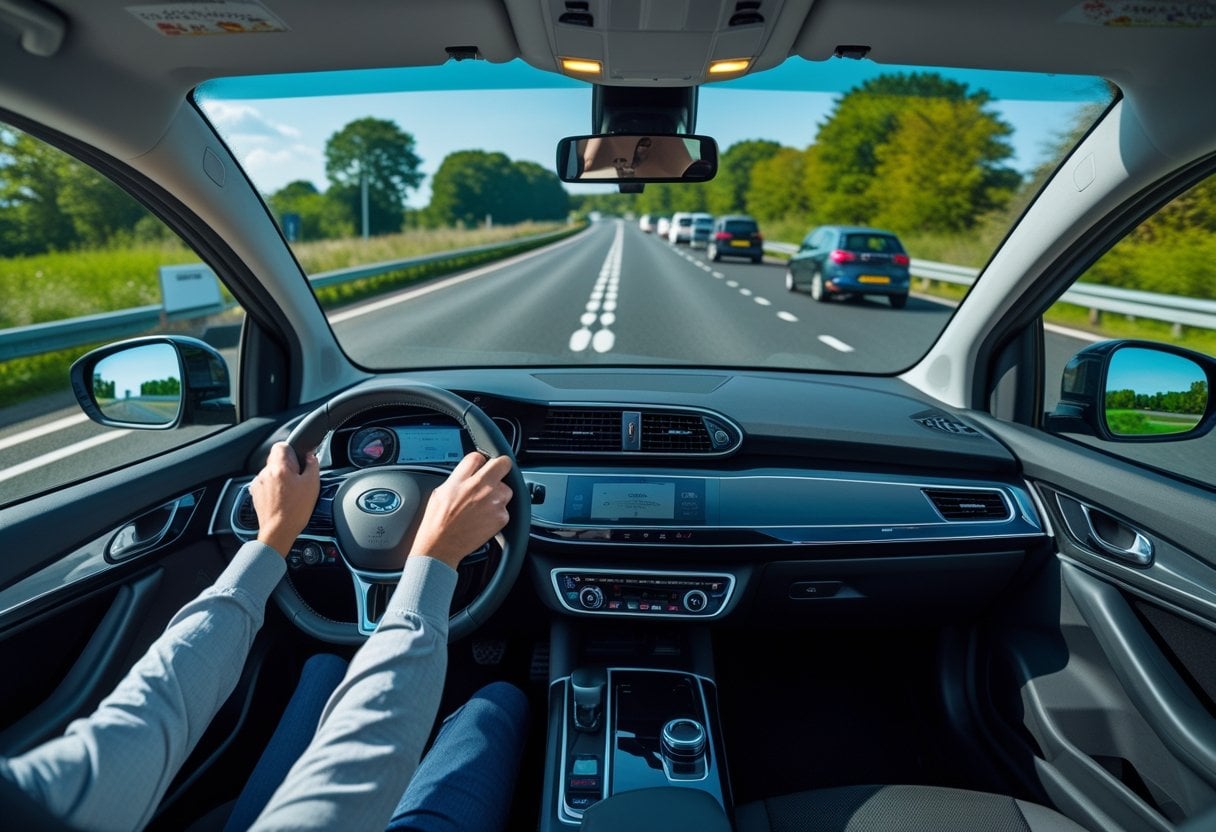
The good news? Dual carriageways are actually designed to be safer than many other road types, with clear lane markings, generous space between opposing traffic, and predictable traffic flow patterns. Once you understand the fundamentals of joining, driving, and exiting these roads, you’ll discover they’re often less stressful than navigating busy town centres or narrow country lanes.
We’ll walk you through everything you need to know about tackling dual carriageways during your driving test. From mastering safe entry techniques and understanding when to overtake, to planning your exit strategy and building genuine confidence behind the wheel, you’ll have all the tools needed to handle these roads like a seasoned driver.
What to Expect on Dual Carriageways During Your Driving Test
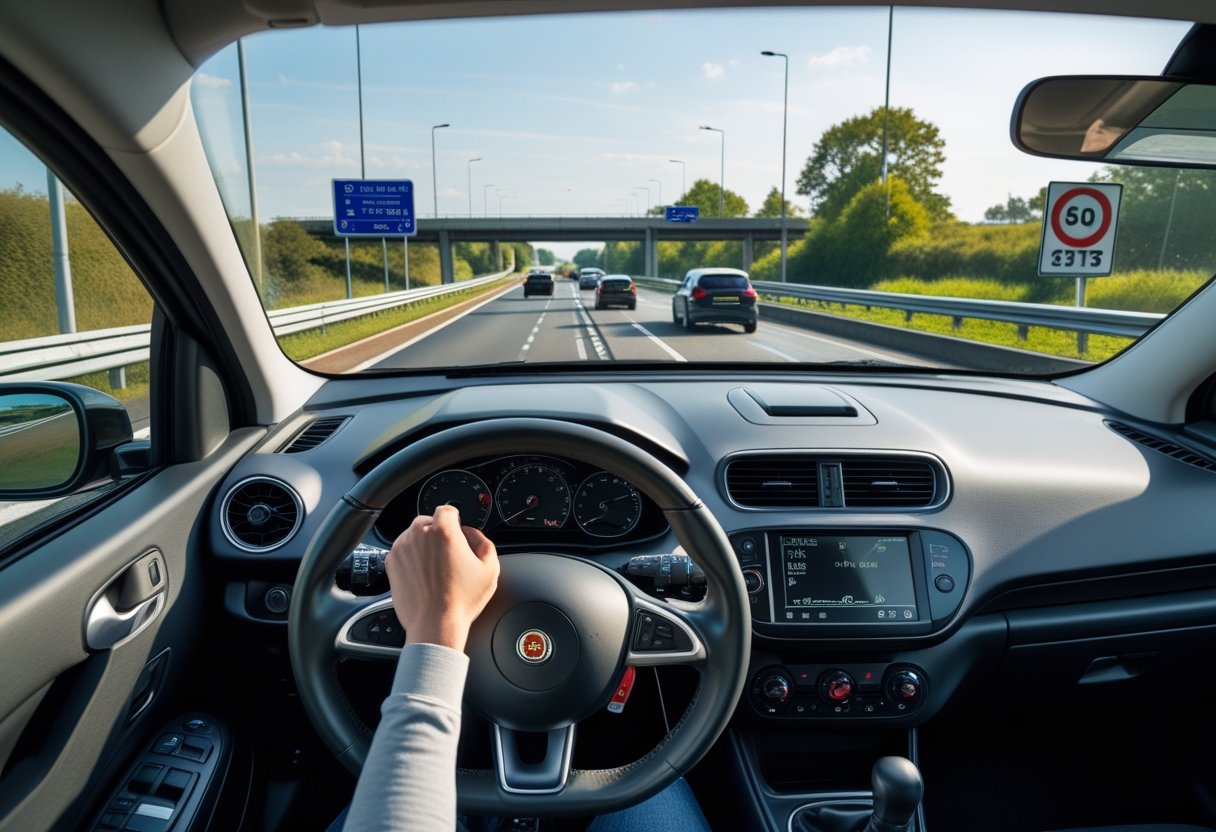
Most UK driving tests include dual carriageway sections where examiners assess your ability to handle higher speeds and merge safely with traffic. You’ll need to demonstrate proper lane discipline, confident overtaking decisions, and smooth speed control whilst managing any nerves that naturally arise.
How Dual Carriageways Fit Into the Driving Test
Many test centres position themselves near dual carriageways, making these roads a standard part of most driving assessments. Your examiner wants to see how you handle the jump from 30mph town driving to 70mph dual carriageway speeds.
The test typically includes joining via slip roads, maintaining proper lane position, and exiting safely. We often see learners practising these manoeuvres extensively because they represent such a significant part of the assessment.
Key areas the examiner evaluates:
- Safe merging and gap judgement when joining
- Staying in the left lane unless overtaking
- Appropriate speed control for conditions
- Smooth lane changes with proper observations
- Confident but cautious overtaking decisions
You won’t necessarily need to overtake during your test. If traffic conditions don’t require it, simply maintaining good lane discipline and speed control will satisfy the examiner’s requirements.
The dual carriageway section usually lasts 5-10 minutes of your 40-minute test. This gives you enough time to demonstrate competence without feeling rushed or pressured.
Common Nerves and Building Your Confidence
Most learner drivers feel their heart rate spike when approaching dual carriageways during tests. The combination of higher speeds, multiple lanes, and test pressure creates a perfect storm of anxiety.
We’ve found that understanding what causes these nerves helps manage them effectively. Speed anxiety tops the list, followed by worries about lane changing and merging with faster traffic.
Common concerns include:
- Feeling overwhelmed by traffic speed
- Worrying about holding up other drivers
- Fear of making wrong lane choices
- Anxiety about overtaking decisions
Building confidence starts with recognising that you’ve already practised these skills extensively. Your driving instructor wouldn’t have entered you for the test without believing in your abilities.
Remember that other drivers expect to see learner plates and generally give you space accordingly. Most experienced drivers remember their own learning journey and show patience with new drivers.
Focus on the fundamentals you’ve practised. Keep left unless overtaking, maintain safe following distances, and use your mirrors regularly. These basics will see you through successfully.
Role of the Examiner and Test Routes
Your examiner remains supportive and encouraging throughout the dual carriageway section, just as they do on quieter roads. They understand that higher speeds can feel intimidating and won’t penalise you for being cautious.
The examiner provides clear, early instructions for dual carriageway manoeuvres. They’ll tell you well in advance about upcoming exits or lane changes, giving you plenty of time to prepare and position correctly.
Test routes vary by centre, but most include predictable dual carriageway sections that local instructors know well. Your driving instructor will have practised these exact routes with you multiple times before your test.
What examiners look for:
- Smooth acceleration when joining
- Proper use of mirrors and signals
- Maintaining appropriate following distances
- Calm, controlled driving at higher speeds
- Safe positioning for exits and turns
Examiners won’t ask you to make dangerous overtakes or risky manoeuvres. If traffic conditions make something unsafe, they’ll adapt the route or instructions accordingly.
The key is demonstrating that you can drive safely and confidently at dual carriageway speeds. Show good judgement, stay alert, and trust in the skills you’ve developed during your lessons.
Understanding Dual Carriageways: The Essentials
A dual carriageway has a physical barrier separating opposing traffic flows, which creates unique driving challenges. We’ll explore what defines these roads, the various junction types you’ll encounter, and how they differ from motorways in practical ways.
What Makes a Road a Dual Carriageway?
The key feature that transforms an ordinary road into a dual carriageway is the central reservation. This physical barrier sits between lanes of traffic moving in opposite directions.
Most central reservations are grass verges. Some include crash barriers for extra protection. The width varies significantly between different roads.
Essential characteristics include:
- Physical separation between opposing traffic
- Speed limit of 70 mph (unless signs state otherwise)
- Usually two or more lanes in each direction
- White road markings similar to motorways
Traffic flow operates differently here compared to single carriageways. Each direction has its own lanes, creating smoother movement at higher speeds.
Some dual carriageways might look identical to motorways. The main difference lies in junction design and access rules, which we’ll cover shortly.
Types of Dual Carriageway Junctions
Unlike motorways, dual carriageways feature various junction types that require different approaches. Right turns are permitted, which creates additional complexity.
Standard junction types include:
- Traffic light controlled crossings
- Roundabouts
- T-junctions with give way markings
- Slip roads (similar to motorway entries)
Right turns present the biggest challenge. You’ll need to cross the central reservation when turning right onto or off the dual carriageway.
Some central reservations are wide enough to wait safely in the middle. Others are too narrow, requiring you to treat both carriageways as one continuous crossing.
Traffic lights often control busy junctions. These work exactly like normal traffic lights but remember that traffic approaches much faster than on regular roads.
Comparing Dual Carriageways and Motorways
Many learners confuse dual carriageways with motorways, but several important differences exist that affect your driving approach.
Key differences:
| Feature | Dual Carriageway | Motorway |
|---|---|---|
| Right turns | Permitted | Prohibited |
| Traffic lights | Common | Never present |
| Pedestrians | Sometimes allowed | Always prohibited |
| Cyclists | Usually permitted | Always prohibited |
| Learner drivers | Allowed | Allowed (since 2018) |
Junction types vary dramatically. Motorways only use slip roads and service areas. Dual carriageways include roundabouts, traffic lights, and standard T-junctions.
Speed limits match at 70 mph for cars. However, dual carriageways often have lower limits through built-up areas or dangerous sections.
The hard shoulder isn’t guaranteed on dual carriageways. Many have grass verges or barriers right next to the left lane instead.
Mastering Entry: Joining Dual Carriageways Safely and Smoothly
Getting onto a dual carriageway smoothly requires building up speed on the slip road whilst watching for gaps in traffic. The secret lies in using the full length of the acceleration lane to match traffic speed before merging confidently into position.
Using Slip Roads for Acceleration
Think of slip roads as your runway for takeoff. These dedicated lanes give you precious time and space to build up speed before joining faster-moving traffic.
Start accelerating as soon as you enter the slip road. Don’t wait until the last moment to pick up speed. Your car needs time to reach dual carriageway speeds, especially if you’re driving a smaller engine.
Keep your foot down steadily as you progress along the slip road. We’re aiming to reach around 50-60 mph by the time we’re ready to merge, depending on traffic conditions.
Use the entire length of the slip road. Many learners make the mistake of trying to merge too early when they still have plenty of acceleration lane left. This creates unnecessary pressure and reduces your options.
Check your mirrors regularly whilst accelerating. You need to know what’s happening behind you on the slip road and what’s approaching in the left lane of the dual carriageway.
Signal early to show your intentions. Other drivers need to know you’re planning to join the main carriageway. This gives them time to adjust their position or speed if needed.
Matching the Speed of Traffic
Your goal is to slot into traffic seamlessly, like a missing puzzle piece clicking into place. This means matching the speed of vehicles in the left lane before you attempt to merge.
Look ahead to gauge traffic flow. If cars are moving at 65 mph, that’s your target speed. If traffic is slower due to congestion, adjust accordingly.
Don’t be the slowest or fastest vehicle trying to merge. Both extremes create dangerous situations for everyone involved.
Use your mirrors constantly during this phase. Check your interior mirror, then your left wing mirror to assess the gap you’re aiming for.
Perform a blind spot check before moving. Turn your head briefly to look over your left shoulder. Motorcycles and smaller cars can hide in these blind spots.
Time your merge for the safest gap. Don’t force your way into tiny spaces or wait so long that you run out of slip road. Look for a gap that gives you comfortable space front and back.
Dealing with Short Slip Roads
Some slip roads feel criminally short, giving you barely enough space to reach dual carriageway speeds. These require quick thinking and decisive action.
Act fast but stay calm. Short slip roads demand more aggressive acceleration than usual, but panic leads to poor decisions.
Get your speed up immediately. Floor the accelerator as soon as conditions allow. Your car’s engine can handle it, and you need every metre of available space.
Look for gaps earlier in the process. With limited slip road length, you can’t afford to be picky about the perfect gap. Sometimes a reasonable gap beats waiting for an ideal one.
Consider indicating before you even start accelerating. On very short slip roads, early signalling gives other drivers maximum warning about your intentions.
Be prepared to yield if no safe gap appears. It’s better to slow down or stop at the end of a slip road than force a dangerous merge. Traffic conditions change quickly, and a gap often opens up within seconds.
Practice makes these challenging merges feel more natural. Each time you successfully navigate a short slip road, your confidence grows for the next encounter.
Essential Skills for Dual Carriageway Driving
Mastering dual carriageways requires three core abilities that work together to keep you safe and confident. Good lane discipline means staying left unless overtaking, maintaining proper following distances gives you time to react at higher speeds, and understanding road signs helps you navigate complex junctions and speed changes.
Perfecting Lane Discipline and Positioning
Lane discipline forms the backbone of safe dual carriageway driving. We always start with a simple rule: keep left unless you’re overtaking. This isn’t just good manners, it’s essential for traffic flow and your safety.
The left lane is your home base. Think of it as where you naturally belong, especially when you’re still building confidence. Many learners worry they’ll hold up traffic, but that’s perfectly fine. Other drivers can overtake when they need to.
When you do need to overtake, signal early and check your mirrors carefully. Move out smoothly, pass the slower vehicle, then return to the left lane as soon as it’s safe. Don’t hang about in the right lane once you’ve finished overtaking.
Position yourself properly within your chosen lane. Stay centred between the white lines and avoid drifting. If you’re approaching slip roads or junctions, move slightly towards the centre of your lane to give joining traffic more space.
Watch out for lane hogging, which happens when drivers cruise in the right lane unnecessarily. If cars are overtaking you on the left, you’re probably in the wrong lane. Move back left when you can.
Maintaining a Safe Following Distance
The two-second rule becomes absolutely crucial at dual carriageway speeds. At 60mph, you’re covering 27 metres every second. That means even small gaps close frighteningly fast.
Pick a fixed point ahead like a bridge or sign. When the car in front passes it, start counting: “one thousand and one, one thousand and two.” You should reach that same point after you’ve finished counting.
Double this distance in wet conditions. Rain cuts your grip dramatically, and stopping distances increase by several car lengths. In heavy rain or fog, we recommend even larger gaps.
Tailgating becomes deadly at high speeds. If someone’s following too close behind you, don’t speed up to get away. Instead, increase your own following distance to the car ahead. This gives you more time to brake gradually rather than suddenly.
Heavy goods vehicles need special consideration. They create air turbulence that can push your car around, and they block your view of the road ahead. Stay well back and be patient when following lorries or buses.
Reading Road Signs and Road Markings
Road signs change rapidly on dual carriageways. We need to spot junction warnings, speed limit changes, and lane directions well in advance. At 70mph, you have less time to react than on slower roads.
Blue rectangular signs show you’re on a dual carriageway, whilst green signs indicate motorway-standard roads. Brown tourist signs help with navigation, but don’t let them distract you from more important warnings.
Lane markings tell you what’s coming up:
| Marking Type | What It Means |
|---|---|
| Solid white lines | No overtaking allowed |
| Broken white lines | Overtaking permitted when safe |
| Double white lines | No crossing the line nearest to you |
| Yellow lines at junctions | Keep the area clear |
Overhead gantries display variable speed limits and lane closures. These change based on traffic conditions, accidents, or roadworks. Always check these signs regularly as you drive.
Exit signs appear at one mile, half a mile, and 300 yards before junctions. Use these to plan your lane changes early rather than cutting across traffic at the last minute.
Overtaking with Confidence and Caution
Mastering overtaking on dual carriageways requires careful timing, thorough observation, and smooth execution. We’ll focus on reading traffic situations properly, performing essential safety checks, and completing the manoeuvre safely whilst maintaining control at higher speeds.
When and How to Overtake
Planning ahead makes all the difference when it comes to successful overtaking. We need to assess the road for at least 200 metres ahead, looking for slip roads, junctions, or slower traffic that might complicate our manoeuvre.
Check the speed difference between you and the vehicle you’re planning to pass. If they’re travelling at 50 mph and you’re doing 65 mph, you’ll need considerable space to complete the overtake safely.
Weather conditions change everything about timing. Rain reduces visibility and grip, whilst strong winds can affect your steering. In poor conditions, we recommend waiting for much larger gaps than you’d normally need.
Never rush into an overtake. If you’re not completely certain about the gap ahead, wait for a better opportunity. The right moment will come along within a few minutes, and patience keeps everyone safer.
Start building speed whilst still in the left lane if possible. This reduces the time you’ll spend in the right lane and makes the whole manoeuvre smoother and more predictable for other drivers.
Mirror Checks and Blind Spots
Check mirrors becomes absolutely critical before any lane change on dual carriageways. Start with your interior mirror to see the complete picture behind you, then check your right wing mirror for approaching traffic.
The two-second rule helps judge approaching speeds. Pick a reference point and count how long it takes vehicles to reach it. Cars moving much faster than expected need more time to slow down or change lanes.
Signal early to give other drivers plenty of warning. We recommend signalling at least three seconds before you plan to move out. This gives faster traffic time to react appropriately.
Blind spot checks catch what mirrors miss. Turn your head quickly to check over your right shoulder before moving. Motorcycles and smaller cars can hide in these spots, especially during busy periods.
Don’t forget to check again during the overtake. Traffic situations change rapidly at 70 mph speeds, so we need to stay aware of what’s happening around us throughout the entire manoeuvre.
Returning to the Left Lane Safely
Wait until you can see the complete vehicle you’ve just overtaken in your interior mirror before indicating left. This ensures you’re leaving adequate space for emergency braking if needed.
At dual carriageway speeds, stopping distances increase dramatically. What feels like a safe gap at 30 mph becomes dangerously close at 70 mph, so we need to adjust our judgement accordingly.
Signal your intention to return left well before you actually move. Other drivers need time to understand your plans, particularly anyone approaching from behind in the overtaking lane.
Move back gradually rather than making sharp steering inputs. Sudden movements can destabilise your car, especially if there are crosswinds or you’re driving a higher vehicle.
Cancel your indicator once you’ve completed the lane change. It sounds obvious, but concentration on other aspects of the manoeuvre can make us forget this simple step.
Never cut back in too early, even if you feel pressure from faster traffic behind. Complete your overtake safely and return to the left when you’ve got proper clearance.
Exiting Dual Carriageways: Planning Your Departure
Successful dual carriageway exits require early planning and smooth execution. We need to spot deceleration lanes well ahead, signal our intentions clearly, and manage our speed whilst being mindful of surrounding traffic.
Spotting and Using Deceleration Lanes
Early recognition is crucial when approaching our exit. We should start scanning for exit signs at least half a mile before we need to leave the dual carriageway.
Look for the distinctive white chevron markings that separate the deceleration lane from the main carriageway. These lanes give us space to slow down safely without affecting traffic behind us.
Once we’ve identified our exit, we need to position ourselves in the left lane well before reaching the deceleration lane. Don’t leave this until the last moment.
Move into the deceleration lane smoothly rather than cutting across at sharp angles. We want other drivers to predict our movements easily.
Use the full length of the deceleration lane to reduce speed gradually. These lanes are designed specifically for this purpose, so we shouldn’t feel pressured to slow down on the main carriageway.
Remember that different exits have varying layouts. Some have longer deceleration lanes than others, so we need to adjust our approach accordingly.
Signalling and Speed Reduction
Signal left early but not too early that we confuse other road users. The ideal timing is just before we begin moving into the deceleration lane.
We should maintain our dual carriageway speed until we’re fully in the deceleration lane. Slowing down whilst still on the main carriageway can cause dangerous situations for following traffic.
Check mirrors frequently during this process. Other drivers might not expect our speed reduction, so we need to monitor what’s happening behind us.
Reduce speed progressively once we’re in the deceleration lane. The exit road ahead will likely have much lower speed limits than the dual carriageway.
Brake gently and steadily rather than harsh, sudden applications. This gives following vehicles time to react and creates smoother traffic flow.
Keep our signal on throughout the exit process. Cancel it only when we’ve completed the manoeuvre and are safely on the exit road.
Navigating Exits with Other Traffic
Multiple vehicles often use the same exit simultaneously. We need to maintain safe following distances even whilst exiting.
Watch for vehicles joining the deceleration lane from behind us. They might be travelling faster initially, so we should check our mirrors before any speed changes.
Some exits serve busy areas and can become congested. If traffic is backing up from the exit road onto the deceleration lane, we need to adjust our approach speed accordingly.
Be patient if other vehicles are exiting slowly ahead of us. Tailgating in deceleration lanes is particularly dangerous because of varying speeds.
Watch for vehicles that might change their minds about exiting. Occasionally, drivers realise they’re taking the wrong exit and attempt to return to the main carriageway.
Heavy goods vehicles need extra space when exiting. Give lorries and coaches plenty of room, as they require longer distances to slow down safely.
Frequently Asked Questions
Learning to drive on dual carriageways brings up plenty of questions, from mastering slip road entries to understanding speed limits and overtaking safely. These common concerns often worry learner drivers the most during their test preparation.
What’s the best way to approach merging onto a dual carriageway from a slip road?
The key to smooth merging lies in building up speed whilst you’re still on the slip road. We need to match the speed of traffic already on the dual carriageway before we attempt to join.
Start accelerating early on the slip road. This gives you time to reach an appropriate speed without rushing or panicking.
Check your mirrors frequently as you approach the main carriageway. Look for gaps in traffic that are large enough for you to merge safely.
Don’t assume other drivers will move over to make space for you. Whilst many considerate drivers do this, we can’t rely on it happening every time.
Use the full length of the slip road if needed. There’s no shame in going all the way to the end if traffic is particularly heavy or fast-moving.
If you can’t find a safe gap, be prepared to stop at the end of the slip road. Wait for a suitable opportunity rather than forcing your way into traffic.
Signal early to show your intentions. This helps other drivers understand what you’re planning to do.
How can I confidently overtake slower vehicles on a dual carriageway while abiding by road safety rules?
Building overtaking confidence starts with thorough observation before you make any moves. Check your mirrors, signal clearly, and always perform a blind spot check by looking over your shoulder.
Plan your overtake well in advance. Look ahead for at least 200 metres to spot any potential hazards or changing traffic conditions.
Only overtake when you have a clear view of the road ahead. Never attempt to pass if you can’t see far enough to complete the manoeuvre safely.
Accelerate decisively once you’ve committed to the overtake. Hesitant movements create dangerous situations for everyone involved.
Give plenty of space to the vehicle you’re passing. Heavy goods vehicles can create air turbulence that affects your steering.
Wait until you can see the complete front of the overtaken vehicle in your rear-view mirror before moving back to the left lane. This ensures adequate stopping distance.
Don’t feel pressured by other drivers behind you. Complete your overtake safely rather than rushing because someone’s tailgating.
Could you shed some light on correctly using lanes on a dual carriageway, especially when I’m preparing to exit?
The left-hand lane should be your default position on any dual carriageway. Think of it as your home base where you spend most of your driving time.
Only use the right-hand lane for overtaking or when you need to turn right. Return to the left lane as soon as you’ve completed your manoeuvre.
When approaching your exit, position yourself in the left lane well in advance. Don’t leave lane changes until the last minute.
If you’re on a three-lane dual carriageway, use the left lane for normal driving, the middle for steady traffic flow, and the right primarily for overtaking.
Check overhead signs regularly for lane closure information or directions to specific destinations. These signs help you plan your positioning early.
Avoid lane hogging in the right-hand lane. If cars are overtaking you on the left, you’re probably in the wrong lane.
Signal early when you need to change lanes for your exit. Give other drivers plenty of warning about your intentions.
Could you offer some tips on maintaining a safe following distance on a dual carriageway?
The two-second rule works well in good conditions on dual carriageways. Pick a fixed point ahead and count the gap between the car in front passing it and you reaching the same spot.
Double your following distance in wet weather. Rain dramatically reduces your tyres’ grip on the road surface.
At 70mph, you need roughly 96 metres to stop in good conditions. That’s about 20 car lengths, so don’t underestimate the space required.
Increase your following distance if you’re driving behind large vehicles. Lorries and buses block your view of the road ahead and need more stopping distance themselves.
Don’t worry if other cars slip into the gap you’ve created. Simply drop back again to re-establish your safe following distance.
Watch the traffic several cars ahead, not just the vehicle immediately in front of you. This helps you anticipate changes in traffic flow.
Use your mirrors regularly to stay aware of what’s happening behind you. This helps you make better decisions about lane changes and speed adjustments.
What should I keep in mind about speed limits when driving on different types of dual carriageways?
Most dual carriageways have a 70mph speed limit for cars, but don’t assume this applies everywhere. Always check overhead gantries and roadside signs for current limits.
Urban dual carriageways often have reduced limits of 40mph or 50mph. These lower speeds account for more junctions and local traffic.
Temporary restrictions appear during roadworks or poor weather conditions. Electronic signs display these variable limits, and speed cameras often monitor compliance.
Remember that speed limits represent maximum speeds in ideal conditions. Rain, fog, or heavy traffic require you to slow down regardless of posted limits.
Different vehicles have different speed restrictions. Lorries and buses typically stick to 60mph maximum, whilst cars towing caravans face the same reduced limit.
Watch for school zones or residential areas alongside dual carriageways. These often have much lower limits during certain times of day.
What are the key things I need to know about navigating through dual carriageway roadworks safely?
Roadworks create narrow lanes and often reduce speed limits significantly. These temporary restrictions are usually well-signposted with advance warnings.
Merge in turn when lanes close ahead. Don’t try to push ahead at the last minute, as this creates dangerous situations and slows everyone down.
Increase your following distance in roadworks. The narrow lanes leave less margin for error, and stopping distances remain the same despite slower speeds.
Watch for workers and machinery near the carriageway. Contractors sometimes need to work close to live traffic lanes.
Contraflow systems can be particularly challenging. These direct traffic from both directions through one side of the carriageway using temporary barriers.
Keep your speed steady rather than constantly accelerating and braking. This helps maintain smooth traffic flow through the restricted sections.
Stay alert for changing conditions within the roadworks. Lane layouts, speed limits, and traffic management can vary along the length of major construction projects.
Practising the things examiners actually mark
Faults like this are usually fixed by concentrated practice rather than by more reading.
On an LPOD Academy intensive course you work with one instructor for 10 to 50 hours, so a weak area gets revisited the same week instead of a fortnight later.
Our learners pass first time 86% of the time, across a network of more than 500 instructors.
Compare intensive course packages · Find the right number of hours
Ready to pass in weeks, not months?
LPOD Academy runs tailored intensive driving courses from 10 to 50 hours across most of the UK, with your theory and practical test support included.
View our intensive course packages
Find the right course for you
Ready to Book Driving Lessons?
LPOD Academy offers intensive driving courses across the UK. Find your nearest location: