

Published 20 November 2025, updated 14 August 2026
Practising Slip‑Road Entries and Exits for Motorway Lessons: The Essential Guide
Learning to use slip roads properly is one of the biggest hurdles for UK motorway driving, yet it’s something every learner driver must master. These connecting lanes might look straightforward, but they require precise timing, speed judgement, and confidence that only comes with proper practice.
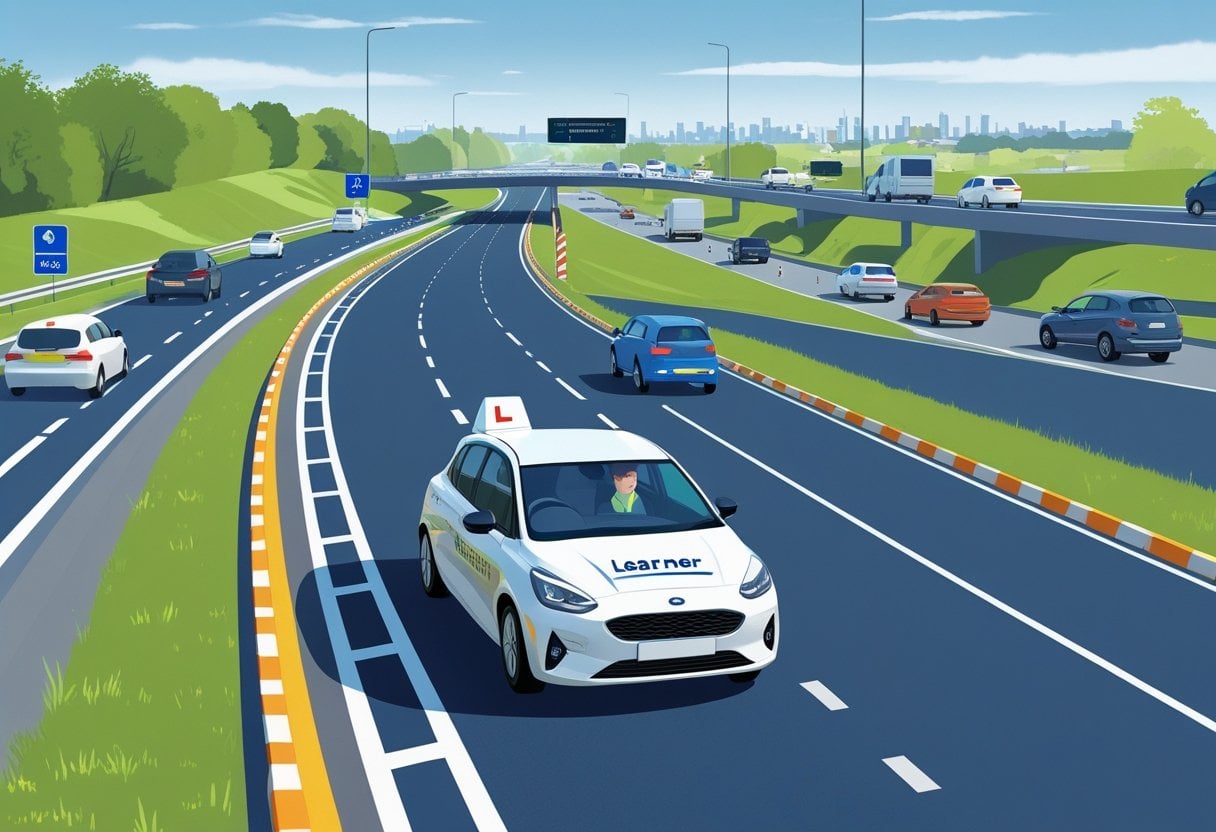
The key to successful motorway lessons lies in breaking down slip-road entries and exits into manageable steps, building your skills gradually until merging feels natural and safe. We’ve all felt that flutter of nerves when approaching a busy motorway for the first time, wondering how on earth we’ll find a gap in all that fast-moving traffic.
Merging feels natural surprisingly quickly with regular guided practice, and an intensive driving course with plenty of motorway time packs that into a short spell.
In this guide, we’ll walk you through everything from understanding how slip roads work to handling tricky situations with confidence. You’ll discover preparation techniques that set you up for success, learn the step-by-step process for smooth entries and exits, and pick up advanced tips that experienced drivers use every day. By the end, those intimidating motorway junctions will feel like just another part of your driving toolkit.
Understanding Slip Roads and Their Role in Motorway Driving

Slip roads serve as the vital connection points between local roads and high-speed motorways, allowing drivers to safely accelerate to match traffic speeds when joining or decelerate when leaving. These specially designed roadways feature specific characteristics that support smooth traffic flow across the UK’s motorway network.
What Is a Slip Road?
A slip road is a short section of roadway that connects regular roads to motorways and dual carriageways. We use these roads to either join or leave high-speed traffic safely.
Entry slip roads help us accelerate from slower local roads up to motorway speeds. These sections give us space to build up speed gradually before merging with fast-moving traffic.
Exit slip roads work the opposite way. They provide a dedicated area where we can slow down safely after leaving the main carriageway.
Most slip roads in the UK are designed to handle specific speed transitions. When joining a motorway, we typically need to accelerate from 30-40 mph up to 60-70 mph. The slip road gives us the distance needed to make this speed change smoothly.
The design varies depending on the motorway section we’re joining. Busier motorways often have longer slip roads to accommodate more merging traffic.
How Slip Roads Support Safe Traffic Flow
Slip roads create a buffer zone that keeps slower-moving traffic separate from high-speed motorway lanes. This separation reduces the risk of accidents and helps maintain steady traffic flow.
When we join the motorway, the slip road gives us time to match the speed of existing traffic. Matching speeds is crucial for safe merging. Entering too slowly creates dangerous speed differences that can cause collisions.
The design also helps drivers already on the motorway. They can see approaching traffic and adjust their position or speed accordingly. Many drivers move to the middle lane to create more space for joining vehicles.
Traffic flow benefits include:
- Reduced congestion at junction points
- Fewer sudden speed changes on the main carriageway
- Better predictability for all drivers
- Lower accident rates at motorway entrances
The slip road length allows us to assess traffic conditions ahead. We can spot heavy traffic or accidents early and adjust our joining strategy accordingly.
Common Features of UK Slip Roads
Most UK motorway slip roads share similar design features that help us navigate them safely. Understanding these common elements builds confidence for motorway driving.
Standard features include:
- Acceleration lanes for building speed
- Clear road markings showing merge points
- Warning signs for motorway traffic
- Speed limit signs (typically 70 mph unless marked otherwise)
Many slip roads have two lanes at the entry point. The left lane often provides a dedicated merging area, whilst the right lane merges directly with motorway traffic.
Road markings play a vital role in slip road design. Solid white lines show where we cannot change lanes. Broken lines indicate safe merging zones.
Signage systems warn both joining and existing motorway traffic. Signs tell us which lanes to use and when to give way to other vehicles.
Some newer slip roads feature smart technology like electronic signs that display current traffic conditions. These help us prepare for the conditions we’ll encounter on the main carriageway.
The merge point is clearly marked where the slip road joins the main motorway. This gives us a specific target area for completing our joining manoeuvre safely.
Getting Ready: Essential Preparation for Slip‑Road Practice

Proper preparation sets the foundation for successful motorway lessons and helps learner drivers build the skills they need to navigate slip roads safely. We’ll focus on route planning, vehicle safety checks, and confidence-building strategies that make all the difference.
Planning Your Route and Lessons
Choosing the right motorway locations makes a huge difference for learner drivers. We recommend starting with quieter motorways during off-peak hours, typically between 10am and 3pm on weekdays.
Look for motorways with longer slip roads first. These give you more time to build up speed and assess traffic flow without feeling rushed.
Map out multiple practice locations before your lessons begin:
- M40 junctions 8-10: Known for gentler traffic flows
- A1(M) northern sections: Excellent for beginners
- M3 outer London areas: Good variety of slip road types
Your instructor should explain which junctions you’ll tackle first. We always start with simpler entries before moving to busier locations.
Book lessons in 2-hour blocks when possible. Motorway driving requires time to build rhythm and confidence. Short lessons often leave learner drivers feeling incomplete.
Weather conditions matter enormously. Avoid scheduling practice during heavy rain or strong winds until you’ve mastered basic techniques.
Pre‑Drive Vehicle Checks
Mirror adjustments become critical for motorway driving. We need perfect visibility when merging at high speeds.
Check that your right-hand mirror shows the full lane beside you. Adjust it slightly outward if needed. Your interior mirror should capture the entire rear window view.
Tyre condition requires extra attention before motorway lessons. High speeds put more stress on tyres than town driving.
Look for these warning signs:
- Tread depth below 3mm
- Uneven wear patterns
- Bulges or cuts in sidewalls
- Low pressure (check monthly)
Signal and light checks prevent dangerous situations on slip roads. Test your indicators thoroughly, as other drivers rely on clear signals when you’re merging.
Your instructor will handle most safety checks, but understanding these basics helps you become a more responsible driver.
Building Confidence as a Learner
Mental preparation often matters more than technical skills for motorway driving. Many learner drivers feel overwhelmed by the speed difference between town roads and motorways.
Start by watching motorway traffic from bridges or service stations. Observe how smoothly cars merge when drivers match speeds properly.
Practice dual carriageway driving first if you haven’t already. A-roads with 70mph limits help bridge the gap between town driving and full motorway conditions.
Discuss your concerns openly with your instructor. Common worries include:
- Judging gaps in fast-moving traffic
- Building up speed quickly enough
- Heavy lorries and their blind spots
We find that talking through these fears reduces anxiety significantly.
Visualisation techniques work brilliantly for nervous learners. Picture yourself successfully completing smooth slip road entries before each lesson.
Remember that your instructor has dual controls and years of experience. They wouldn’t take you on a motorway unless they believed you were ready for this important step.
Mastering Slip‑Road Entries: Joining the Motorway with Confidence
Joining a motorway smoothly requires a careful dance of observation, acceleration, and timing. We need to master mirror checks, match traffic speeds, spot the perfect gap, and signal our intentions clearly to merge safely into the flow of traffic.
Using Mirrors and Checking Blind Spots
Getting a complete picture of what’s happening around us is absolutely crucial when we’re preparing to join the motorway. We can’t rely on just one mirror or a quick glance.
Start with frequent checks in your right-hand mirror as you enter the slip road. This gives you the first glimpse of approaching traffic in the left lane where you’ll be merging.
Quick shoulder checks are essential. We need to turn our heads and look over our right shoulder to check our blind spot. This area isn’t visible in mirrors but could hide a car that’s exactly where we want to merge.
Keep switching between three key areas: your right mirror, over your shoulder, and straight ahead. It might feel overwhelming at first, but this becomes natural with practice.
Don’t forget to check ahead on the slip road too. Other cars might be slowing down or there could be obstacles we need to avoid.
The traffic behind us matters as well. A quick glance in your interior mirror shows if someone’s following too closely, which might affect our merging options.
We recommend practising this scanning pattern at lower speeds first. Once you’re comfortable with the rhythm, it becomes second nature even at motorway speeds.
Accelerating to Match Traffic Speed
Matching the speed of motorway traffic is one of the most important skills we need to master. The slip road gives us this opportunity to get up to speed safely.
Most free-flowing motorway traffic travels between 60 and 70 mph. We need to reach similar speeds before we attempt to merge. Joining too slowly creates dangerous speed differences.
Start accelerating as soon as you enter the slip road. Don’t wait until the last moment. The earlier we begin building speed, the more time we have to assess traffic and find our gap.
Watch the traffic flow on the main carriageway. If cars are moving slowly due to congestion, we adjust our speed accordingly. There’s no point reaching 70 mph if traffic is crawling at 30 mph.
Use the full length of the slip road. These entry lanes are designed to give us enough distance to reach motorway speeds safely. Rushing or hesitating both create problems.
Your right foot becomes your best friend here. Be confident with the accelerator, but stay smooth and controlled. Sudden speed changes make it harder to judge gaps and timing.
Finding the Right Gap and Merging Smoothly
Spotting the right gap requires patience and good judgement. We’re looking for a space with enough room to merge without forcing other drivers to brake or swerve.
Look for gaps early while you’re still building speed on the slip road. Mark your target space mentally, but stay flexible as traffic conditions change.
A good gap should be about four to five car lengths. This gives us room to merge safely and maintains a safe distance from the car in front once we’re in the left lane.
Sometimes we need to speed up slightly to catch a gap. Other times, easing off the accelerator helps us slot into a better space further back.
Watch for helpful drivers on the motorway. Many experienced drivers will spot you joining and either slow down to create space or move to the middle lane to help you merge.
Never try to force your way into a gap that’s too small. It’s better to find another space than risk a collision or cause other drivers to brake suddenly.
If the left lane is very busy, be patient. A suitable gap will appear, and it’s worth waiting for the right moment rather than making a dangerous move.
Signals and Timing Your Move
Getting your signals right helps everyone understand your intentions and creates a smoother merge for all road users.
Indicate right about halfway down the slip road. This gives motorway traffic plenty of warning that you plan to join their lane.
Don’t signal too early as it might confuse drivers who see you entering the slip road. Wait until you’re committed to joining and have assessed the traffic situation.
Keep your indicator on while you’re positioning for the merge. Other drivers need this constant signal to understand what you’re doing.
Cancel your signal immediately after joining the left lane. Leaving it on creates confusion and might make other drivers think you want to change lanes again.
Time your move carefully. We want to merge when we’ve matched the traffic speed and found our gap, not before we’re ready.
Stay in the left lane after joining until you’re comfortable with the motorway traffic flow. Don’t rush to overtake or change lanes straight away.
Some motorway signs show lane arrangements at junctions. Pay attention to these as they help you understand which part of the slip road has priority and where traffic might be merging from multiple directions.
Perfecting Slip‑Road Exits: Leaving the Motorway Safely
Successfully leaving a motorway requires proper timing, awareness of your surroundings, and smooth execution of lane changes. We’ll focus on reading signs early, positioning your vehicle correctly, and managing your speed as you transition from high-speed motorway driving to slower local roads.
Preparing for Your Exit in Advance
The key to a smooth motorway exit lies in your preparation. We recommend starting to look for your junction signs at least a mile before your intended exit.
Motorway signs appear in a predictable sequence. You’ll first see your junction mentioned on overhead gantries or roadside signs well before you reach it. These early warnings give you time to check your mirrors and assess the traffic around you.
Don’t leave your exit planning to the last minute. Many learner drivers make the mistake of suddenly realising their junction is approaching. This creates dangerous situations where you might be tempted to cut across multiple lanes quickly.
Start moving towards the left-hand lane as soon as you’ve identified your junction ahead. If you’re in the middle or outside lanes, plan your lane changes carefully. Check your mirrors, signal clearly, and move over one lane at a time.
Traffic conditions will affect your timing. During busy periods, you might need even more time to safely move across to the left lane. We always tell our students that it’s better to take the next junction if you can’t get across safely than to force a dangerous lane change.
Changing Lanes Correctly Before Exiting
Moving to the left-hand lane requires the same careful technique you’ve learned for all lane changes. We use the MSM routine: Mirror, Signal, Manoeuvre.
Check your interior mirror first, then your left wing mirror. Look for vehicles in your blind spot by glancing over your left shoulder if necessary. You need a clear picture of what’s happening around you before you signal.
Signal left early enough to give other drivers time to react. This isn’t just about indicating your lane change; you’re also letting traffic know you plan to leave the motorway soon.
Time your lane changes properly. Don’t signal and immediately move across. Give other drivers a few seconds to see your indicator and adjust their driving if needed.
If the left lane is busy, be patient. Wait for a suitable gap rather than forcing your way in. Other drivers often make space when they see you indicating, especially if you’ve given them plenty of notice.
Remember that vehicles already in the left lane have priority. You’re joining their lane, so it’s your responsibility to fit in safely with the flow of traffic.
Reading Motorway Signs and Junction Numbers
Motorway signs follow a consistent format that makes them easier to read once you understand the system. Junction numbers appear prominently, usually in a white box or circle.
Look for your destination rather than just the junction number. Signs show major towns and cities that each junction serves. This gives you multiple ways to confirm you’re approaching the right exit.
Countdown markers appear on the left side of the carriageway. These show three bars, then two bars, then one bar as you approach your junction. Each marker represents roughly 100 yards.
Distance information helps you judge your timing. Signs typically show junctions that are half a mile, then quarter of a mile away. Use this information to fine-tune your position and speed.
Some junctions have multiple exits or complex layouts. The signs will show this with arrows indicating which lanes serve which destinations. Pay attention to these details, especially at large motorway interchanges.
We encourage our students to practice reading signs on familiar routes first. This builds confidence in interpreting the information quickly when you’re driving on unfamiliar motorways.
Using the Exit Slip Road Responsibly
The slip road is where many drivers make critical errors with their speed and positioning. Your motorway speed will feel deceptively slow once you’re on the slip road.
Check your speedometer as soon as you enter the slip road. What feels like 30 mph might actually be 50 mph or more. This speed illusion happens because you’ve been travelling much faster on the motorway.
Begin reducing your speed gradually. Don’t brake harshly unless you need to for safety. The slip road is designed to help you slow down naturally, but you need to work with it actively.
Watch for sharp bends on the slip road. Some exits have tight curves that require significant speed reduction. Look ahead and adjust your speed before you reach these bends, not while you’re in them.
Keep your position steady in the slip road. Don’t drift towards the barriers or back towards the motorway. Maintain a smooth path that follows the road’s natural curve.
Be prepared for the change in driving conditions at the end of the slip road. You might encounter traffic lights, roundabouts, or busy local roads. Reduce your speed to match the new environment you’re entering.
Lane Usage and Overtaking Etiquette on the Motorway
Good lane discipline forms the foundation of safe motorway driving, whilst proper overtaking techniques help you navigate traffic confidently. Understanding when to stay left and how to overtake correctly will keep you safe and avoid penalty points.
Understanding Lane Discipline After Joining
Once you’ve successfully merged onto the motorway, your home base is the left lane. This isn’t just a suggestion – it’s actually a legal requirement under the Highway Code.
The left lane serves as your default position when driving at a steady speed. You should only move out of this lane when you need to overtake slower traffic ahead.
Many new drivers feel tempted to cruise in the middle lane because it seems easier. However, this creates unnecessary congestion and frustrates other drivers. Middle lane hogging can even result in penalty points and a £100 fine.
Here’s when to use each lane:
- Left lane: Normal driving speed, preparing to exit
- Middle lane: Overtaking traffic in the left lane only
- Right lane: Overtaking traffic in middle and left lanes
The golden rule is simple: always return to the left lane when it’s safe to do so. This keeps traffic flowing smoothly and shows you understand proper motorway etiquette.
Not sure which course length is right for you, our licence course finder matches you to the package that suits your experience and timeline.
Safe Overtaking Practices
Overtaking on the motorway requires planning, patience, and precision. Never rush the process or force your way into gaps that aren’t quite large enough.
Before you overtake, check your mirrors thoroughly. Look ahead to ensure the lane you’re moving into is clear for a good distance. Signal early to give other drivers plenty of warning about your intentions.
Maintain a safe distance from the vehicle you’re overtaking. This three-second rule becomes even more critical at motorway speeds. If something goes wrong, you’ll need that extra space to react.
Build up speed gradually as you move into the overtaking lane. Don’t dawdle alongside other vehicles – complete your manoeuvre efficiently but safely.
Watch out for vehicles that might be overtaking you whilst you’re overtaking someone else. The right-hand lane traffic often moves much faster than you might expect.
Returning to the Left Lane
Completing your overtake properly is just as important as starting it safely. Many accidents happen because drivers cut back in too early or misjudge the space they need.
Wait until you can see the entire vehicle you’ve overtaken in your rear-view mirror. This gives you adequate clearance to move back safely without forcing the other driver to brake suddenly.
Signal left and check your mirrors again before moving back. Shoulder checks are particularly important here – blind spots can hide motorcycles or cars you haven’t noticed.
Don’t linger in the middle or right lanes after overtaking. Other drivers behind you may be travelling much faster and need to use these lanes for their own overtaking manoeuvres.
Return to the left lane smoothly and maintain your speed. Sudden deceleration after overtaking can catch following drivers off guard and create dangerous situations.
Advanced Tips: Handling Motorway Hazards and Special Situations
Modern motorways present unique challenges that go beyond basic merging skills. Smart technology systems and variable conditions require quick thinking and proper hazard response techniques.
Lane Closures and Smart Motorways
Smart motorways use technology to manage traffic flow more effectively. They often convert the hard shoulder into a live running lane during busy periods.
Red X signals mean the lane is closed. You must move out of that lane immediately. Never drive in a lane with a red X above it, even if other cars are doing so.
Lane closures happen for several reasons:
- Broken-down vehicles
- Accidents ahead
- Road maintenance work
- Emergency vehicle access
When you see lane closure signs ahead, we recommend moving to an open lane early. Don’t wait until the last moment to merge. This creates dangerous situations for everyone.
Refuge areas appear every 1.5 miles on smart motorways. These are safe spaces to stop if your car breaks down. Look for the blue signs with “SOS” markings.
If you miss a refuge area and your car stops working, move to the left edge of your lane. Turn on your hazard lights immediately. Get out through the left side doors and stand behind the safety barrier.
Variable Speed Limits and Message Signs
Variable speed limits change based on traffic conditions. Electronic signs above each lane show the current limit for that specific lane.
Speed limits might drop to 40mph or 50mph when traffic is heavy. This helps prevent stop-start traffic jams and keeps everyone moving steadily.
Variable message signs give you important information about:
- Accidents ahead
- Weather warnings
- Lane closures coming up
- Alternative route suggestions
Read these signs quickly but thoroughly. They often warn you about hazards several miles ahead, giving you time to prepare.
Sometimes signs show “Queue Caution” or “Slow Traffic Ahead.” Start reducing your speed gradually when you see these warnings. Sudden braking catches other drivers off guard.
Recognising and Using the Hard Shoulder
On traditional motorways, the hard shoulder is for emergencies only. It’s narrower than normal lanes and has less grip surface.
Only stop on the hard shoulder if:
- Your car breaks down completely
- You feel seriously unwell
- Police signal you to stop
- You have a genuine emergency
When you do stop, pull over as far left as possible. Turn your wheels slightly left so your car won’t roll into traffic if hit from behind.
Get everyone out through the left doors. Stand well behind the safety barrier, not beside your car. Your car can be replaced, but you cannot.
Call for help from behind the barrier. If you must return to your car for anything, approach it from behind the barrier side, never from the traffic side.
Using Hazard Lights and Lights Correctly
Hazard lights serve specific purposes on motorways. Use them when you’re creating a temporary hazard or warning others about danger ahead.
Turn on hazard lights when:
- You’ve broken down and stopped
- You’re moving much slower than traffic flow
- You’re warning about a sudden hazard ahead
- Emergency vehicles need to pass through
Switch them off once you’re moving at normal speed again. Continuous hazard light use confuses other drivers about your intentions.
Your headlights should be on dipped beam during poor visibility. This includes heavy rain, fog, or spray from other vehicles. Don’t use full beam when following other cars closely.
Fog lights are powerful and can dazzle other drivers. Only use rear fog lights when visibility drops below 100 metres. Turn them off when conditions improve.
Frequently Asked Questions
Mastering slip road entries and exits brings up common questions about speed matching, mirror positioning, observation timing, and maintaining safe distances during these critical manoeuvres.
How can I gauge the correct speed for merging onto a motorway from a slip road?
We recommend using the acceleration lane to gradually build your speed until it matches the traffic flow on the motorway. Start by observing the speed of vehicles in the left lane as you approach.
Most motorway traffic travels between 60-70 mph. Your goal is to reach a similar speed by the time you’re ready to merge.
Watch your speedometer whilst keeping an eye on surrounding traffic. If motorway vehicles are moving slower due to congestion, adjust accordingly.
The key is avoiding a significant speed difference between your car and the traffic you’re joining. This prevents dangerous situations where faster vehicles must brake suddenly.
What’s the best way to adjust my mirrors before tackling motorway slip road entries and exits?
We suggest checking all three mirrors before entering the slip road. Your interior mirror should show the full rear window without any head movement required.
Wing mirrors need positioning so you can see a small sliver of your car’s side in the inner edge. This helps eliminate blind spots when changing lanes.
During the approach to any slip road, make final mirror adjustments at a safe moment. Never fiddle with mirrors whilst accelerating or decelerating on the slip road itself.
Remember that mirrors have limitations. Always combine mirror checks with shoulder glances to cover blind spots completely.
Could you offer pointers on timing my observation and signalling when approaching a motorway via a slip road?
We advise starting your observations early, ideally as soon as you enter the slip road. This gives you maximum time to assess traffic conditions and plan your merge.
Begin signalling left (to join the motorway) approximately halfway along the slip road. This alerts other drivers to your intentions without signalling too early.
Your observation sequence should be: mirrors first, then a quick shoulder check for blind spots, followed by another mirror glance before moving.
Time these checks during straight sections of the slip road. Avoid looking away from the road ahead whilst navigating curves or gradients.
What strategies should I follow to seamlessly blend into motorway traffic from a slip road?
We encourage you to think of merging as a cooperative process with other drivers. Look for natural gaps in traffic rather than forcing your way in.
Match your speed to the traffic flow before attempting to merge. This makes it easier for other drivers to accommodate your entry.
If the first gap doesn’t work, don’t panic. Continue along the slip road and look for the next suitable opportunity.
Some motorway drivers will move to the middle lane to help you merge. Acknowledge this courtesy with a brief wave or hazard light flash.
Never stop on a slip road unless absolutely necessary. Keep moving and use the full length available to find your merging opportunity.
Are there specific techniques to ensure a safe exit from a motorway using a slip road?
We recommend planning your exit well in advance. Start moving to the left lane at least a mile before your junction when possible.
Signal left as you approach the slip road, but avoid slowing down on the motorway itself. Use the slip road’s deceleration lane for reducing speed.
Check your mirrors before signalling and again before moving onto the slip road. Other drivers need advance warning of your intentions.
Once on the exit slip road, gradually reduce your speed to match the upcoming road conditions. Roundabouts and traffic lights often follow motorway exits.
Keep checking behind you as you slow down. Some drivers might be following you off the motorway and need time to adjust their speed too.
How can I maintain a safe following distance when entering and exiting motorways, especially in heavy traffic?
We suggest using the two-second rule as your baseline, extending this to four seconds in poor weather or heavy traffic conditions.
During slip road entries, avoid tailgating the car ahead. They might need to accelerate quickly or abort their merge attempt.
In congested conditions, accept that merging takes patience. Maintain a safe distance from the vehicle you’re following onto the motorway.
When exiting, resist the urge to close gaps with the car in front. You both need space to decelerate safely on the slip road.
Heavy traffic often means stop-start conditions. Leave extra room so you can coast when traffic ahead slows, reducing the need for harsh braking.
Getting this right with an instructor beside you
Car control comes from repetition with someone watching and correcting you, which is hard to replicate from an article.
LPOD Academy intensive courses run from 10 to 50 hours with the same instructor throughout, covering around 95% of England, Wales and Scotland.
If you are not sure how many hours you need, the recommendation tool asks a few questions and suggests a package.
Ready to pass in weeks, not months?
LPOD Academy runs tailored intensive driving courses from 10 to 50 hours across most of the UK, with your theory and practical test support included.
Ready to Book Driving Lessons?
LPOD Academy offers intensive driving courses across the UK. Find your nearest location: