

Instant Fails: What Actions Cause an Automatic Fail? Your Key to Success
When you’re preparing for your UK driving test, understanding what can instantly end your test is crucial for success. Any dangerous or serious fault that puts you, your examiner, or other road users at risk will result in an immediate fail, regardless of how well you’ve performed in other areas of the test.

We know how nerve-wracking the driving test can feel, especially when one wrong move could mean starting over. The good news is that most instant fails are completely avoidable once you understand what they are and how to prevent them. From junction observations to maintaining proper lane position, these critical mistakes follow predictable patterns that we can help you recognise and avoid.
Throughout this guide, we’ll walk you through the most common actions that cause automatic failure, explore the different fault categories, and share practical strategies to keep you on track. Whether it’s understanding pre-drive checks or mastering those tricky junction manoeuvres, you’ll gain the confidence and knowledge needed to navigate your test successfully.
What Is an Instant Fail on Your Driving Test?
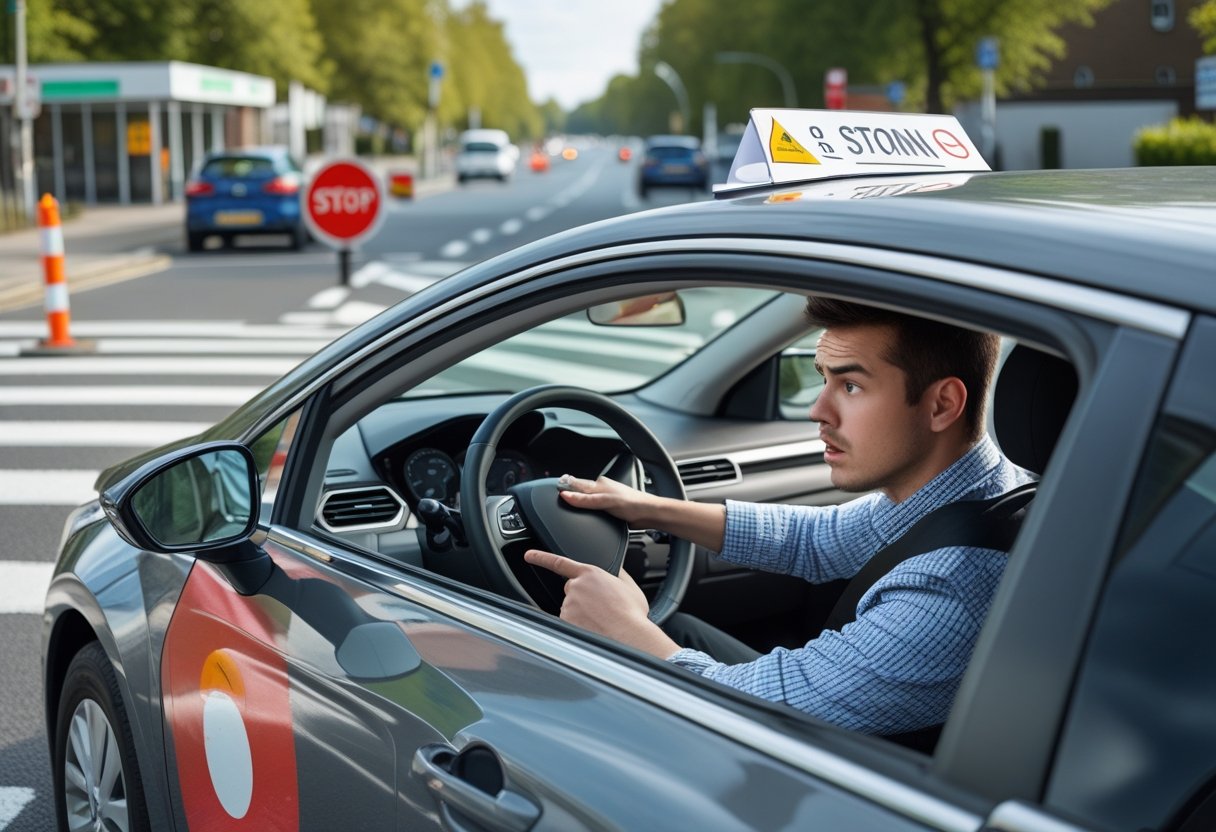
An instant fail means your driving test stops immediately when you make a dangerous or serious mistake. These automatic fails happen when your actions put yourself, your examiner, or other road users at risk.
Defining the Automatic Fail
An automatic fail occurs when you commit what driving examiners call a “dangerous fault” or “serious fault.” These are major mistakes that create immediate safety risks.
Dangerous faults are the most severe. They put everyone in direct, immediate danger. Your test ends the moment you make one of these mistakes.
Serious faults are also automatic fails, though slightly less severe than dangerous ones. They still show you’re not ready to drive safely on your own.
Common automatic fails include:
- Running through red lights
- Forcing other drivers to brake or swerve
- Hitting the kerb during manoeuvres
- Crossing solid white lines inappropriately
- Ignoring stop signs completely
- Making the examiner grab the steering wheel
These driving test faults are quite different from minor mistakes. We don’t give second chances with major faults because they demonstrate serious gaps in your driving skills or judgement.
Why Examiners Issue Instant Fails
Driving examiners issue instant fails to protect everyone’s safety. Their primary job is ensuring only competent, safe drivers get licences.
When you commit a dangerous fault, the examiner knows you’re not ready for independent driving. They can’t risk letting unsafe drivers onto our roads.
Safety comes first in every decision. If your actions force another car to slam on their brakes, that’s proof you’re not assessing risks properly.
The examiner also considers legal compliance. Running red lights or ignoring no-entry signs shows you don’t understand basic traffic laws.
Public protection drives these decisions too. Every new driver needs to demonstrate they won’t endanger pedestrians, cyclists, or other motorists.
Your examiner isn’t being harsh when they issue an automatic fail. They’re doing their job properly by maintaining road safety standards.
The Difference Between Minor and Major Faults
Understanding fault categories helps you prepare better for your test. Minor faults (also called driving faults) are small mistakes that don’t create danger.
You can accumulate up to 15 minor faults and still pass your test. Examples include slightly harsh braking or forgetting to cancel your indicator promptly.
Major faults include both serious and dangerous faults. Just one of these results in an automatic fail, regardless of how well you’ve driven otherwise.
Here’s how they compare:
| Minor Faults | Major Faults |
|---|---|
| No immediate danger | Create safety risks |
| Up to 15 allowed | Just one fails you |
| Small technique issues | Serious skill gaps |
| Test continues | Test often ends immediately |
Serious faults show significant control problems or poor decision-making. Dangerous faults create immediate hazards that could cause accidents.
The examiner marks everything they observe. But remember, major faults demonstrate you need more practice before driving independently.
Most Common Actions That Cause Instant Fails
Most automatic fails happen when we fail to observe properly at junctions, ignore traffic signs and signals, make dangerous lane changes, or run red lights and stop signs. These critical errors put everyone on the road at risk and show examiners that we’re not ready for independent driving.
Failure to Observe at Junctions
Poor junction observations cause more instant fails than any other mistake. About one in four test failures happens because we don’t look properly before moving into new roads.
Making no observations at all is the most serious error. When we emerge from a junction without checking left or right, we force other drivers to brake hard or swerve. This often leads to the examiner using dual controls.
Misjudging approaching vehicle speeds is equally dangerous. We might look but fail to assess how quickly traffic is moving. Pulling out and causing another car to slow significantly will result in an instant fail.
At roundabouts, entering when vehicles approach from the right creates immediate danger. The same applies when we join dual carriageways from slip roads without checking for main carriageway traffic.
Looking too late makes observations pointless. If we’re already halfway into the new road before checking, we can’t react to what we see.
Some common junction observation fails include:
- Not recognising crossroads as junctions
- Repeatedly failing to look left when turning left
- Ignoring parked vehicles and obstructions
- Making assumptions about clear roads
Not Responding Correctly to Traffic Signs and Signals
Ignoring or misreading road signs and signals leads to immediate test failure. These mistakes show we don’t understand basic traffic rules.
Running red lights tops this list. Attempting to proceed through clearly visible red signals demonstrates dangerous judgement. We must always stop when lights show red.
Ignoring stop signs creates similar risks. Crossing the line without ensuring the way is clear breaks fundamental road rules.
Advanced stop lines catch many learners off guard. Stopping beyond the first white line in cyclist areas counts as a serious fault.
Speed limit changes require immediate response. Acting too late or not at all when signs clearly show new limits will fail our test.
Other critical sign errors include:
- Going the wrong way around keep left bollards
- Entering no entry zones
- Driving in restricted bus lanes
- Using wrong lanes despite clear signage
- Ignoring box junction markings
Traffic light timing also matters. We shouldn’t wait at green lights when junctions are clear, but we also can’t proceed when exits are blocked.
Unsafe Lane Changes or Merging
Dangerous lane discipline creates immediate hazards for other road users. Poor lane changes show we lack essential safety awareness.
Changing lanes without proper mirror checks causes most problems. We must check mirrors, signal clearly, and look for blind spots before moving. Missing these steps often forces other drivers to brake or swerve.
Merging onto dual carriageways requires special care. Entering without observing main carriageway traffic or failing to give way causes serious conflicts.
At roundabouts, attempting lane changes when vehicles sit alongside us is extremely dangerous. Examiners may need to grab the steering wheel to prevent collisions.
Straddling lane markings shows poor vehicle control. We must keep our car clearly within marked lanes, especially on roundabouts with multiple exits.
Key merging and lane change fails include:
- Cutting across following vehicles when exiting roundabouts
- Forcing way into occupied lanes
- Staying in wrong lanes despite clear markings
- Making unnecessary lane changes on dual carriageways
Running Red Lights or Stop Signs
Failing to stop at red lights or stop signs creates immediate danger and automatic test failure. These actions show complete disregard for traffic safety.
Red light violations happen when we attempt to proceed through clearly visible red signals. There’s no excuse for this error, even if we think we can “make it through.”
Stop sign failures occur when we roll through without coming to a complete halt. We must stop fully behind the line and check the way is clear before proceeding.
Advanced stop lines require stopping at the first white line when lights show red. Moving into cyclist waiting areas will fail our test.
Amber gambling also causes problems. Speeding up to beat changing lights instead of stopping safely shows poor judgement.
We might also fail by:
- Blocking junctions when lights change
- Not progressing when green lights show clear junctions
- Misunderstanding filter light systems
- Stopping in wrong positions at signal-controlled crossings
Remember, traffic lights and stop signs exist to prevent collisions and keep traffic flowing safely. Ignoring them puts lives at risk and demonstrates we’re not ready for our licence.
Other Major Mistakes That Lead to Automatic Failure
Beyond the obvious violations like running red lights, several other critical errors can instantly end your driving test. These mistakes often involve losing control of your vehicle, failing to follow your examiner’s guidance, or making dangerous steering decisions that put everyone at risk.
Poor Vehicle Control
When we talk about vehicle control, we’re referring to your ability to handle the car smoothly and safely in all situations. Your driving examiner will be watching closely for any signs that you can’t manage the vehicle properly.
Stalling repeatedly is one of the most common control issues. While one stall might not fail you automatically, multiple stalls or stalling in dangerous situations (like roundabouts or busy junctions) often will. Practice your clutch control until it becomes second nature.
Mounting kerbs during manoeuvres is another instant failure. Whether you’re parallel parking or doing a three-point turn, hitting the pavement shows dangerous spatial awareness. Your driving instructor should have helped you judge distances, so trust that training.
Rolling backwards on hills without control can be terrifying for examiners. If you roll back more than a few inches, especially into traffic, that’s an automatic fail. Use your handbrake confidently and find your biting point before releasing it.
Excessive speed wobbles or inability to maintain a straight line also demonstrate poor control. These issues often stem from gripping the steering wheel too tightly or overcompensating for minor movements.
Ignoring Safety Procedures and Examiners’ Instructions
Your driving examiner isn’t just there to judge you, they’re also responsible for everyone’s safety during the test. Failing to follow their instructions or ignoring basic safety procedures will result in immediate failure.
Refusing to follow directions is an obvious fail, but so is misunderstanding them repeatedly. If you’re unsure about an instruction, it’s perfectly acceptable to ask for clarification. Don’t guess and hope for the best.
Not performing proper safety checks before starting can end your test before it begins. This includes adjusting mirrors, checking the handbrake is off, and ensuring your seatbelt is secure. These aren’t just formalities, they’re essential safety habits.
Failing to observe properly at junctions remains the top reason for test failures. We must check left, right, and left again, making obvious head movements so the examiner can see we’re being thorough.
Opening car doors without checking for cyclists or pedestrians is dangerous and will fail you instantly. Always look before opening any door, especially on busy roads.
Steering and Position Errors
Steering control goes beyond just turning the wheel. It’s about positioning your vehicle safely and predictably throughout the entire test journey. Poor steering decisions can create dangerous situations very quickly.
Crossing into oncoming traffic is perhaps the most serious steering error. This includes cutting corners on right turns or swinging too wide on left turns. Both put you in the path of other vehicles and will fail you immediately.
Driving too close to parked cars, cyclists, or pedestrians shows poor judgement. We should always maintain safe distances and position ourselves properly in our lane. If you’re consistently hugging one side of the road, that suggests steering control issues.
Inappropriate lane positioning on dual carriageways or motorways can be dangerous. Stay in the left lane unless overtaking, and don’t weave between lanes unnecessarily.
Oversteering during manoeuvres often leads to mounting kerbs or getting too close to other vehicles. Smooth, controlled movements are what examiners want to see, not jerky corrections that suggest you’re fighting with the car rather than controlling it.
Pre-Drive Instant Fails: Starting Off on the Right Foot
Before we even turn the key, there are crucial checks that could end your test before it properly begins. The examiner will look for properly functioning safety equipment, correctly positioned mirrors and controls, and all necessary documentation.
Issues With Vehicle Safety Features
Your driving test centre examiner will conduct safety checks before we start the engine. This isn’t just a formality – faulty safety features mean an immediate test failure.
Brake lights are the first thing they’ll check. If any bulb is blown or the lights don’t respond when you press the pedal, that’s an instant fail. We always recommend checking these the night before your test.
The handbrake must work properly and hold the car securely on a slope. If it feels loose or doesn’t engage fully, the examiner won’t let the test continue. This could leave you scrambling to rebook.
Indicators need to flash clearly and at the correct speed. A rapid blinking usually means a bulb has gone. Both hazard lights and individual indicators must function perfectly.
Your horn should produce a clear, audible sound when pressed. While it seems minor, a broken horn is considered a safety defect. The examiner might test this during the show-me-tell-me questions.
Windscreen wipers and washers must clear the screen effectively. Torn wiper blades or empty washer bottles will stop your test immediately. These are easy fixes that many learners overlook.
Improperly Adjusted Mirrors and Controls
Getting your driving position right isn’t just about comfort – it’s about safety and control. The examiner expects to see you make these adjustments confidently.
Your seat position needs to let you reach all controls comfortably whilst maintaining good visibility. If you’re stretching for the pedals or can’t see properly over the steering wheel, that’s a serious safety concern.
The rearview mirror should give you a clear view of the entire back window. Many learners forget to adjust this after the previous driver. Take a moment to position it correctly for your height.
Wing mirrors must show the appropriate view of the road behind and to the sides. The examiner will notice if you haven’t adjusted these properly. You should see a small portion of your car and mostly road.
Your steering wheel height and reach (if adjustable) should feel natural. You want a slight bend in your arms when holding the wheel. Don’t leave this to chance – adjust everything methodically.
Seatbelt positioning matters too. The belt should sit across your chest and hips properly, not across your neck or stomach. This shows you understand basic safety principles.
Missing or Invalid Documents
Documentation problems cause instant test cancellation before you’ve even started. This wastes months of preparation and your test fee.
Your provisional driving licence must be the original paper or photocard version. Photos on smartphones won’t suffice, and expired licences mean no test. Double-check the dates carefully.
Insurance documents need to cover you for driving test purposes. Many learner policies don’t automatically include test cover. Ring your insurer to confirm you’re covered on the test date.
The MOT certificate (if required) must be current and valid. Cars over three years old need this annual safety check. An expired MOT means the car isn’t legally roadworthy.
Vehicle registration documents should match the car you’re using. If you’re borrowing a friend’s car, make sure they’ve given you the correct paperwork. Mismatched details raise red flags.
Some test centres require theory test pass certificates as proof you’ve completed this stage. Whilst not always checked, having it available prevents potential complications on test day.
Understanding the Three Fault Categories
During your driving test, examiners classify every mistake into one of three categories based on how dangerous your actions were. Minor faults won’t automatically fail you, serious faults mean instant failure, and dangerous faults result in immediate test termination.
What Counts as a Minor Fault?
Minor faults are those small slip-ups that don’t put anyone in immediate danger. We’ve all made them during our learning journey, and they’re completely normal.
Think of things like forgetting to cancel your indicator after turning, stalling the engine once, or positioning your car slightly off-centre in a lane. These mistakes show you’re still learning, but they don’t create hazardous situations.
Common minor faults include:
- Hesitating at roundabouts when it’s safe to go
- Rolling back slightly on a hill start
- Not checking mirrors as frequently as you should
- Taking corners a bit too slowly
You can actually accumulate up to 15 minor faults and still pass your test. However, if you repeat the same type of minor fault multiple times, your examiner might reclassify it as a serious fault.
The key here is consistency. One forgotten mirror check won’t doom your test, but repeatedly failing to observe properly will raise red flags about your safety awareness.
How Serious Faults Tip Into Failure
Serious faults (sometimes called major faults) are actions that could potentially create danger, even if no actual harm occurs. Just one serious fault means automatic failure.
These faults demonstrate that you haven’t quite developed the judgment needed for independent driving. Your examiner will be looking for situations where you make other road users take action to avoid problems you’ve created.
Examples of serious faults:
- Pulling out at a junction when another vehicle has to brake or swerve
- Not giving way to pedestrians at crossings when you should
- Emerging from a side road causing traffic to slow down
- Incorrect lane positioning that forces other drivers to adjust
The difference between minor and serious often comes down to impact on other road users. If your mistake makes someone else react defensively, it’s likely serious.
Remember, serious faults aren’t about being a “bad driver.” They simply indicate you need more practice before driving solo safely.
Dangerous Faults and Immediate Disqualification
Dangerous faults represent the most severe category and result in immediate test termination. These actions create actual danger to yourself, your examiner, or other road users.
When you commit a dangerous fault, your examiner will likely ask you to pull over safely and may even take control of the vehicle if necessary. The test ends immediately, regardless of how well you were doing beforehand.
Dangerous faults typically involve:
| Action | Why It’s Dangerous |
|---|---|
| Causing actual collisions | Physical harm or damage occurs |
| Mounting pavements with pedestrians present | Risk of serious injury |
| Ignoring traffic lights completely | High collision risk |
| Wrong-way driving on dual carriageways | Head-on collision potential |
| Excessive speeding in built-up areas | Reduced stopping ability |
The distinction between serious and dangerous often depends on actual versus potential consequences. If someone has to take emergency action or you create an genuinely perilous situation, it becomes dangerous.
These faults are rare among test candidates, but understanding them helps you recognise the absolute boundaries of safe driving behaviour.
Pro Tips to Steer Clear of Instant Fails
The secret to avoiding instant fails lies in thorough preparation, learning from others’ mistakes, and staying calm when it counts. We’ll show you how proper lessons, understanding common pitfalls, and building genuine confidence can transform your test day experience.
The Power of Practice and Driving Lessons
Nothing beats proper preparation with a qualified driving instructor. We’ve seen countless learners who thought they were ready, only to discover gaps in their knowledge during the practical driving test.
Your driving instructor knows exactly what examiners look for. They’ll spot dangerous habits before they become automatic fails. Book extra lessons focusing on your weak areas rather than general practice.
Practice in different conditions whenever possible. Rain, busy roundabouts, and unfamiliar roads all present challenges that could trip you up on test day.
Mock tests with your instructor are brilliant for building muscle memory. We recommend at least three mock tests before booking your practical driving test. This helps you get comfortable with the format and timing.
Ask your instructor about local test routes. Whilst examiners don’t follow set paths, they often use similar road types and junctions. Knowing these areas reduces surprises that might lead to poor decisions.
Don’t rush into your test. If your instructor suggests more lessons, listen to them. An extra week of practice is better than months of waiting after a failed attempt.
Learning From the Most Frequent Mistakes
The statistics don’t lie: most instant fails happen at junctions due to poor observation. Right turns are particularly dangerous because you’re crossing traffic.
Here’s what causes the most failures:
- Inadequate observation: Not checking mirrors and blind spots properly
- Dangerous positioning: Drifting into other lanes or mounting kerbs
- Speed errors: Going too fast for conditions or ignoring speed limits
- Traffic light violations: Jumping amber lights or misreading signals
We always tell our learners to take an extra second at junctions. Count “one Mississippi” before moving off. This simple habit prevents rushed decisions that lead to instant fails.
Never assume other drivers will behave predictably. Wait for clear gaps rather than hoping someone will let you out. Examiners fail candidates who rely on other drivers’ courtesy rather than safe gaps.
Remember that hesitation is better than dangerous action. If you’re unsure, wait. Examiners prefer cautious drivers over overconfident ones who take risks.
Building Confidence on Test Day
Confidence isn’t about feeling fearless. It’s about trusting your preparation and staying focused when pressure mounts.
Get a good night’s sleep and eat breakfast. Tiredness and hunger affect decision-making, increasing the chances of instant fails. We’ve seen too many capable drivers fail because they weren’t physically prepared.
Arrive early but not too early. Getting there 10 minutes before your appointment gives you time to settle without building anxiety.
Talk yourself through actions during the test. Silent commentary helps maintain focus: “Checking mirrors, indicating left, looking for pedestrians.” This prevents mental blanks that cause errors.
Don’t dwell on small mistakes during the test. Minor faults won’t fail you, but losing concentration after one mistake often leads to major errors. Keep your attention on the road ahead.
Listen carefully to your examiner’s instructions. Ask for clarification if you don’t understand something. It’s better to ask than guess wrong and create a dangerous situation.
Remember that your examiner wants you to pass. They’re not looking for reasons to fail you. Drive as you’ve been taught in your driving lessons, and trust the skills you’ve developed.
Frequently Asked Questions
These questions cover the most common concerns about instant fails, from dangerous maneuvers that immediately end your test to specific infractions that guarantee you’ll need to rebook.
What missteps during the driving test can lead to an instant disqualification?
Several critical errors will stop your test immediately. Driving on the wrong side of the road tops this list, as it creates immediate danger for everyone.
Running red lights or stop signs also results in instant disqualification. We’ve seen countless learners lose focus at traffic signals, so always come to a complete stop and check carefully.
Causing any collision, no matter how minor, means your test ends right there. This includes bumping kerbs during manoeuvres or scraping other vehicles whilst parking.
Failing to give way to pedestrians at crossings is another serious error. Always scan for people crossing and be prepared to stop completely.
Could you enlighten me on which moves are considered driving no-nos that’ll surely end your test prematurely?
Crossing solid white lines guarantees failure every time. These markings appear at bus lanes, junction approaches, and advanced stop lines for cyclists.
Making other drivers brake sharply, swerve, or take avoiding action because of your manoeuvre results in immediate failure. Your driving should never force others to react suddenly.
Refusing to follow your examiner’s directions will end your test instantly. We understand nerves can make instructions seem unclear, so don’t hesitate to ask for clarification politely.
Speeding excessively or driving dangerously slow also triggers instant fails. Maintain appropriate speeds for road conditions and traffic flow.
Might you share what are the absolute deal-breakers during a practical driving exam?
Equipment failures before you even start driving can end things quickly. Non-functioning brake lights, indicators, or windscreen wipers mean you cannot proceed safely.
Missing essential documents like your provisional licence or valid insurance certificate stops the test before it begins. Double-check everything the night before your exam.
Improperly adjusted mirrors that don’t provide adequate rear vision constitute an immediate safety concern. Take time during your pre-drive checks to position them correctly.
Using mobile phones or other distractions during the test results in instant failure. Keep devices switched off and stored away throughout your examination.
Could you please elaborate on the errors that would directly result in a fail on the driving assessment?
Loss of control situations create immediate danger and end your test. This includes mounting pavements, striking kerbs hard, or veering into other lanes unexpectedly.
Failing to respond to emergency vehicles with sirens and flashing lights is a serious error. Always pull over safely when ambulances, fire engines, or police need to pass.
Dangerous overtaking manoeuvres, especially on busy roads or near junctions, will fail you instantly. Only overtake when it’s completely safe and legal to do so.
Ignoring school crossing patrols or not stopping for children at designated crossings shows poor hazard awareness and endangers vulnerable road users.
Would you mind clarifying which infractions guarantee a ‘better luck next time’ scenario in a road test?
Entering yellow box junctions when your exit isn’t clear creates traffic problems and results in instant failure. Only enter when you can completely clear the junction.
Making illegal turns, such as turning right where prohibited or U-turns on busy roads, demonstrates poor understanding of traffic regulations.
Blocking emergency access routes or parking inappropriately during manoeuvres shows lack of consideration for other road users’ safety needs.
Driving too close to cyclists or motorcyclists puts vulnerable road users at risk. Always maintain safe following distances from all vehicles.
Is there a chance you could illuminate the serious slip-ups that ensure the driving test comes to an abrupt halt?
Approaching roundabouts without proper observation or entering when unsafe causes immediate test termination. Take time to assess traffic flow from all directions.
Failing to check blind spots during lane changes or merging creates dangerous situations. Your mirrors alone aren’t sufficient for safe manoeuvres.
Reversing without adequate observation, especially around parked cars or near pedestrian areas, puts people at risk unnecessarily.
Showing aggressive driving behaviour, including road rage or deliberately intimidating other drivers, demonstrates you’re not ready for independent driving privileges.