

Responding Appropriately to Traffic Lights: Master UK Road Signals with Confidence
Traffic lights might seem straightforward, but many learners get caught off guard by amber signals, red-and-amber combinations, and those tricky filter arrows. Knowing exactly how to respond to each traffic light sequence keeps you safe, confident, and legal on UK roads. Getting these fundamentals right from the start builds the solid foundation you need for smooth, stress-free driving.
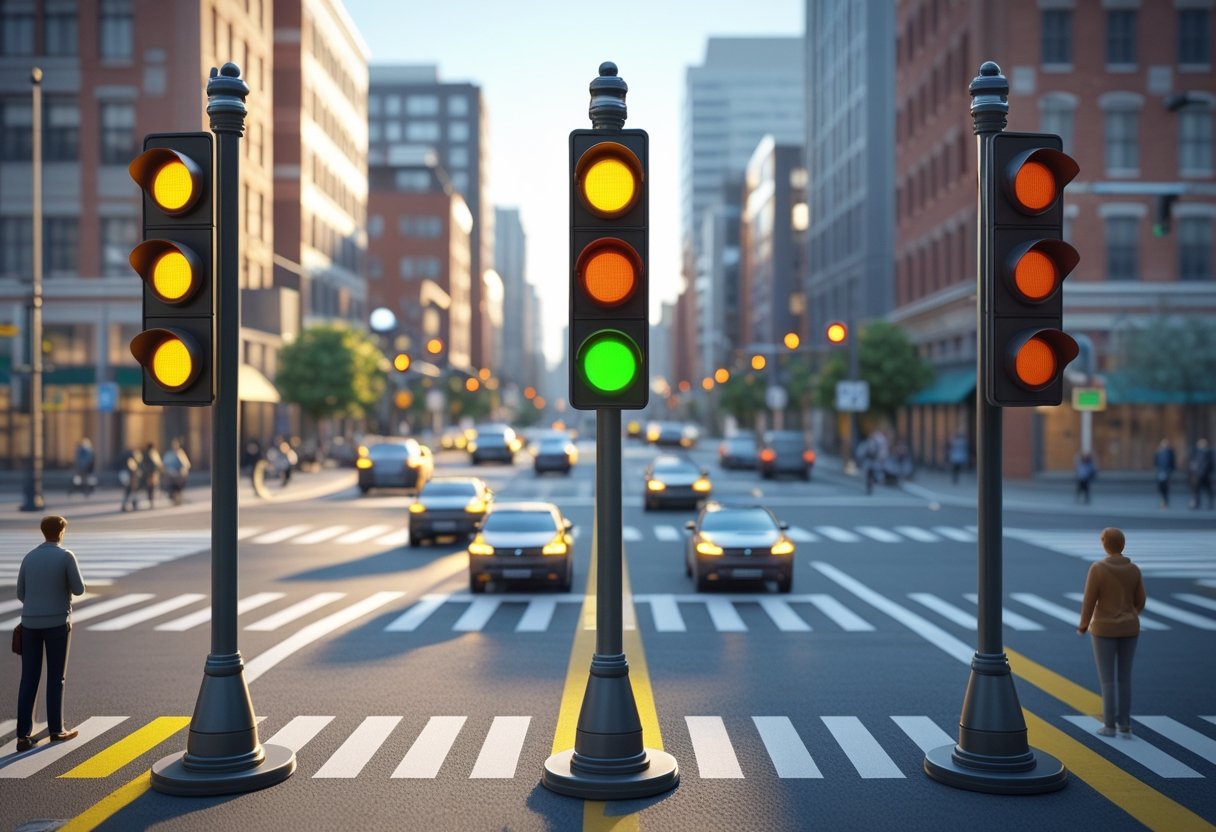
We’ve all been there: approaching lights that suddenly change, wondering whether to stop or go, or spotting an unfamiliar filter arrow and feeling uncertain. These moments can feel overwhelming, especially when you’re still building your driving confidence. The good news is that once you understand the logic behind each signal, responding becomes second nature.
Today we’re breaking down everything you need to know about traffic light responses. From the standard sequence to special situations like flashing amber and filter arrows, you’ll gain the clarity and confidence to handle any traffic light scenario with ease.
Key Takeaways
- The UK traffic light sequence follows a predictable pattern: red, red-and-amber, green, then amber before returning to red
- Green filter arrows allow you to proceed in the indicated direction even when other signals show red, provided it’s safe to do so
- Amber lights mean prepare to stop if safe, whilst red-and-amber together means stop and prepare to move off when green appears
Understanding the Basics: What Traffic Lights Mean
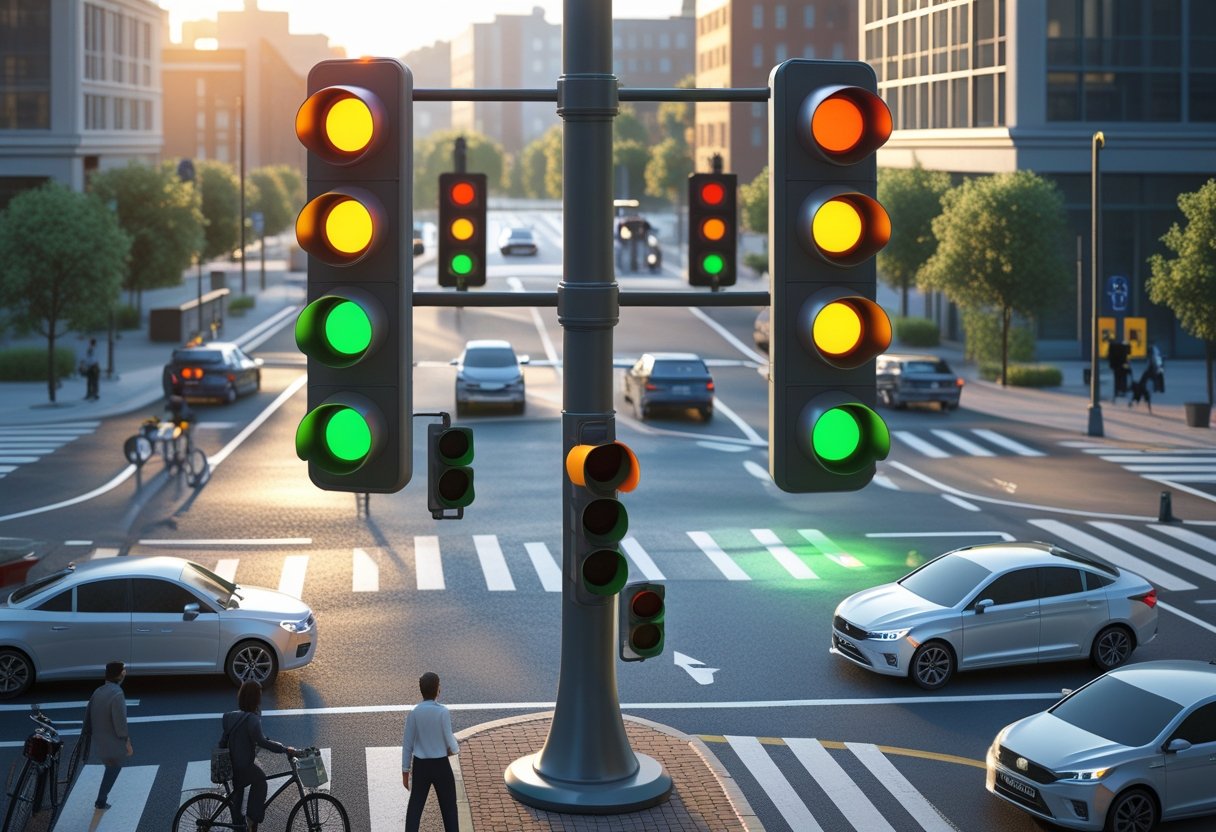
Traffic lights control traffic flow using three colours in a specific sequence, whilst road markings and signs provide additional guidance to help drivers navigate junctions safely. These systems work together to prevent congestion and protect all road users at busy intersections.
Purpose of Traffic Lights and Road Safety
Traffic lights serve as guardians of our roads, controlling the flow of vehicles at intersections where chaos could easily reign. We see them managing traffic streams from different directions, preventing accidents that would otherwise occur when cars, buses, and lorries meet at the same point.
The primary purpose centres on road safety. These devices eliminate the guesswork of who should go first at busy junctions. Without them, drivers would need to negotiate every crossing, leading to confusion and crashes.
Traffic lights also tackle congestion by creating organised patterns of movement. They allow traffic from one direction to move whilst others wait, then switch to give different routes their turn. This systematic approach keeps vehicles flowing rather than creating gridlock.
Key benefits include:
- Accident prevention at high-risk intersections
- Organised traffic flow during peak hours
- Protected crossing points for pedestrians
- Clear right-of-way rules that everyone understands
For your theory test, you’ll need to demonstrate understanding of how these systems protect lives. The questions often focus on real-world scenarios where traffic lights prevent dangerous situations.
Key Components of the Traffic Light Sequence
The UK traffic light system uses three colours arranged vertically: red at the top, amber in the middle, and green at the bottom. Each colour communicates specific instructions that drivers must follow to maintain safe roads.
Red means stop completely. Your vehicle must come to a halt before the stop line. This isn’t negotiable, even if the road appears clear.
Red and amber together signal preparation time. When both lights show, get ready to move off but don’t actually go yet. This combination warns you that green is coming next.
Green gives permission to proceed if it’s safe to do so. Always check the junction before moving, as other road users might still be clearing the area.
Amber alone means stop if you can do so safely. If you’re too close to stop without harsh braking, you may continue through.
The standard sequence follows this pattern:
- Red (stop)
- Red and amber (prepare)
- Green (go if safe)
- Amber (stop if safe)
- Back to red
This cycle repeats continuously, giving all directions their turn to move through the junction safely.
The Role of Road Markings and Signs
Road markings work alongside traffic lights to guide your positioning and movement at junctions. These painted lines and symbols tell you exactly where to stop, which lane to use, and where it’s safe to wait.
The stop line appears as a thick white line across your lane. When lights show red or amber, you must stop before this line, not beyond it. Going past this marking can trigger cameras and result in penalties.
Lane markings show which direction each lane serves. Arrows painted on the road surface indicate whether you can go straight ahead, turn left, or turn right from that position. Following these markings prevents dangerous last-minute lane changes.
Traffic lights road signs appear before major junctions to warn of the lights ahead. These triangular warning signs help you prepare to slow down and choose the correct lane early.
Filter lane markings create dedicated spaces for vehicles turning in specific directions. These special lanes often have their own traffic lights with green arrows, allowing certain movements whilst other traffic waits.
Box junctions feature yellow criss-cross markings that you mustn’t enter unless your exit is clear. These prevent blocking the junction when lights change, keeping traffic flowing smoothly for everyone.
The Standard Traffic Light Sequence Explained
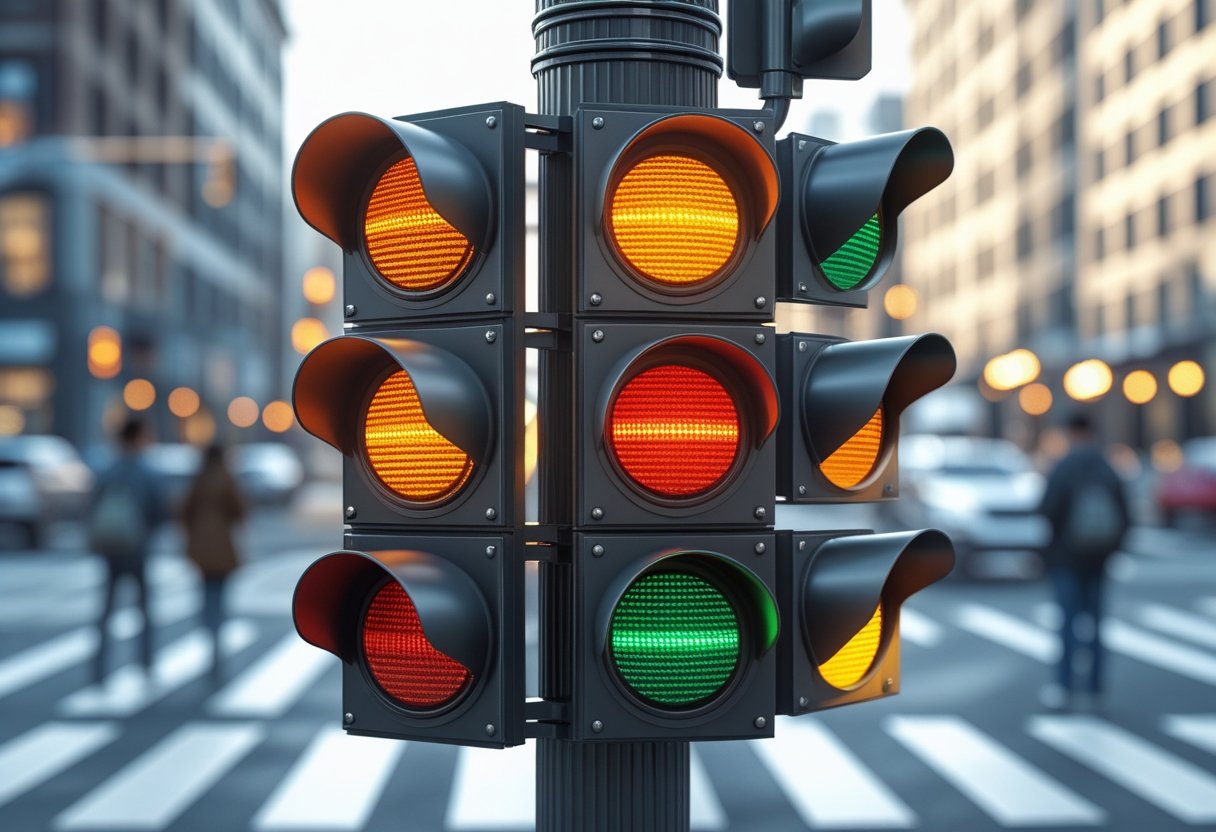
The UK traffic light system follows a clear pattern that every driver needs to master: red (stop completely), red and amber together (prepare to move), green (proceed when safe), then amber alone (prepare to stop). Understanding exactly what each phase requires keeps you safe and helps you respond confidently at every junction.
Red Traffic Light: Stopping Without Exception
When you see a red traffic light, there’s only one rule that matters: stop completely. No exceptions, no hesitation.
The Highway Code makes this crystal clear. Running a red light isn’t just dangerous, it’s a serious offence that can result in penalty points and hefty fines.
Where to stop matters just as much as stopping itself:
- Pull up behind the solid white stop line
- Never let any part of your car cross this line
- Leave enough space between you and the car ahead
Your stopping routine should become second nature:
- Check your mirrors as you slow down
- Brake smoothly and progressively
- Apply your handbrake once stopped
- Select neutral gear
- Take your feet off the pedals
We often see advanced stop lines for cyclists at busy junctions. Keep these areas completely clear. Cyclists need this space for their safety, and blocking it creates unnecessary hazards.
Stay alert whilst waiting. Avoid the temptation to check your phone or fiddle with the radio. Keeping your attention on the road helps you spot when lights are about to change.
Red and Amber: Gear Up, But Hold Steady
Red and amber traffic lights together send a specific message: get ready to go, but don’t move yet. Many learners get caught out here, thinking they can creep forward.
The red light is still active during this phase. Your car must stay completely stationary behind the stop line.
Use this time to prepare properly:
- Select first gear if you’re not already in it
- Find your biting point with the clutch
- Keep your handbrake firmly applied
- Check all three mirrors thoroughly
This preparation phase gives you a massive advantage. When green appears, you’ll move off smoothly instead of stalling or jerking forward.
Red and amber lights typically last just a few seconds. Don’t rush or panic if you’re not quite ready when green shows. It’s better to take an extra moment than risk a dangerous start.
Watch for pedestrians and cyclists who might still be crossing. They might not expect traffic to move off quickly, so give them time to clear the junction safely.
Green Light: Moving Off with Caution
A green traffic light gives you permission to proceed, but it doesn’t guarantee the road ahead is clear. Smart driving means looking before you leap.
Before releasing your handbrake, take a final glance around. Check that traffic ahead is actually moving and the junction is clear of pedestrians.
Your move-off sequence should be smooth and controlled:
- Release the handbrake only when ready to move
- Let the clutch up to the biting point gradually
- Apply gentle acceleration as you pull away
- Build up speed progressively, not aggressively
Sometimes the car in front doesn’t move immediately when lights change green. Stay patient and wait for them rather than getting frustrated or honking your horn.
At busy junctions, don’t enter the junction if you can see traffic is backed up on the other side. Getting stuck in the middle of a junction blocks other traffic and creates dangerous situations.
Keep watching for cyclists and motorcyclists who might be filtering through traffic. They’re often harder to spot but have every right to use the road safely.
Amber Light: When to Stop, When It’s Safe to Proceed
The amber traffic light creates the trickiest decisions you’ll face as a driver. The Highway Code says you should stop at amber lights unless stopping would cause an accident.
When you should definitely stop:
- You’re a reasonable distance from the stop line
- You can brake safely without harsh, sudden braking
- The car behind you isn’t following too closely
When you might need to continue:
- You’ve already crossed the stop line when amber appears
- Stopping suddenly would risk a rear-end collision
- You’re so close that braking hard would be dangerous
This split-second decision improves with experience. The key is staying alert as you approach any green light, ready for it to change.
Amber traffic lights aren’t an invitation to speed up and race through. Accelerating towards amber creates dangerous situations and often results in running red lights.
Many drivers make poor decisions at amber lights because they’re not paying attention early enough. As you approach any traffic light, scan ahead and be mentally prepared for changes.
Navigating Filter Arrows and Special Traffic Signals
Filter arrows give specific directions at busy junctions, allowing certain lanes to move whilst others must wait. These special signals help control traffic flow and reduce congestion by directing vehicles safely through complex intersections.
Understanding Green Filter Arrows
Green filter arrows appear alongside regular traffic lights to guide specific lanes or turning movements. When you see a green filter arrow, you can proceed in that direction even if the main lights show red.
These arrows typically appear for:
- Right turns at busy junctions
- Left turns where pedestrian crossings create conflicts
- Lane-specific movements on multi-lane roads
The key point is priority. When your filter arrow shows green, oncoming traffic faces red lights. This means you have right of way for that particular movement.
However, we still need to check for pedestrians and cyclists. They might not expect your movement, especially when the main lights appear red to other road users.
Filter arrows usually sit next to or below the main traffic signals. Some junctions have multiple arrows for different lanes, so make sure you’re following the correct signal for your intended route.
Red and Amber with Filter Lights
Filter lights can combine with standard red and amber signals, creating situations that confuse many learners. The most common scenario involves a red main light with an active green filter arrow.
When the main light shows red but your filter arrow glows green, you can only move in the arrow’s direction. Going straight ahead or turning the opposite way breaks traffic laws and creates dangerous situations.
During amber phases with filter arrows:
- Prepare to stop if the filter arrow isn’t lit
- Complete your turn if you’ve already committed and the arrow remains green
- Watch for changing arrow signals, not just main lights
Some junctions show red and amber together whilst filter arrows operate separately. This combination tells traffic in other lanes to prepare for movement whilst your filter arrow controls your specific direction.
Always position yourself correctly before reaching these signals. Being in the wrong lane when filter arrows activate leads to missed turns or illegal movements across traffic.
Responding to Filter Arrows on Busy Junctions
Busy junctions often feature multiple filter arrows operating in sequence to manage heavy traffic flows. We need to stay alert and respond appropriately to our specific signal whilst remaining aware of other vehicles.
Key strategies for busy filter arrow junctions:
- Position early in the correct lane
- Watch your designated signal, not neighbouring arrows
- Don’t follow other vehicles blindly through filter phases
- Check pedestrian crossings before turning on filter arrows
Rush hour periods see filter arrows working overtime. Some junctions extend filter phases during peak times, giving more turning opportunities. Others reduce filter periods to prioritise straight-through traffic.
Large vehicles sometimes block your view of filter arrows. Move slightly within your lane (whilst staying safe) to see your signal clearly. Never assume the junction sequence based on other vehicles’ movements.
Common mistakes include:
- Following vehicles turning when your filter arrow isn’t active
- Moving too early before your filter phase begins
- Stopping unnecessarily when your filter arrow shows green
Advanced stop lines at filter junctions require extra attention. Cyclists often wait ahead of cars, and they mightn’t see filter arrow changes immediately. Give them space and time to react when your arrow permits movement.
Flashing Amber and Unconventional Signal Situations
Some traffic situations involve flashing amber lights or unusual signal patterns that catch many learners off guard. These special signals require different responses than standard red, amber, and green sequences.
The Flashing Amber at Pelican Crossings
Pelican crossings are brilliant once you know what to expect. After the red light stops traffic, you’ll see a flashing amber phase that’s unique to these pedestrian crossings.
When the flashing amber light appears, we can proceed if the crossing is clear. This means no pedestrians are still crossing or waiting to cross. Think of it as “proceed with extreme caution” rather than “go”.
The key difference here is judgment. Unlike regular amber lights where we must stop (unless it’s unsafe to do so), flashing amber gives us permission to move if it’s safe. We need to check the crossing thoroughly before proceeding.
Many learners panic when they first encounter this. Don’t worry! Take your time to assess the situation. If you’re unsure whether pedestrians have finished crossing, it’s perfectly fine to wait for the green light.
The zigzag markings around pelican crossings also remind us to stay alert. These markings mean we shouldn’t overtake or park nearby, keeping the crossing area clear for everyone’s safety.
Dealing with Flashing Amber at Junctions
Sometimes we encounter flashing amber lights at junctions, particularly during maintenance work or unusual traffic conditions. These situations require us to treat the junction like an unmarked crossroads.
Flashing amber means proceed with caution, giving way to traffic already on the junction or approaching from the right. We essentially follow normal priority rules as if no traffic lights were present.
The tricky part is that other drivers might not understand these rules. Some might assume they have priority, whilst others become overly cautious and create confusion.
Watch other traffic carefully and make eye contact with drivers when possible. Clear communication through positioning and signalling becomes even more important in these situations.
If you’re genuinely unsure about who has priority, err on the side of caution. It’s better to give way unnecessarily than cause an accident.
Navigating Non-Standard Traffic Signals
Beyond typical traffic lights, we encounter various specialised signals on our roads. Lane control signals above motorway lanes show green arrows (lane open), red crosses (lane closed), or white diagonal arrows (change lanes).
At level crossings, flashing red lights mean stop immediately. Never attempt to cross when these lights are active, even if no train is visible yet.
Emergency vehicles sometimes use rear-facing flashing red and blue lights to control traffic flow. Traffic officers use red and amber combinations. When you spot these signals, slow down and prepare to stop.
Fire stations and airfields also use flashing red lights to warn of emergency vehicle movements. These signals demand immediate attention and cautious responses.
The golden rule with any unusual signal is simple: when in doubt, stop safely and assess the situation. Most non-standard signals are designed to warn us of potential dangers, so treating them seriously keeps everyone safer.
Approaching and Stopping at Traffic Lights: Best Practices
Getting comfortable with approaching traffic lights takes practice, but mastering the right techniques will boost your confidence on the road. We’ll focus on lane positioning, proper stopping procedures at cycle boxes, and the essential habits that keep you safe and in control.
Choosing the Correct Lane and Mirror Checks
When we spot traffic lights ahead, our first priority is getting into the right lane well before we reach the junction. Don’t leave this until the last minute, as sudden lane changes near lights can catch other drivers off guard.
Check your mirrors frequently as you approach. The driver behind might not expect you to slow down, so give them plenty of warning.
Signal your intentions early if you need to change lanes. This helps cyclists, motorcyclists, and other drivers understand where you’re heading.
Key mirror checks to make:
- Interior mirror for vehicles directly behind
- Left wing mirror for cyclists filtering up the inside
- Right wing mirror before any lane changes
Watch for warning signs that indicate traffic lights ahead. However, many junctions don’t have these signs, so stay alert even when you don’t see advance warning.
Never try to “beat the lights” by speeding up when they’re green. This creates dangerous situations and defeats the purpose of controlled junctions.
Stopping Safely at Advanced Stop Lines and Cycle Boxes
Advanced stop lines create a two-stage stopping system that protects cyclists at busy junctions. The first white line marks where cars must stop, whilst the area between the lines (the cycle box) is reserved for cyclists only.
When the lights turn amber or red, stop at the first white line you reach. Crossing into the cycle box can earn you a £100 fine and three penalty points on your licence.
If you accidentally cross the first line as the lights change, you must stop at the second line. Don’t reverse back into the cycle box, as this puts cyclists at risk.
What to do in slow-moving traffic:
- Leave extra space between you and the car ahead
- Watch the light sequence carefully
- Be prepared to stop before entering the cycle box
Give cyclists time and space when the lights turn green. They need a moment to get moving, especially if they’re clipped into their pedals.
The Importance of Handbrake and Neutral
Once you’ve stopped at traffic lights, applying the handbrake and selecting neutral gear shows good control and consideration for other road users. This prevents your brake lights from dazzling the driver behind you during longer waits.
The handbrake also acts as a safety backup. If your foot slips off the footbrake, you won’t roll forward into the junction or cycle box.
Select neutral gear to give your left leg a rest, particularly at longer red lights. This reduces fatigue and keeps you comfortable during stop-start traffic.
Steps for a proper stop:
- Stop at the correct stop line
- Apply the handbrake firmly
- Select neutral gear
- Keep your foot covering the footbrake
When the lights show red and amber together, prepare to move off by selecting first gear and finding the biting point. Keep the handbrake on until you see green, then release it smoothly as you move away.
Dealing with Special Scenarios and Common Pitfalls
Even experienced drivers can find themselves puzzled by unusual traffic light situations, whilst learner drivers often struggle with temporary signals and broken lights. These scenarios require extra caution and a solid understanding of who has the right of way when things don’t go according to plan.
Temporary Traffic Lights and Roadworks
Temporary traffic lights pop up frequently around roadworks and can catch us off guard. These portable signals often have different timing patterns than permanent lights.
Key differences to watch for:
- Longer red phases to allow workers and machinery to move safely
- Amber periods that may be shorter or longer than usual
- Sometimes only red and green lights (no amber phase)
The most important rule is patience. Don’t assume the timing will match regular traffic lights.
When approaching temporary signals, reduce your speed early. The road surface might be uneven or narrow due to construction work.
Look out for these warning signs:
- Advanced warning boards showing temporary lights ahead
- Reduced speed limit signs
- Lane closure markings
If you see workers near the carriageway, give them plenty of space. Emergency vehicles may also need access through these areas, so stay alert for sirens or flashing lights.
Remember that temporary traffic lights control one lane of traffic at a time. This means longer waits, but it keeps everyone safe whilst roadworks are completed.
Traffic Lights Out of Order: Who Has Priority?
When traffic lights fail completely, many drivers panic. The key is treating the junction as if it has no traffic control at all.
Nobody has priority at a failed traffic light junction. This means we must approach with extreme caution and be prepared to give way to traffic from all directions.
Here’s what to do:
- Slow down well before reaching the junction
- Look in all directions for approaching vehicles
- Make eye contact with other drivers when possible
- Proceed only when completely safe
Think of it like an unmarked crossroads where patience wins over speed. Some drivers might try to rush through, but don’t follow their lead.
Watch for these signs of light failure:
- All lights showing red simultaneously
- No lights illuminated at all
- Flickering or partial lighting
- Traffic backing up from multiple directions
If you spot police directing traffic, follow their signals instead of the broken lights. Officers may use hand gestures to control the flow until repairs are made.
Don’t assume other drivers know the rules. Some might stop completely whilst others charge through without checking.
Handling Traffic Lights at Roundabouts and Pedestrian Crossings
Traffic lights on roundabouts can confuse even seasoned drivers. These signals control entry onto the roundabout, not movement around it.
Roundabout traffic lights work differently:
- Red means stop before entering the roundabout
- Green means you can enter if your exit is clear
- Once on the roundabout, normal roundabout rules apply
The tricky part is when your light shows green but traffic is still circulating. Always check that your intended exit path is clear before moving forward.
Pedestrian crossings with traffic lights have their own quirks. The amber light phase might be shorter to help pedestrians cross safely.
Watch for these pedestrian crossing scenarios:
- Pelican crossings: Flashing amber means give way to pedestrians still crossing
- Puffin crossings: Sensors detect if pedestrians are still crossing
- Toucan crossings: Shared by pedestrians and cyclists
Never assume pedestrians will wait for their green man signal. Some might start crossing early or continue after their time expires.
If an emergency vehicle approaches whilst you’re waiting at pedestrian lights, don’t move until you’re certain pedestrians have finished crossing. Their safety comes first, even in emergencies.
Rules, Penalties, and Safe Habits
Breaking traffic light rules carries serious consequences that can affect your driving record and wallet. We’ll explore the penalties you might face and the essential Highway Code requirements that keep everyone safe on our roads.
Consequences of Running a Red Light
Running a red light is one of the most serious traffic offences you can commit. The penalties are steep and designed to protect all road users from dangerous behaviour.
Fixed penalty notices typically include a £100 fine and three penalty points on your licence. However, if your case goes to court, fines can reach £1,000.
New drivers face particularly harsh consequences. If you’ve passed your driving test within the last two years, accumulating six penalty points means an automatic licence revocation. You’ll need to retake both your theory and practical driving tests.
The impact extends beyond immediate penalties. Insurance premiums often increase significantly after traffic light violations. Some insurers may refuse to cover drivers with multiple offences.
Serious cases involving accidents or dangerous driving can result in:
- Driving bans
- Higher court fines
- Criminal records
- Mandatory retesting requirements
Traffic Light Cameras and Penalty Points
Traffic light cameras monitor junctions across the UK, capturing evidence when drivers break the rules. These systems photograph your vehicle’s number plate and record the exact moment of the violation.
How they work: Cameras activate when lights turn red. If your vehicle crosses the stop line after this point, the system captures photographic evidence of the offence.
We often get asked about the timing. There’s no grace period after lights change to red. Once that light shows, crossing the stop line becomes an offence.
Challenge options exist if you receive a penalty notice. You can contest the charge if circumstances were exceptional, such as emergency vehicle movements or faulty traffic signals.
Many cameras now use digital technology that provides clearer evidence than older systems. This makes successful appeals more challenging unless you have strong grounds.
Key Highway Code Rules Every Driver Should Know
The Highway Code sets out specific requirements for traffic light behaviour that every driver must follow. Understanding these rules helps you stay safe and legal.
Red lights mean stop completely. Wait behind the stop line until green appears. Never proceed through red lights, even if the junction looks clear.
Red and amber together still mean stop. This combination tells us to prepare for green, but we mustn’t move until the light actually changes.
Amber lights require careful judgement. Stop if you can do so safely. Only continue if stopping would cause danger or you’ve already crossed the stop line.
Green lights give permission to proceed, but only when safe. Check for pedestrians, cyclists, and vehicles still clearing the junction before moving off.
Filter arrows provide specific instructions for turning movements. Green arrows allow turns in that direction when the main lights may show red or amber.
Frequently Asked Questions
Traffic light situations often create confusion for learner drivers, especially when dealing with amber sequences and filter arrows. These common questions address the specific actions you should take in different traffic light scenarios.
What should I do when approaching a junction with an amber traffic light?
When you spot an amber light ahead, your first instinct should be to assess whether you can stop safely. If you’re close enough that braking hard would be dangerous, continue through the junction carefully.
The key is avoiding sudden, harsh braking that could cause the driver behind you to crash into your car. We always recommend preparing for amber lights by observing the timing of traffic signals as you approach.
If you can stop comfortably before the white line, do so. This means you’re not rushing through at the last second or putting yourself in a risky position.
Can you tell me the correct procedure for dealing with red-and-amber lights before they turn green?
Red and amber lights appearing together signal that green is coming next. This combination gives you a heads up to prepare your vehicle for moving off.
Start by selecting first gear and finding your biting point if you’re driving a manual car. Check your mirrors and be ready to move when green appears.
Don’t actually move until the light turns green though. The red and amber phase is purely preparation time, not permission to go.
How should I respond to filter arrows when waiting at traffic signals?
Green filter arrows give specific lanes permission to move in the direction the arrow points. You can only use the filter if you’re in the correct lane for that movement.
Sometimes the filter arrow lights up alongside the main green light. Other times it appears on its own whilst the main lights stay red for other traffic.
Always check which lane you need before reaching the junction. Filter arrows help reduce congestion by allowing certain movements whilst keeping other traffic stopped.
What’s the best practice for anticipating traffic light changes, including amber lights, to ensure a smooth and safe drive?
Watching pedestrian crossing signals gives you clues about timing. When pedestrian lights start flashing, the main traffic lights often change soon after.
Look for patterns at lights you use regularly. Many traffic lights have predictable sequences that you’ll learn over time.
Maintain a steady speed as you approach rather than racing to beat the lights. This gives you better options when the amber light appears.
Could you explain the differences in right-of-way when faced with a solid amber light versus a flashing amber signal?
A solid amber light follows the standard sequence and means prepare to stop if safe. You should treat it the same way as any other amber light in the normal red, red-amber, green, amber cycle.
Flashing amber lights work differently and usually appear at pedestrian crossings. They mean proceed with caution, giving way to any pedestrians who are still crossing.
With flashing amber, you don’t need to stop unless pedestrians are actually using the crossing. Solid amber requires you to stop unless it’s unsafe to do so.
What actions are expected from drivers when encountering green filter arrows at busy intersections?
Move confidently but carefully when you have a green filter arrow and you’re in the correct lane. Other traffic will be held back, giving you a clear path.
Check that oncoming traffic has actually stopped before proceeding, especially when turning right. Occasionally drivers jump red lights or don’t notice the change.
Keep your speed appropriate for the manoeuvre you’re making. Just because you have right of way doesn’t mean you should rush through the turn.