

Should You Learn to Drive in Your Native Language or English? Expert Guidance for Confident Learners
Learning to drive opens up a world of freedom and independence, but choosing the right language for your lessons can feel overwhelming. If English isn’t your mother tongue, you might wonder whether you should learn with an instructor who speaks your native language or push yourself to learn in English from the start.

We believe the best approach is to start with an instructor who speaks your native language if you’re a complete beginner, then gradually transition to English as your confidence grows. This gives you the strongest foundation whilst preparing you for the English-language theory and practical tests you’ll eventually need to pass.
The truth is, there’s no one-size-fits-all answer. Your decision should depend on your current English level, how quickly you want to progress, and what makes you feel most confident behind the wheel. Both approaches have genuine advantages, and understanding these can help you make the choice that’s right for your unique situation.
Key Takeaways
- Starting in your native language builds confidence faster, whilst English lessons prepare you directly for the official tests
- You can combine both approaches by beginning with native language instruction and gradually switching to English practice
- Your current English ability, learning style, and comfort level should guide your decision between native or English-language lessons
Understanding the Importance of Language When Learning to Drive
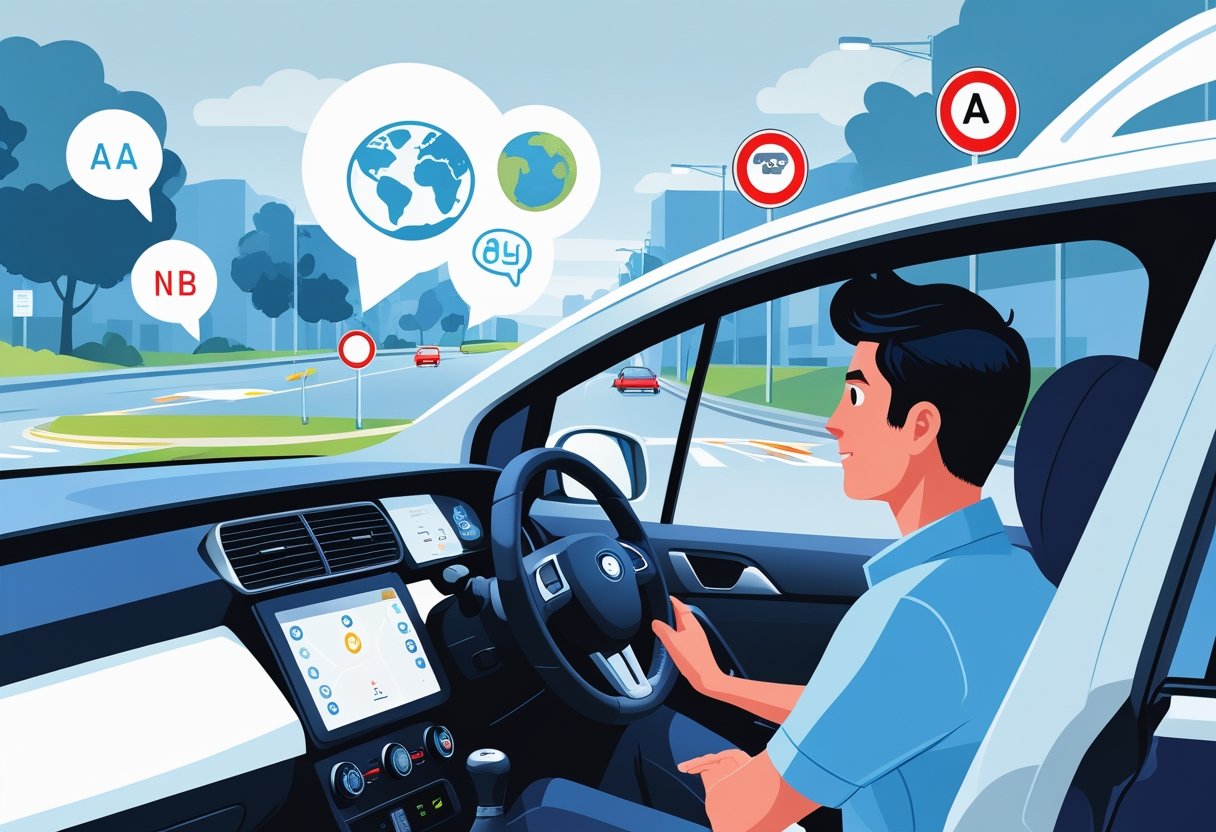
Language acts as the bridge between you and road safety, whilst the choice between native language instruction and English lessons can significantly impact your learning experience and test success.
How Language Shapes Driving Instruction
We often underestimate how much clear communication matters during driving lessons. When your instructor speaks your native language, complex concepts like roundabout navigation or motorway merging become easier to grasp.
Think about those split-second moments when your instructor needs to give urgent guidance. A quick “brake now” in your mother tongue registers faster than wrestling with English translations in your head.
Native language benefits include:
- Instant understanding of safety instructions
- Better grasp of complex traffic scenarios
- Reduced stress during challenging manoeuvres
- Clearer explanation of UK-specific driving rules
However, learning in English isn’t without merit. You’ll encounter road signs, highway code materials, and official communications exclusively in English.
Many successful drivers have tackled both approaches simultaneously. Some take formal lessons in their native language whilst practising English driving terminology through apps during their commute.
The sweet spot often involves starting with native language instruction for foundational skills, then gradually incorporating English terms. This builds confidence whilst preparing you for real-world driving scenarios.
Your learning style matters enormously here. Visual learners might adapt to English instruction more easily, whilst those who process information through listening often benefit from native language teaching initially.
Legal Considerations for Driving Tests
The DVSA offers theory tests in multiple languages, but practical tests remain predominantly English-based. This creates an interesting dynamic we need to navigate carefully.
Available theory test languages include:
- Arabic
- Bengali
- Farsi
- Gujarati
- Hindi
- Kurdish
- Polish
- Portuguese
- Punjabi
- Turkish
- Urdu
- Welsh
Taking your theory test in your native language can boost confidence and comprehension. You’re less likely to misinterpret questions due to language barriers.
Yet here’s where it gets tricky. Your practical driving test examiner will communicate in English. They’ll give directions, explain manoeuvres, and discuss any issues that arise.
We’ve seen learners struggle when they’ve relied heavily on native language instruction but face an English-speaking examiner. The terminology feels foreign, creating unnecessary anxiety.
Some test centres accommodate interpreters for practical tests, though availability varies significantly. You’ll need to arrange this well in advance and pay additional fees.
Consider this: even after passing your test, you’ll interact with English-speaking police officers, breakdown services, and insurance representatives. Building these communication skills early proves invaluable.
Safety and Comprehension Concerns
Road safety hinges on split-second decision making, and language plays a crucial role in this process. When emergency situations arise, you need instant comprehension without mental translation delays.
We’ve witnessed scenarios where language barriers contributed to confusion during critical moments. A learner might misunderstand “emergency stop” instructions or struggle with sudden directional changes.
Key safety considerations:
- Emergency responses: Understanding urgent commands instantly
- Road sign interpretation: Processing information whilst maintaining focus
- Communication with other drivers: Handling road rage or accident situations
- Navigation systems: Following GPS directions confidently
Your brain processes familiar language patterns more quickly. If you’ve learned primarily in Punjabi, English safety instructions might require extra processing time.
However, UK roads demand English comprehension. Road signs, electronic displays, and warning messages appear exclusively in English. Learning these terms early prevents dangerous misinterpretations.
Many driving schools now blend approaches effectively. They’ll teach core safety concepts in your native language, then introduce English terminology gradually.
This method builds solid foundations whilst preparing you for real driving conditions. You’ll understand the why behind safety rules in your comfort language, then learn to recognise English applications.
Some learners find language learning whilst driving helpful for building vocabulary. Audio lessons during practice sessions can reinforce driving-related English terms naturally.
Remember, confidence in both languages ultimately serves your safety best. You’ll handle diverse situations more effectively when language barriers don’t impede your responses.
Benefits of Learning to Drive in Your Native Language
Learning to drive in your native language creates a more comfortable environment and helps you understand instructions more clearly. This approach often leads to faster skill development and builds confidence more quickly than struggling with language barriers whilst mastering complex driving techniques.
Comfort and Confidence Behind the Wheel
When we learn to drive in our native language, we eliminate the stress of translating instructions in our heads whilst trying to focus on the road. This natural communication flow allows us to concentrate fully on developing our driving skills.
Reduced cognitive load means we can process information faster. Instead of decoding English terms for “roundabout” or “dual carriageway,” we instantly understand these concepts in our mother tongue.
Our confidence grows when we can:
- Ask questions without hesitation
- Express concerns clearly about specific manoeuvres
- Understand feedback immediately during lessons
- Feel relaxed during practice sessions
Many driving schools now offer multilingual instructors who speak over 30 different languages. This support system helps us feel more at ease, especially during those nerve-wracking first lessons behind the wheel.
The emotional comfort of speaking our native language reduces anxiety significantly. We’re already dealing with the pressure of learning complex motor skills, so removing language barriers creates a much more supportive learning environment.
Clearer Communication with Instructors
Effective communication forms the backbone of successful driving lessons. When our instructor speaks our native language, we receive precise explanations of driving concepts without any confusion or misunderstandation.
Technical driving terms become much clearer in our mother tongue. Complex concepts like “clutch control” or “mirror-signal-manoeuvre” are easier to grasp when explained using familiar vocabulary and cultural references.
We benefit from:
- Instant clarification when we don’t understand something
- Detailed explanations of road rules and safety procedures
- Cultural context for local driving customs and expectations
- Immediate feedback during practical exercises
Our instructors can explain the theory test requirements more thoroughly in our native language. This deeper understanding helps us prepare more effectively for both practical and written examinations.
Clear communication also means we can discuss our specific concerns or fears about driving. Whether we’re worried about motorway driving or parallel parking, expressing these feelings accurately helps our instructor tailor lessons to our needs.
Faster Mastery of Driving Skills
Learning complex motor skills becomes more efficient when we understand instructions immediately. Our brains can focus entirely on coordination and technique rather than processing unfamiliar vocabulary during critical moments.
Skill retention improves dramatically when we learn in our native language. We remember instructions more easily because they’re stored in our most comfortable linguistic framework.
Key advantages include:
- Quicker understanding of safety procedures
- Faster response to instructor guidance
- Better retention of traffic rules
- More efficient practice sessions
We often progress through lessons more rapidly because communication flows naturally. Instead of pausing to clarify terminology, we can move smoothly from one skill to the next.
Our muscle memory develops faster when verbal cues match our natural thought patterns. Commands like “ease off the clutch” or “check your blind spot” become automatic responses when delivered in our mother tongue.
This accelerated learning often translates to fewer required lessons overall. We reach test-ready standards more quickly, saving both time and money whilst building genuine confidence in our driving abilities.
Advantages of Learning to Drive in English
Learning to drive in English opens doors beyond just passing your test. You’ll build language skills that benefit your career, prepare yourself for life across English-speaking countries, and tap into a much wider pool of resources and instructors.
Preparing for Life in the UK or Abroad
When you learn to drive in English, you’re essentially future-proofing your skills. Road signs, traffic laws, and official documents use standardised English terminology across the UK, making it easier to drive anywhere from London to Edinburgh.
This preparation becomes invaluable if you’re planning to work or study in other English-speaking countries. Australian, Canadian, and American driving systems share similar foundations with British driving. The vocabulary you learn during lessons translates directly to these environments.
Key benefits include:
- Understanding official DVLA documentation without translation
- Communicating confidently with police during traffic stops
- Reading insurance policies and rental agreements clearly
- Navigating GPS systems that use English voice commands
Many of our students tell us they feel more confident moving between cities or even countries once they’ve mastered driving terminology in English. You’re not just learning to operate a vehicle; you’re gaining cultural fluency that extends far beyond the car.
Access to More Resources and Instructors
The English-speaking driving instruction market offers significantly more options than native language alternatives. We’ve found that students have access to hundreds more qualified instructors, often with shorter waiting lists and more flexible scheduling.
Online resources multiply exponentially when you’re comfortable with English materials. YouTube tutorials, practice tests, and driving apps predominantly use English content. This means you can supplement your formal lessons with endless practice materials.
Available resources include:
- Theory test apps with thousands of practice questions
- Detailed Highway Code explanations and updates
- Professional driving courses and advanced techniques
- Community forums where experienced drivers share tips
Cost benefits often emerge too. With more instructors competing for students, prices tend to be more competitive. You’ll also find specialty instructors who focus on nervous drivers, intensive courses, or specific vehicle types more readily available in English.
Building English Language Skills While Learning to Drive
This approach creates a perfect storm for language development. You’re learning a language while driving becomes natural when technical vocabulary meets real-world application. Every lesson strengthens both your driving abilities and English fluency simultaneously.
The structured nature of driving instruction provides an ideal learning environment. You’ll encounter the same terms repeatedly in different contexts, which helps cement new vocabulary. Words like “clutch,” “roundabout,” and “right of way” become second nature through practical use.
Language skills you’ll develop:
- Technical vocabulary related to vehicle operation and maintenance
- Directional language for navigation and spatial awareness
- Safety terminology for emergency situations and road rules
- Conversational skills through instructor interaction
Many students discover that learning a language while driving sessions improve their overall English confidence. The focused, one-on-one environment with an instructor creates a safe space to practice speaking without judgment.
Your English skills will extend beyond driving too. The communication techniques and vocabulary you develop transfer to job interviews, social situations, and everyday conversations throughout British life.
Overcoming Challenges: Tips for Non-Native English Speakers
Technology can bridge language gaps during driving lessons, whilst finding bilingual instructors and mastering high-pressure communication will boost your confidence behind the wheel.
Bridging the Language Gap with Technology
Modern technology offers brilliant tools to support non-native English speakers during driving lessons. Translation apps like Google Translate can quickly clarify confusing terms when your instructor uses unfamiliar vocabulary.
Voice translation tools work particularly well during breaks in lessons. Simply speak into your phone in your native language, and it will translate driving concepts instantly.
Language learning programmes can strengthen your driving vocabulary before lessons begin. Pimsleur focuses on conversational skills that translate well to instructor communication. Michel Thomas builds confidence through practical phrases you’ll actually use on the road.
Assimil offers structured lessons that help you understand complex driving terminology. These programmes teach you to think in English rather than constantly translating.
| Technology Tool | Best For | When to Use |
|---|---|---|
| Translation apps | Quick clarification | During lesson breaks |
| Voice translators | Complex explanations | Before/after driving |
| Language programmes | Building vocabulary | Home preparation |
Consider downloading driving theory apps in both languages. This helps you connect English terms with concepts you already understand.
Record voice memos after each lesson. Note new vocabulary and phrases your instructor used. Review these recordings at home to reinforce your learning.
Finding Bilingual Driving Instructors
Bilingual driving instructors understand the unique challenges you face as a non-native English speaker. They can explain complex manoeuvres in your native language when English becomes overwhelming.
Start by contacting local driving schools directly. Ask specifically about instructors who speak your language. Many schools maintain lists of multilingual instructors but don’t always advertise this service.
Community centres often have notice boards where bilingual instructors advertise their services. Religious centres, cultural associations, and immigrant support groups frequently know excellent bilingual instructors.
Online platforms like social media groups for your community can provide valuable recommendations. Search for groups like “Spanish Speakers in London” or “Polish Community Manchester” for instructor suggestions.
When interviewing potential instructors, ask about their teaching approach. The best bilingual instructors gradually increase English usage as your confidence grows.
Key questions to ask:
- Can you explain complex concepts in my native language?
- Do you have experience with non-native English speakers?
- Will you help me learn English driving terminology?
Don’t settle for the first instructor you find. The right bilingual instructor will make your driving journey much smoother and more enjoyable.
Effective Communication in High-Pressure Situations
High-pressure driving situations can make English communication particularly challenging. Practising specific phrases beforehand helps you stay calm and communicate clearly with your instructor.
Learn essential safety phrases first: “Stop,” “Slow down,” “I don’t understand,” and “Please repeat that.” These simple phrases can prevent dangerous situations.
Emergency communication requires special preparation. Practise saying “I need help,” “Call emergency services,” and “There’s been an accident” until they become automatic responses.
During lessons, don’t hesitate to ask your instructor to speak more slowly. Most instructors appreciate honesty about communication difficulties rather than dangerous confusion.
Breathing techniques help manage anxiety when English becomes overwhelming. Take three deep breaths before responding to complex instructions.
Create hand signals with your instructor for common situations. A raised hand might mean “please slow down your speech,” whilst pointing could indicate “repeat that instruction.”
Pre-lesson preparation builds confidence:
- Review lesson vocabulary the night before
- Practise pronunciation of difficult words
- Write down questions in advance
Remember that making mistakes is part of learning. Your instructor wants you to succeed and will work with your communication needs to ensure safe, effective lessons.
Combining Language Learning with Driving Practice
Learning whilst behind the wheel can transform your daily commute into valuable study time, using audio-based programmes that keep your hands free and eyes on the road. The key lies in choosing courses designed for passive listening and selecting content that matches real-world driving scenarios.
Audio Courses That Support Safe Multitasking
Pimsleur stands out as one of the most driving-friendly language programmes available. Their 30-minute lessons focus entirely on listening and speaking, requiring no visual elements whatsoever.
You simply listen to native speakers and repeat phrases during natural pauses. This hands-free approach means you can concentrate fully on the road whilst absorbing new vocabulary.
Michel Thomas offers another excellent option for motorists. His method teaches through audio explanations and gradual building of sentences. The courses feel like sitting in on a private lesson, making them perfect for longer journeys.
Assimil programmes work brilliantly during commutes because they emphasise passive listening in the early stages. You’ll hear natural conversations and dialogues without pressure to respond immediately.
These courses avoid complex grammar explanations that might distract you from driving. Instead, they focus on natural language patterns that your brain absorbs gradually over time.
Choosing the Right Programme: Pimsleur, Michel Thomas, Assimil
Each programme suits different learning styles and driving habits. Pimsleur works best for short, regular commutes because lessons are perfectly timed at 30 minutes.
Michel Thomas suits longer drives where you can immerse yourself in his step-by-step building method. His courses feel conversational and engaging, making motorway journeys fly by.
Assimil offers flexibility with both passive listening and active participation phases. During busy traffic, stick to passive listening. When driving conditions are easier, try the speaking exercises.
Consider your typical driving situations when choosing. City driving with frequent stops suits shorter, repetitive lessons. Motorway driving allows for longer, more immersive content.
Start with one programme and give it several weeks before switching. Consistency matters more than finding the “perfect” course immediately.
Using Podcasts and Real-Life Scenarios
LanguagePod101 creates podcast-style lessons that feel natural during drives. Their bite-sized episodes cover practical topics you’ll actually use in conversation.
News in Slow programmes help advanced learners stay current whilst improving comprehension. The deliberately slower pace makes complex topics accessible during your commute.
Regular podcasts in your target language expose you to authentic speech patterns. Choose topics that interest you personally, whether that’s cooking, sport, or current affairs.
Mix structured lessons with authentic content for the best results. Start your journey with a formal lesson, then switch to a podcast for variety.
Keep programmes downloaded offline to avoid connectivity issues during your drive. This ensures consistent learning regardless of signal strength.
Deciding What’s Right for You: Key Questions and Considerations
Your personal comfort zone, future driving plans, and practical learning steps all play crucial roles in choosing between native language or English driving instruction. The decision ultimately comes down to what makes you feel most confident behind the wheel.
Assessing Your Personal Comfort Zone
Think about how you learn best under pressure. Driving lessons can feel stressful, especially in the beginning.
Your stress response matters. If you’re already nervous about clutch control or roundabouts, adding language barriers might overwhelm you. Some learners find their English skills disappear when they’re concentrating hard on steering.
Consider these personal factors:
- How comfortable are you discussing complex topics in English?
- Do you panic when you can’t find the right words quickly?
- Are you confident asking questions when something’s unclear?
Safety comes first. You need to understand instructions instantly, especially in emergency situations. If there’s even a tiny doubt about comprehension, your native language might be the safer choice.
Some people actually focus better in English because it forces them to concentrate more. Others find their native tongue lets them relax and absorb information naturally.
Test yourself honestly. Try explaining a complex process (like parallel parking) in English to a friend. If you struggle with technical vocabulary or feel frustrated, that’s valuable information for your decision.
Thinking About Your Long-Term Goals
Your future plans should heavily influence this choice. Where will you be driving most often?
Consider your driving destinations. If you’re planning to drive mainly in English-speaking areas, learning in English makes brilliant sense. You’ll understand road signs, sat nav instructions, and interactions with police or mechanics.
Career implications matter too. Some jobs require driving in English-speaking environments. Delivery drivers, taxi operators, or sales representatives often need this skill.
Think about these scenarios:
- Will you take driving holidays in English-speaking countries?
- Do you plan to live permanently where you’re learning?
- Might you move to another English-speaking region later?
Family considerations count. If your children will learn to drive in English, you’ll be better equipped to help them if you’ve done the same.
Don’t overthink distant possibilities. Focus on what you’ll likely need in the next few years rather than remote “what if” scenarios.
Your driving confidence builds gradually. Starting in your comfort zone might actually prepare you better for future challenges in English.
Practical Steps to Start Your Learning Journey
Ready to make your choice? Here’s how to move forward with confidence.
Research local options first. Find out which driving schools in your area offer instruction in your preferred language. Native language instructors might have longer waiting lists.
Book trial lessons in both languages if possible. Many schools offer assessment sessions that let you experience different teaching styles.
Key questions for potential instructors:
- What’s their pass rate with students like you?
- How do they handle language difficulties during lessons?
- Can they provide materials in your preferred language?
Start with theory study. Begin learning road signs and rules in your chosen language. This gives you a foundation before practical lessons begin.
Budget considerations matter. Native language instructors sometimes charge premium rates due to limited availability. Factor this into your decision.
Trust your instincts after those first few lessons. If something feels wrong, don’t hesitate to switch approaches. Your learning journey should feel supportive, not stressful.
Connect with other learners who made similar choices. Online forums and local communities offer valuable insights from people who’ve walked this path.
Remember: there’s no universally “right” answer. The best choice is the one that gets you safely and confidently driving.
Frequently Asked Questions
Learning to drive involves choosing between native language instruction for comfort and familiarity, versus English lessons for practical test preparation and long-term driving benefits in English-speaking countries.
What are the benefits of undertaking driving lessons in a language you’re most comfortable with?
Learning to drive in your native language removes communication barriers that might slow down your progress. You’ll grasp complex driving concepts more quickly when explained in familiar terms.
Your confidence builds faster when you don’t have to translate instructions in your head whilst trying to focus on the road. This mental clarity helps you absorb safety techniques and driving rules more effectively.
We find that learners who start in their mother tongue often feel less anxious during lessons. They can ask detailed questions about manoeuvres without worrying about language mistakes.
Complex topics like hazard perception and junction rules become clearer when taught in your first language. You’ll understand the reasoning behind driving decisions rather than just memorising steps.
How does learning driving vocabulary in English benefit a learner in a predominately English-speaking country?
Road signs, traffic announcements, and emergency instructions in the UK appear in English. Understanding these instantly without mental translation keeps you safer on busy roads.
Speaking with mechanics, insurance representatives, and other drivers becomes much easier when you know driving terms in English. These conversations are part of regular car ownership.
We see that learners who master English driving vocabulary integrate better into local driving culture. They understand informal road etiquette and common expressions used by other motorists.
English driving lessons prepare you for real-world situations like asking for directions or reporting accidents to authorities. These skills prove invaluable beyond your driving test.
Can mastering driving terminology in English enhance my chances of passing the driving test in the UK?
The UK driving theory test is only available in English or Welsh. Strong English vocabulary directly improves your performance on written questions about road rules and hazard awareness.
During practical tests, examiners give all instructions in English. Understanding terms like “pull up on the left” or “reverse around the corner” without delay shows competence and confidence.
We notice that candidates comfortable with English driving terms handle test pressure better. They focus on demonstrating skills rather than decoding what the examiner wants.
Emergency stop commands and directional guidance happen quickly during tests. Instant comprehension of these instructions often determines whether you pass or need another attempt.
Is there a significant advantage to learning to drive in English if I plan to drive internationally?
English serves as the common language for international driving situations. Rental car companies, GPS systems, and traffic signs in tourist areas often use English alongside local languages.
Many countries require International Driving Permits with English translations of your licence details. Understanding driving concepts in English makes these applications and renewals straightforward.
We find that drivers trained in English adapt faster when driving abroad. They recognise universal traffic symbols and can communicate basic needs to foreign traffic police or emergency services.
International driving forums, safety resources, and travel guides predominantly use English. This knowledge base becomes accessible when you understand driving terminology in English.
Will I feel more at ease during my driving test if I’ve been instructed in my mother tongue?
Native language instruction builds a solid foundation of driving knowledge without language stress. You’ll understand the principles behind safe driving practices more thoroughly.
The familiar communication style reduces test anxiety because you’ve practised similar conversations during lessons. Your instructor’s explanations in your first language create lasting confidence.
We observe that students taught in their native tongue often develop better relationships with instructors. This trust translates into calmer nerves when facing the official driving test.
However, remember that UK tests happen in English. Some additional English practice becomes necessary to bridge the gap between lesson language and test requirements.
How can bilingual driving instruction boost my confidence and proficiency behind the wheel?
Starting with native language lessons builds core understanding, then gradually introducing English terms creates the best of both approaches. You develop skills without language barriers initially.
Bilingual instructors can explain complex manoeuvres in your preferred language, then teach you the English equivalents. This dual approach prepares you for real UK driving whilst maintaining clarity.
We recommend this method for learners who want thorough understanding plus practical preparation. You gain confidence from native language instruction and test readiness from English practice.
The gradual transition from your mother tongue to English mirrors how you’ll actually drive in the UK. You’ll use both languages depending on the situation, making this approach realistic and effective.